

242 Basic Engineering Mathematics
Outer diameter, D = 25 cm = 0.25 m and inner diameter, d = 12 cm = 0.12 m.
Area of cross-section of copper
=
π D 2
4
−
πd 2
4
=
π(0.25) 2
4
−
π(0.12) 2
4
= 0.0491 − 0.0113 = 0.0378 m
2
Hence, volume of copper
= (cross-sectional area) × length of pipe
= 0.0378 × 2.5 = 0.0945 m
3
27.2.3 More prisms
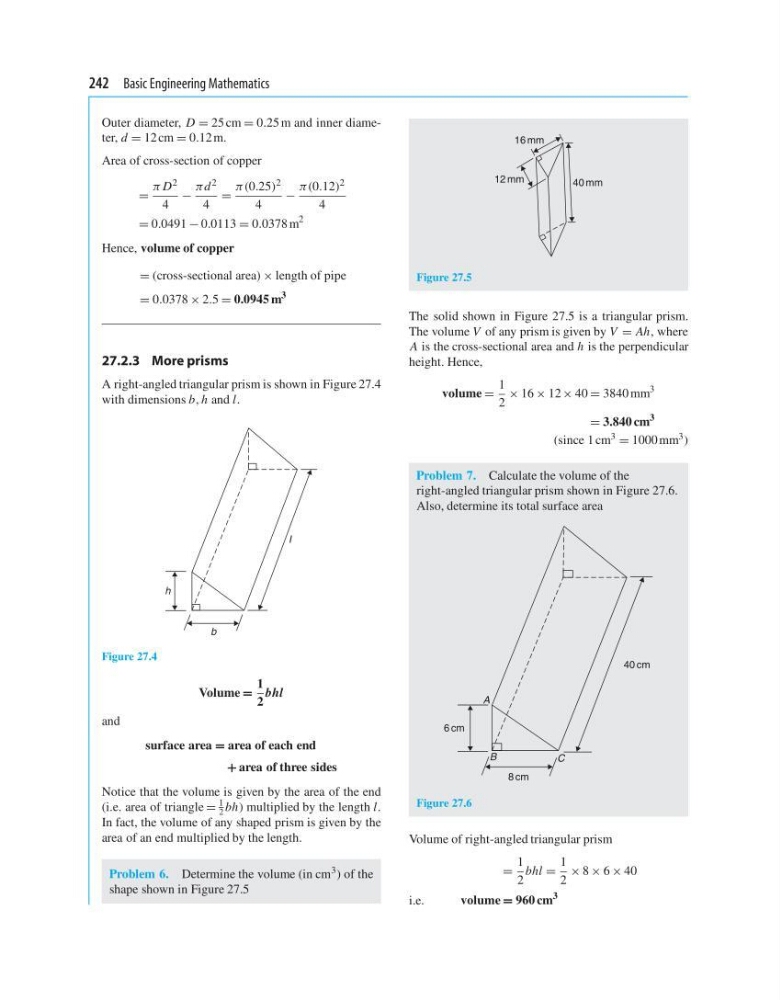
A right-angled triangular prism is shown in Figure 27.4
with dimensions b, h and l.
I
b
h
Figure 27.4
Volume =
1
2
bhl
and
surface area = area of each end
+ area of three sides
Notice that the volume is given by the area of the end
(i.e. area of triangle =
1
2 bh) multiplied by the length l.
In fact, the volume of any shaped prism is given by the
area of an end multiplied by the length.
Problem 6. Determine the volume (in cm
3 ) of the
shape shown in Figure 27.5
12 mm
16 mm
40 mm
Figure 27.5
The solid shown in Figure 27.5 is a triangular prism.
The volume V of any prism is given by V = Ah, where
A is the cross-sectional area and h is the perpendicular
height. Hence,
volume =
1
2
× 16 × 12 × 40 = 3840 mm
3
= 3.840 cm
3
(since 1 cm 3 = 1000 mm 3 )
Problem 7. Calculate the volume of the
right-angled triangular prism shown in Figure 27.6.
Also, determine its total surface area
6 cm
40 cm
A
B
C
8 cm
Figure 27.6
Volume of right-angled triangular prism
=
1
2
bhl =
1
2
× 8 × 6 × 40
i.e.
volume = 960 cm
3
Outer diameter, D = 25 cm = 0.25 m and inner diameter, d = 12 cm = 0.12 m.
Area of cross-section of copper
=
π D 2
4
−
πd 2
4
=
π(0.25) 2
4
−
π(0.12) 2
4
= 0.0491 − 0.0113 = 0.0378 m
2
Hence, volume of copper
= (cross-sectional area) × length of pipe
= 0.0378 × 2.5 = 0.0945 m
3
27.2.3 More prisms
A right-angled triangular prism is shown in Figure 27.4
with dimensions b, h and l.
I
b
h
Figure 27.4
Volume =
1
2
bhl
and
surface area = area of each end
+ area of three sides
Notice that the volume is given by the area of the end
(i.e. area of triangle =
1
2 bh) multiplied by the length l.
In fact, the volume of any shaped prism is given by the
area of an end multiplied by the length.
Problem 6. Determine the volume (in cm
3 ) of the
shape shown in Figure 27.5
12 mm
16 mm
40 mm
Figure 27.5
The solid shown in Figure 27.5 is a triangular prism.
The volume V of any prism is given by V = Ah, where
A is the cross-sectional area and h is the perpendicular
height. Hence,
volume =
1
2
× 16 × 12 × 40 = 3840 mm
3
= 3.840 cm
3
(since 1 cm 3 = 1000 mm 3 )
Problem 7. Calculate the volume of the
right-angled triangular prism shown in Figure 27.6.
Also, determine its total surface area
6 cm
40 cm
A
B
C
8 cm
Figure 27.6
Volume of right-angled triangular prism
=
1
2
bhl =
1
2
× 8 × 6 × 40
i.e.
volume = 960 cm
3