

Volumes of common solids 241
(a) Volume of oil tank = volume of cube
= 1.5 m × 1.5 m × 1.5 m
= 1.5
3 m
3
= 3.375 m
3
1 m 3 = 100 cm × 100 cm × 100 cm = 10 6 cm 3 .
Hence,
volume of tank = 3.375 × 10
6 cm
3
1 litre = 1000 cm 3 , hence oil tank capacity
=
3.375 × 10 6
1000
litres = 3375 litres
(b) Surface area of one side = 1.5 m × 1.5 m
= 2.25 m 2 .
A cube has six identical sides, hence
total surface area of oil tank = 6 × 2.25
= 13.5 m
2
Problem 3. A water tank is the shape of a
rectangular prism having length 2 m, breadth 75 cm
and height 500 mm. Determine the capacity of the
tank in (a) m 3 (b) cm 3 (c) litres
Capacity means volume; when dealing with liquids, the
word capacity is usually used.
The water tank is similar in shape to that in Figure 27.1,
with l = 2 m, b = 75 cm and h = 500 mm.
(a) Capacity of water tank = l × b × h. To use this formula, all dimensions must be in the same units.
Thus, l = 2 m, b = 0.75 m and h = 0.5 m (since
1 m = 100 cm = 1000 mm). Hence,
capacity of tank = 2 × 0.75 × 0.5 = 0.75 m
3
(b) 1 m 3 = 1 m × 1 m × 1 m
= 100 cm × 100 cm × 100 cm
i.e., 1 m
3 = 1 000 000 =10
6 cm 3 . Hence,
capacity = 0.75 m
3
= 0.75 × 10
6 cm
3
= 750 000 cm
3
(c) 1 litre = 1000 cm 3 . Hence,
750 000 cm
3
=
750,000
1000
= 750 litres
27.2.2 Cylinders
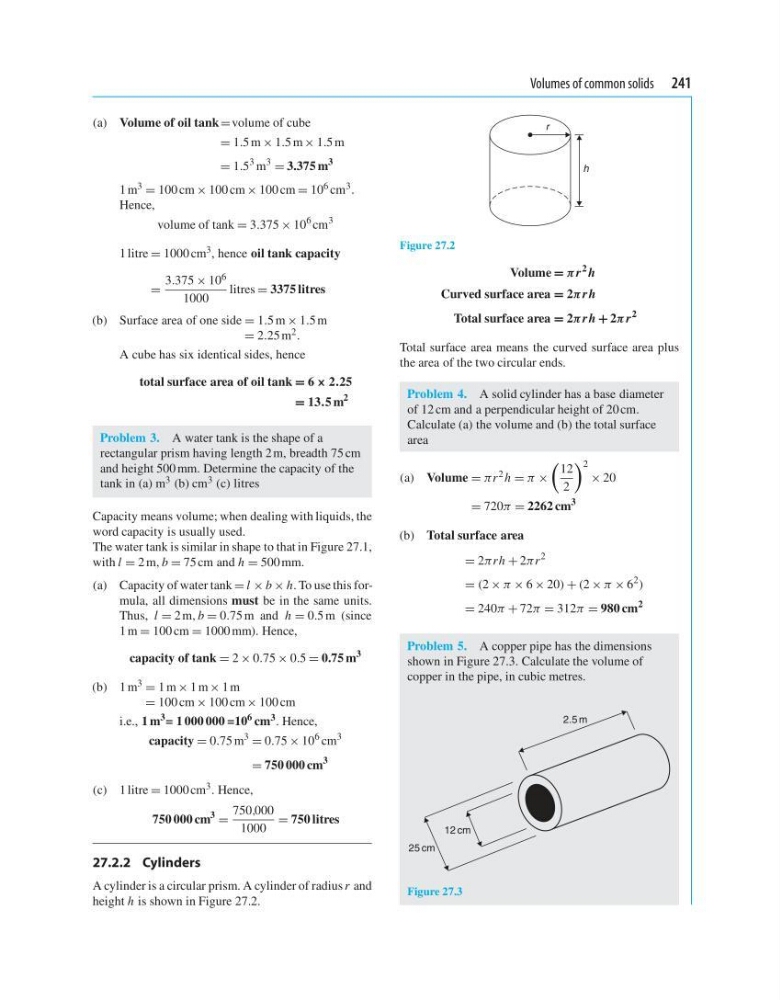
A cylinder is a circular prism. A cylinder of radius r and
height h is shown in Figure 27.2.
h
r
Figure 27.2
Volume = πr
2 h
Curved surface area = 2πrh
Total surface area = 2πrh + 2πr
2
Total surface area means the curved surface area plus
the area of the two circular ends.
Problem 4. A solid cylinder has a base diameter
of 12 cm and a perpendicular height of 20 cm.
Calculate (a) the volume and (b) the total surface
area
(a) Volume = πr 2 h = π ×
12
2
2
× 20
= 720π = 2262 cm
3
(b) Total surface area
= 2πrh + 2πr
2
= (2 × π × 6 × 20) + (2 × π × 6
2
)
= 240π + 72π = 312π = 980 cm
2
Problem 5. A copper pipe has the dimensions
shown in Figure 27.3. Calculate the volume of
copper in the pipe, in cubic metres.
2.5 m
12 cm
25 cm
Figure 27.3
(a) Volume of oil tank = volume of cube
= 1.5 m × 1.5 m × 1.5 m
= 1.5
3 m
3
= 3.375 m
3
1 m 3 = 100 cm × 100 cm × 100 cm = 10 6 cm 3 .
Hence,
volume of tank = 3.375 × 10
6 cm
3
1 litre = 1000 cm 3 , hence oil tank capacity
=
3.375 × 10 6
1000
litres = 3375 litres
(b) Surface area of one side = 1.5 m × 1.5 m
= 2.25 m 2 .
A cube has six identical sides, hence
total surface area of oil tank = 6 × 2.25
= 13.5 m
2
Problem 3. A water tank is the shape of a
rectangular prism having length 2 m, breadth 75 cm
and height 500 mm. Determine the capacity of the
tank in (a) m 3 (b) cm 3 (c) litres
Capacity means volume; when dealing with liquids, the
word capacity is usually used.
The water tank is similar in shape to that in Figure 27.1,
with l = 2 m, b = 75 cm and h = 500 mm.
(a) Capacity of water tank = l × b × h. To use this formula, all dimensions must be in the same units.
Thus, l = 2 m, b = 0.75 m and h = 0.5 m (since
1 m = 100 cm = 1000 mm). Hence,
capacity of tank = 2 × 0.75 × 0.5 = 0.75 m
3
(b) 1 m 3 = 1 m × 1 m × 1 m
= 100 cm × 100 cm × 100 cm
i.e., 1 m
3 = 1 000 000 =10
6 cm 3 . Hence,
capacity = 0.75 m
3
= 0.75 × 10
6 cm
3
= 750 000 cm
3
(c) 1 litre = 1000 cm 3 . Hence,
750 000 cm
3
=
750,000
1000
= 750 litres
27.2.2 Cylinders
A cylinder is a circular prism. A cylinder of radius r and
height h is shown in Figure 27.2.
h
r
Figure 27.2
Volume = πr
2 h
Curved surface area = 2πrh
Total surface area = 2πrh + 2πr
2
Total surface area means the curved surface area plus
the area of the two circular ends.
Problem 4. A solid cylinder has a base diameter
of 12 cm and a perpendicular height of 20 cm.
Calculate (a) the volume and (b) the total surface
area
(a) Volume = πr 2 h = π ×
12
2
2
× 20
= 720π = 2262 cm
3
(b) Total surface area
= 2πrh + 2πr
2
= (2 × π × 6 × 20) + (2 × π × 6
2
)
= 240π + 72π = 312π = 980 cm
2
Problem 5. A copper pipe has the dimensions
shown in Figure 27.3. Calculate the volume of
copper in the pipe, in cubic metres.
2.5 m
12 cm
25 cm
Figure 27.3