

Volumes of common solids 243
Total surface area = area of each end + area of three
sides.
In triangle ABC,
AC
2
= AB
2
+ BC
2
from which,
AC =
AB 2 + BC 2 =
6 2 + 8 2
= 10 cm
Hence, total surface area
= 2
1
2
bh
+ (AC × 40) + (BC × 40) + (AB × 40)
= (8 × 6) + (10 × 40) + (8 × 40) + (6 × 40)
= 48 + 400 + 320 + 240
i.e. total surface area = 1008 cm
2
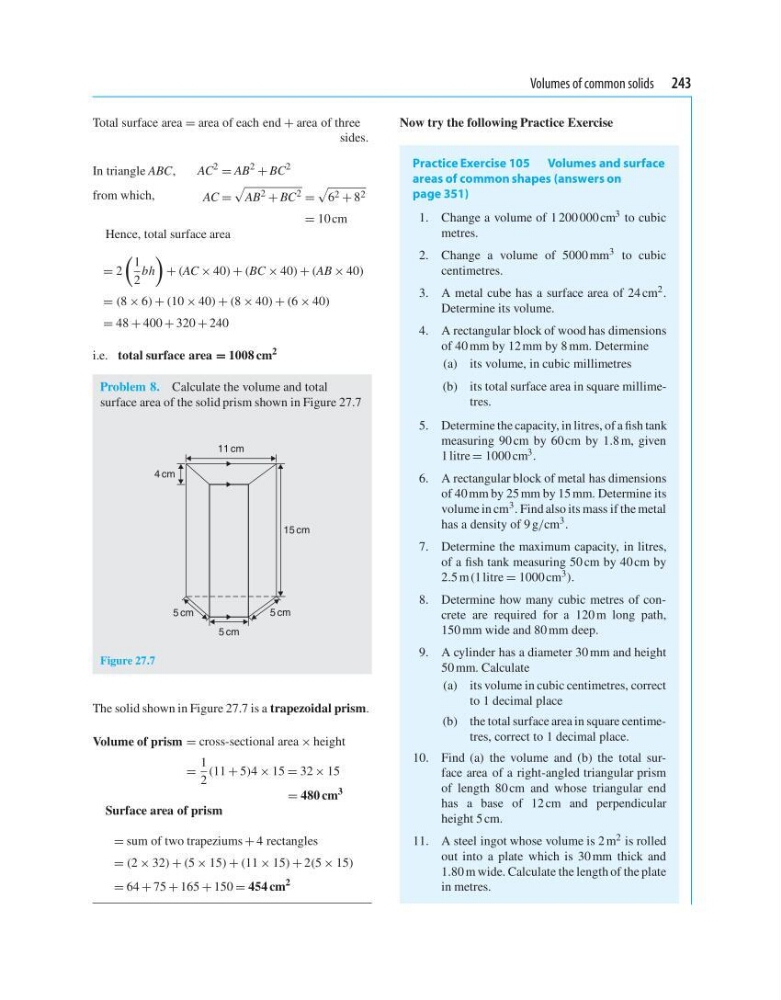
Problem 8. Calculate the volume and total
surface area of the solid prism shown in Figure 27.7
15 cm
5 cm
5 cm
5 cm
4 cm
11 cm
Figure 27.7
The solid shown in Figure 27.7 is a trapezoidal prism.
Volume of prism = cross-sectional area × height
=
1
2
(11 + 5)4 × 15 = 32 × 15
= 480 cm
3
Surface area of prism
= sum of two trapeziums + 4 rectangles
= (2 × 32) + (5 × 15) + (11 × 15) + 2(5 × 15)
= 64 + 75 + 165 + 150 = 454 cm
2
Now try the following Practice Exercise
Practice Exercise 105 Volumes and surface
areas of common shapes (answers on
page 351)
1. Change a volume of 1 200 000 cm 3 to cubic
metres.
2. Change a volume of 5000 mm 3 to cubic
centimetres.
3. A metal cube has a surface area of 24 cm 2 .
Determine its volume.
4. A rectangular block of wood has dimensions
of 40 mm by 12 mm by 8 mm. Determine
(a) its volume, in cubic millimetres
(b) its total surface area in square millimetres.
5. Determine the capacity, in litres, of a fish tank
measuring 90cm by 60cm by 1.8 m, given
1 litre = 1000 cm 3 .
6. A rectangular block of metal has dimensions
of 40 mm by 25 mm by 15 mm. Determine its
volume in cm 3 . Find also its mass if the metal
has a density of 9 g/cm 3 .
7. Determine the maximum capacity, in litres,
of a fish tank measuring 50 cm by 40 cm by
2.5 m(1 litre = 1000 cm 3 ).
8. Determine how many cubic metres of concrete are required for a 120 m long path,
150 mm wide and 80 mm deep.
9. A cylinder has a diameter 30 mm and height
50 mm. Calculate
(a) its volume in cubic centimetres, correct
to 1 decimal place
(b) the total surface area in square centimetres, correct to 1 decimal place.
10. Find (a) the volume and (b) the total surface area of a right-angled triangular prism
of length 80 cm and whose triangular end
has a base of 12 cm and perpendicular
height 5 cm.
11. A steel ingot whose volume is 2 m 2 is rolled
out into a plate which is 30 mm thick and
1.80 m wide. Calculate the length of the plate
in metres.
Total surface area = area of each end + area of three
sides.
In triangle ABC,
AC
2
= AB
2
+ BC
2
from which,
AC =
AB 2 + BC 2 =
6 2 + 8 2
= 10 cm
Hence, total surface area
= 2
1
2
bh
+ (AC × 40) + (BC × 40) + (AB × 40)
= (8 × 6) + (10 × 40) + (8 × 40) + (6 × 40)
= 48 + 400 + 320 + 240
i.e. total surface area = 1008 cm
2
Problem 8. Calculate the volume and total
surface area of the solid prism shown in Figure 27.7
15 cm
5 cm
5 cm
5 cm
4 cm
11 cm
Figure 27.7
The solid shown in Figure 27.7 is a trapezoidal prism.
Volume of prism = cross-sectional area × height
=
1
2
(11 + 5)4 × 15 = 32 × 15
= 480 cm
3
Surface area of prism
= sum of two trapeziums + 4 rectangles
= (2 × 32) + (5 × 15) + (11 × 15) + 2(5 × 15)
= 64 + 75 + 165 + 150 = 454 cm
2
Now try the following Practice Exercise
Practice Exercise 105 Volumes and surface
areas of common shapes (answers on
page 351)
1. Change a volume of 1 200 000 cm 3 to cubic
metres.
2. Change a volume of 5000 mm 3 to cubic
centimetres.
3. A metal cube has a surface area of 24 cm 2 .
Determine its volume.
4. A rectangular block of wood has dimensions
of 40 mm by 12 mm by 8 mm. Determine
(a) its volume, in cubic millimetres
(b) its total surface area in square millimetres.
5. Determine the capacity, in litres, of a fish tank
measuring 90cm by 60cm by 1.8 m, given
1 litre = 1000 cm 3 .
6. A rectangular block of metal has dimensions
of 40 mm by 25 mm by 15 mm. Determine its
volume in cm 3 . Find also its mass if the metal
has a density of 9 g/cm 3 .
7. Determine the maximum capacity, in litres,
of a fish tank measuring 50 cm by 40 cm by
2.5 m(1 litre = 1000 cm 3 ).
8. Determine how many cubic metres of concrete are required for a 120 m long path,
150 mm wide and 80 mm deep.
9. A cylinder has a diameter 30 mm and height
50 mm. Calculate
(a) its volume in cubic centimetres, correct
to 1 decimal place
(b) the total surface area in square centimetres, correct to 1 decimal place.
10. Find (a) the volume and (b) the total surface area of a right-angled triangular prism
of length 80 cm and whose triangular end
has a base of 12 cm and perpendicular
height 5 cm.
11. A steel ingot whose volume is 2 m 2 is rolled
out into a plate which is 30 mm thick and
1.80 m wide. Calculate the length of the plate
in metres.