

208 Basic Engineering Mathematics
from which
e =
√
1082.85
= 32.91 mm = DF
Applying the sine rule,
32.91
sin 64 ◦ =
25.0
sin F
from which sin F =
25.0 sin64 ◦
32.91
= 0.6828
Thus,
∠F = sin
−1 0.6828 = 43
◦ 4
or 136
◦ 56
F = 136 ◦ 56 is not possible in this case since 136 ◦ 56 +
64 ◦ is greater than 180 ◦ . Thus, only F = 43 ◦ 4 is valid.
Then ∠D = 180 ◦ − 64 ◦ − 43 ◦ 4 = 72 ◦ 56 .
Area of triangle DEF =
1
2
d f sin E
=
1
2
(35.0)(25.0) sin 64 ◦ = 393.2 mm
2
Problem 5. A triangle ABC has sides
a = 9.0 cm, b = 7.5 cm and c = 6.5 cm. Determine
its three angles and its area
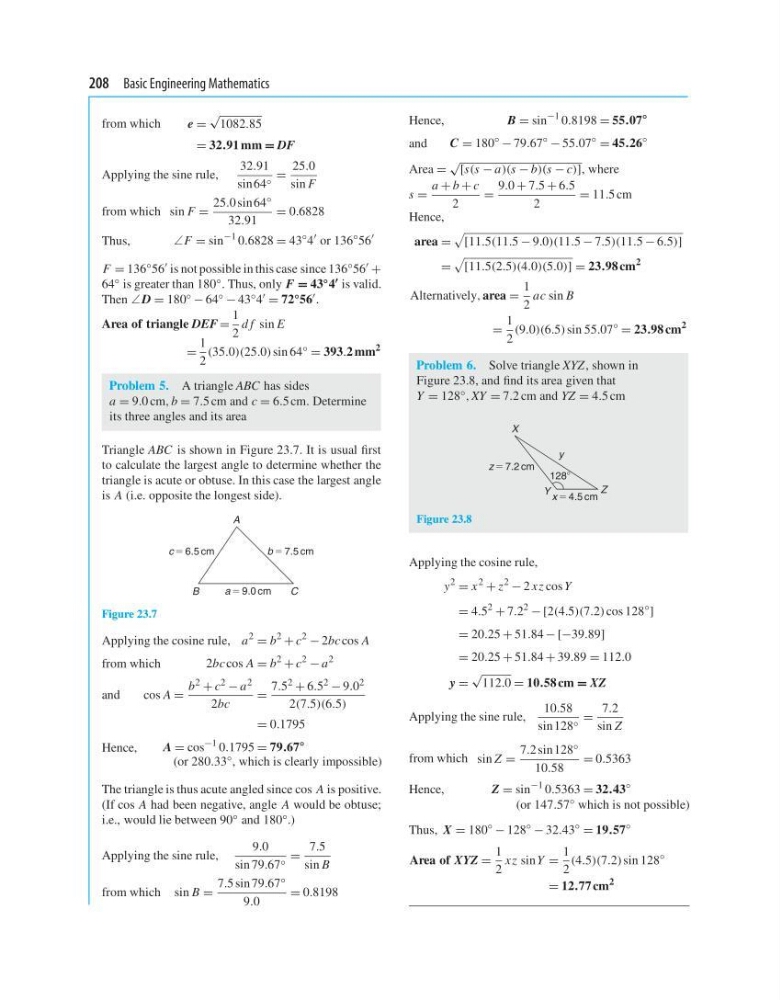
Triangle ABC is shown in Figure 23.7. It is usual first
to calculate the largest angle to determine whether the
triangle is acute or obtuse. In this case the largest angle
is A (i.e. opposite the longest side).
A
B
C
a 5 9.0 cm
c 5 6.5 cm
b 5 7.5 cm
Figure 23.7
Applying the cosine rule, a
2
= b
2
+ c
2
− 2bc cos A
from which
2bc cos A = b
2
+ c
2
− a
2
and
cos A =
b 2 + c 2 − a 2
2bc
=
7.5 2 + 6.5 2 − 9.0 2
2(7.5)(6.5)
= 0.1795
Hence,
A = cos
−1 0.1795 = 79.67
◦
(or 280.33 ◦ , which is clearly impossible)
The triangle is thus acute angled since cos A is positive.
(If cos A had been negative, angle A would be obtuse;
i.e., would lie between 90 ◦ and 180 ◦ .)
Applying the sine rule,
9.0
sin 79.67 ◦ =
7.5
sin B
from which sin B =
7.5 sin79.67 ◦
9.0
= 0.8198
Hence,
B = sin
−1 0.8198 = 55.07
◦
and
C = 180
◦
− 79.67
◦
− 55.07
◦
= 45.26
◦
Area =
√
[s(s − a)(s − b)(s − c)], where
s =
a + b + c
2
=
9.0 + 7.5 + 6.5
2
= 11.5 cm
Hence,
area =
[11.5(11.5 − 9.0)(11.5 − 7.5)(11.5 − 6.5)]
=
[11.5(2.5)(4.0)(5.0)] = 23.98 cm
2
Alternatively, area =
1
2
ac sin B
=
1
2
(9.0)(6.5) sin 55.07
◦
= 23.98 cm
2
Problem 6. Solve triangle XYZ, shown in
Figure 23.8, and find its area given that
Y = 128 ◦ , XY = 7.2 cm and YZ = 4.5 cm
1288
x 5 4.5 cm
z 5 7.2 cm
y
X
Y
Z
Figure 23.8
Applying the cosine rule,
y
2
= x
2
+ z
2
− 2 xz cos Y
= 4.5
2
+ 7.2
2
− [2(4.5)(7.2) cos 128
◦ ]
= 20.25 + 51.84 − [−39.89]
= 20.25 + 51.84 + 39.89 = 112.0
y =
√
112.0 = 10.58 cm = XZ
Applying the sine rule,
10.58
sin 128 ◦ =
7.2
sin Z
from which sin Z =
7.2 sin 128 ◦
10.58
= 0.5363
Hence,
Z = sin
−1 0.5363 = 32.43
◦
(or 147.57 ◦ which is not possible)
Thus, X = 180
◦
− 128
◦
− 32.43
◦
= 19.57
◦
Area of XYZ =
1
2
xz sin Y =
1
2
(4.5)(7.2) sin 128
◦
= 12.77 cm
2
from which
e =
√
1082.85
= 32.91 mm = DF
Applying the sine rule,
32.91
sin 64 ◦ =
25.0
sin F
from which sin F =
25.0 sin64 ◦
32.91
= 0.6828
Thus,
∠F = sin
−1 0.6828 = 43
◦ 4
or 136
◦ 56
F = 136 ◦ 56 is not possible in this case since 136 ◦ 56 +
64 ◦ is greater than 180 ◦ . Thus, only F = 43 ◦ 4 is valid.
Then ∠D = 180 ◦ − 64 ◦ − 43 ◦ 4 = 72 ◦ 56 .
Area of triangle DEF =
1
2
d f sin E
=
1
2
(35.0)(25.0) sin 64 ◦ = 393.2 mm
2
Problem 5. A triangle ABC has sides
a = 9.0 cm, b = 7.5 cm and c = 6.5 cm. Determine
its three angles and its area
Triangle ABC is shown in Figure 23.7. It is usual first
to calculate the largest angle to determine whether the
triangle is acute or obtuse. In this case the largest angle
is A (i.e. opposite the longest side).
A
B
C
a 5 9.0 cm
c 5 6.5 cm
b 5 7.5 cm
Figure 23.7
Applying the cosine rule, a
2
= b
2
+ c
2
− 2bc cos A
from which
2bc cos A = b
2
+ c
2
− a
2
and
cos A =
b 2 + c 2 − a 2
2bc
=
7.5 2 + 6.5 2 − 9.0 2
2(7.5)(6.5)
= 0.1795
Hence,
A = cos
−1 0.1795 = 79.67
◦
(or 280.33 ◦ , which is clearly impossible)
The triangle is thus acute angled since cos A is positive.
(If cos A had been negative, angle A would be obtuse;
i.e., would lie between 90 ◦ and 180 ◦ .)
Applying the sine rule,
9.0
sin 79.67 ◦ =
7.5
sin B
from which sin B =
7.5 sin79.67 ◦
9.0
= 0.8198
Hence,
B = sin
−1 0.8198 = 55.07
◦
and
C = 180
◦
− 79.67
◦
− 55.07
◦
= 45.26
◦
Area =
√
[s(s − a)(s − b)(s − c)], where
s =
a + b + c
2
=
9.0 + 7.5 + 6.5
2
= 11.5 cm
Hence,
area =
[11.5(11.5 − 9.0)(11.5 − 7.5)(11.5 − 6.5)]
=
[11.5(2.5)(4.0)(5.0)] = 23.98 cm
2
Alternatively, area =
1
2
ac sin B
=
1
2
(9.0)(6.5) sin 55.07
◦
= 23.98 cm
2
Problem 6. Solve triangle XYZ, shown in
Figure 23.8, and find its area given that
Y = 128 ◦ , XY = 7.2 cm and YZ = 4.5 cm
1288
x 5 4.5 cm
z 5 7.2 cm
y
X
Y
Z
Figure 23.8
Applying the cosine rule,
y
2
= x
2
+ z
2
− 2 xz cos Y
= 4.5
2
+ 7.2
2
− [2(4.5)(7.2) cos 128
◦ ]
= 20.25 + 51.84 − [−39.89]
= 20.25 + 51.84 + 39.89 = 112.0
y =
√
112.0 = 10.58 cm = XZ
Applying the sine rule,
10.58
sin 128 ◦ =
7.2
sin Z
from which sin Z =
7.2 sin 128 ◦
10.58
= 0.5363
Hence,
Z = sin
−1 0.5363 = 32.43
◦
(or 147.57 ◦ which is not possible)
Thus, X = 180
◦
− 128
◦
− 32.43
◦
= 19.57
◦
Area of XYZ =
1
2
xz sin Y =
1
2
(4.5)(7.2) sin 128
◦
= 12.77 cm
2