

Non-right-angled triangles and some practical applications 207
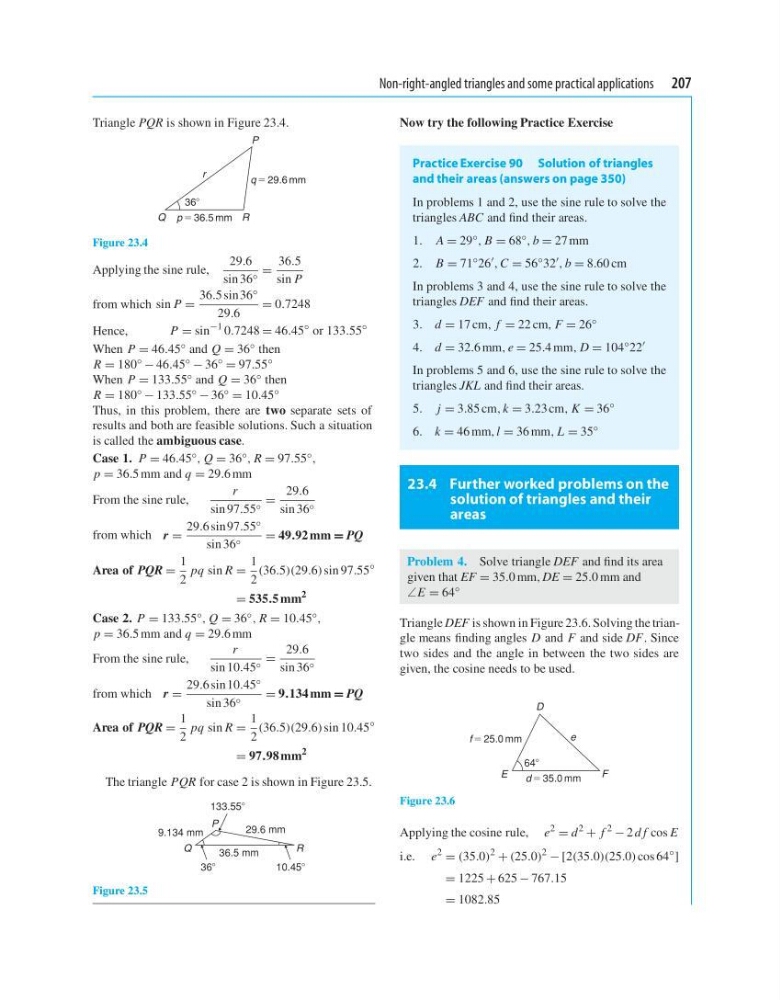
Triangle PQR is shown in Figure 23.4.
q 5 29.6 mm
p 5 36.5 mm
368
r
Q
R
P
Figure 23.4
Applying the sine rule,
29.6
sin 36 ◦ =
36.5
sin P
from which sin P =
36.5 sin36 ◦
29.6
= 0.7248
Hence,
P = sin
−1 0.7248 = 46.45
◦ or 133.55
◦
When P = 46.45 ◦ and Q = 36 ◦ then
R = 180 ◦ − 46.45 ◦ − 36 ◦ = 97.55 ◦
When P = 133.55 ◦ and Q = 36 ◦ then
R = 180 ◦ − 133.55 ◦ − 36 ◦ = 10.45 ◦
Thus, in this problem, there are two separate sets of
results and both are feasible solutions. Such a situation
is called the ambiguous case.
Case 1. P = 46.45 ◦ , Q = 36 ◦ , R = 97.55 ◦ ,
p = 36.5 mm and q = 29.6 mm
From the sine rule,
r
sin 97.55 ◦ =
29.6
sin 36 ◦
from which r =
29.6 sin97.55 ◦
sin 36 ◦
= 49.92 mm = PQ
Area of PQR =
1
2
pq sin R =
1
2
(36.5)(29.6) sin 97.55
◦
= 535.5 mm
2
Case 2. P = 133.55 ◦ , Q = 36 ◦ , R = 10.45 ◦ ,
p = 36.5 mm and q = 29.6 mm
From the sine rule,
r
sin 10.45 ◦ =
29.6
sin 36 ◦
from which r =
29.6 sin10.45 ◦
sin 36 ◦
= 9.134 mm = PQ
Area of PQR =
1
2
pq sin R =
1
2
(36.5)(29.6) sin 10.45
◦
= 97.98 mm
2
The triangle PQR for case 2 is shown in Figure 23.5.
368
10.458
133.558
9.134 mm
29.6 mm
36.5 mm
Q
P
R
Figure 23.5
Now try the following Practice Exercise
Practice Exercise 90 Solution of triangles
and their areas (answers on page 350)
In problems 1 and 2, use the sine rule to solve the
triangles ABC and find their areas.
1. A = 29 ◦ , B = 68 ◦ , b = 27 mm
2. B = 71 ◦ 26 , C = 56 ◦ 32 , b = 8.60 cm
In problems 3 and 4, use the sine rule to solve the
triangles DEF and find their areas.
3. d = 17 cm, f = 22 cm, F = 26 ◦
4. d = 32.6 mm, e = 25.4 mm, D = 104
◦ 22
In problems 5 and 6, use the sine rule to solve the
triangles JKL and find their areas.
5. j = 3.85 cm, k = 3.23 cm, K = 36 ◦
6. k = 46 mm, l = 36 mm, L = 35 ◦
23.4 Further worked problems on the
solution of triangles and their
areas
Problem 4. Solve triangle DEF and find its area
given that EF = 35.0 mm, DE = 25.0 mm and
∠E = 64 ◦
Triangle DEF is shown in Figure 23.6. Solving the triangle means finding angles D and F and side DF. Since
two sides and the angle in between the two sides are
given, the cosine needs to be used.
648
D
F
E
e
d 5 35.0 mm
f 5 25.0 mm
Figure 23.6
Applying the cosine rule, e
2
= d
2
+ f
2
− 2 d f cos E
i.e. e
2
= (35.0)
2
+ (25.0)
2
− [2(35.0)(25.0) cos 64
◦ ]
= 1225 + 625 − 767.15
= 1082.85
Triangle PQR is shown in Figure 23.4.
q 5 29.6 mm
p 5 36.5 mm
368
r
Q
R
P
Figure 23.4
Applying the sine rule,
29.6
sin 36 ◦ =
36.5
sin P
from which sin P =
36.5 sin36 ◦
29.6
= 0.7248
Hence,
P = sin
−1 0.7248 = 46.45
◦ or 133.55
◦
When P = 46.45 ◦ and Q = 36 ◦ then
R = 180 ◦ − 46.45 ◦ − 36 ◦ = 97.55 ◦
When P = 133.55 ◦ and Q = 36 ◦ then
R = 180 ◦ − 133.55 ◦ − 36 ◦ = 10.45 ◦
Thus, in this problem, there are two separate sets of
results and both are feasible solutions. Such a situation
is called the ambiguous case.
Case 1. P = 46.45 ◦ , Q = 36 ◦ , R = 97.55 ◦ ,
p = 36.5 mm and q = 29.6 mm
From the sine rule,
r
sin 97.55 ◦ =
29.6
sin 36 ◦
from which r =
29.6 sin97.55 ◦
sin 36 ◦
= 49.92 mm = PQ
Area of PQR =
1
2
pq sin R =
1
2
(36.5)(29.6) sin 97.55
◦
= 535.5 mm
2
Case 2. P = 133.55 ◦ , Q = 36 ◦ , R = 10.45 ◦ ,
p = 36.5 mm and q = 29.6 mm
From the sine rule,
r
sin 10.45 ◦ =
29.6
sin 36 ◦
from which r =
29.6 sin10.45 ◦
sin 36 ◦
= 9.134 mm = PQ
Area of PQR =
1
2
pq sin R =
1
2
(36.5)(29.6) sin 10.45
◦
= 97.98 mm
2
The triangle PQR for case 2 is shown in Figure 23.5.
368
10.458
133.558
9.134 mm
29.6 mm
36.5 mm
Q
P
R
Figure 23.5
Now try the following Practice Exercise
Practice Exercise 90 Solution of triangles
and their areas (answers on page 350)
In problems 1 and 2, use the sine rule to solve the
triangles ABC and find their areas.
1. A = 29 ◦ , B = 68 ◦ , b = 27 mm
2. B = 71 ◦ 26 , C = 56 ◦ 32 , b = 8.60 cm
In problems 3 and 4, use the sine rule to solve the
triangles DEF and find their areas.
3. d = 17 cm, f = 22 cm, F = 26 ◦
4. d = 32.6 mm, e = 25.4 mm, D = 104
◦ 22
In problems 5 and 6, use the sine rule to solve the
triangles JKL and find their areas.
5. j = 3.85 cm, k = 3.23 cm, K = 36 ◦
6. k = 46 mm, l = 36 mm, L = 35 ◦
23.4 Further worked problems on the
solution of triangles and their
areas
Problem 4. Solve triangle DEF and find its area
given that EF = 35.0 mm, DE = 25.0 mm and
∠E = 64 ◦
Triangle DEF is shown in Figure 23.6. Solving the triangle means finding angles D and F and side DF. Since
two sides and the angle in between the two sides are
given, the cosine needs to be used.
648
D
F
E
e
d 5 35.0 mm
f 5 25.0 mm
Figure 23.6
Applying the cosine rule, e
2
= d
2
+ f
2
− 2 d f cos E
i.e. e
2
= (35.0)
2
+ (25.0)
2
− [2(35.0)(25.0) cos 64
◦ ]
= 1225 + 625 − 767.15
= 1082.85