

Non-right-angled triangles and some practical applications 209
Now try the following Practice Exercise
Practice Exercise 91 Solution of triangles
and their areas (answers on page 350)
In problems 1 and 2, use the cosine and sine rules
to solve the triangles PQR and find their areas.
1. q = 12 cm, r = 16 cm, P = 54 ◦
2. q = 3.25 m, r = 4.42 m, P = 105 ◦
In problems 3 and 4, use the cosine and sine rules
to solve the triangles XYZ and find their areas.
3. x = 10.0 cm, y = 8.0 cm, z = 7.0 cm
4. x = 21 mm, y = 34 mm, z = 42 mm
23.5 Practical situations involving
trigonometry
There are a number of practical situations in which the
use of trigonometry is needed to find unknown sides and
angles of triangles. This is demonstrated in the following
worked problems.
Problem 7. A room 8.0 m wide has a span roof
which slopes at 33 ◦ on one side and 40 ◦ on the
other. Find the length of the roof slopes, correct to
the nearest centimetre
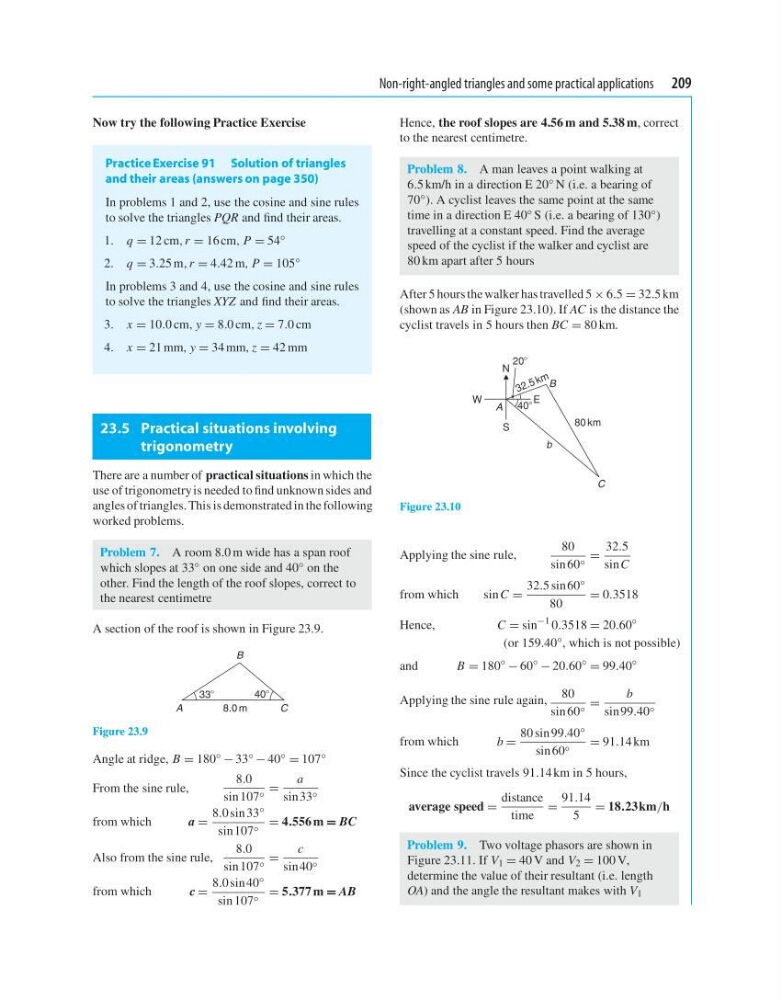
A section of the roof is shown in Figure 23.9.
B
A
C
8.0 m
338
408
Figure 23.9
Angle at ridge, B = 180 ◦ − 33 ◦ − 40 ◦ = 107 ◦
From the sine rule,
8.0
sin 107 ◦ =
a
sin 33 ◦
from which
a =
8.0 sin 33 ◦
sin 107 ◦ = 4.556 m = BC
Also from the sine rule,
8.0
sin 107 ◦ =
c
sin 40 ◦
from which
c =
8.0 sin40 ◦
sin 107 ◦ = 5.377 m = AB
Hence, the roof slopes are 4.56 m and 5.38 m, correct
to the nearest centimetre.
Problem 8. A man leaves a point walking at
6.5 km/h in a direction E 20 ◦ N (i.e. a bearing of
70 ◦ ). A cyclist leaves the same point at the same
time in a direction E 40 ◦ S (i.e. a bearing of 130 ◦ )
travelling at a constant speed. Find the average
speed of the cyclist if the walker and cyclist are
80 km apart after 5 hours
After 5 hours the walker has travelled 5 × 6.5 = 32.5 km
(shown as AB in Figure 23.10). If AC is the distance the
cyclist travels in 5 hours then BC = 80 km.
b
A
B
C
80 km
W
S
408
E
N
208
3 2 .5 k m
Figure 23.10
Applying the sine rule,
80
sin 60 ◦ =
32.5
sin C
from which
sin C =
32.5 sin60 ◦
80
= 0.3518
Hence,
C = sin
−1 0.3518 = 20.60
◦
(or 159.40 ◦ , which is not possible)
and
B = 180
◦
− 60
◦
− 20.60
◦
= 99.40
◦
Applying the sine rule again,
80
sin 60 ◦ =
b
sin 99.40 ◦
from which
b =
80 sin 99.40 ◦
sin 60 ◦
= 91.14 km
Since the cyclist travels 91.14 km in 5 hours,
average speed =
distance
time
=
91.14
5
= 18.23km/h
Problem 9. Two voltage phasors are shown in
Figure 23.11. If V 1 = 40 V and V 2 = 100 V,
determine the value of their resultant (i.e. length
OA) and the angle the resultant makes with V 1
Now try the following Practice Exercise
Practice Exercise 91 Solution of triangles
and their areas (answers on page 350)
In problems 1 and 2, use the cosine and sine rules
to solve the triangles PQR and find their areas.
1. q = 12 cm, r = 16 cm, P = 54 ◦
2. q = 3.25 m, r = 4.42 m, P = 105 ◦
In problems 3 and 4, use the cosine and sine rules
to solve the triangles XYZ and find their areas.
3. x = 10.0 cm, y = 8.0 cm, z = 7.0 cm
4. x = 21 mm, y = 34 mm, z = 42 mm
23.5 Practical situations involving
trigonometry
There are a number of practical situations in which the
use of trigonometry is needed to find unknown sides and
angles of triangles. This is demonstrated in the following
worked problems.
Problem 7. A room 8.0 m wide has a span roof
which slopes at 33 ◦ on one side and 40 ◦ on the
other. Find the length of the roof slopes, correct to
the nearest centimetre
A section of the roof is shown in Figure 23.9.
B
A
C
8.0 m
338
408
Figure 23.9
Angle at ridge, B = 180 ◦ − 33 ◦ − 40 ◦ = 107 ◦
From the sine rule,
8.0
sin 107 ◦ =
a
sin 33 ◦
from which
a =
8.0 sin 33 ◦
sin 107 ◦ = 4.556 m = BC
Also from the sine rule,
8.0
sin 107 ◦ =
c
sin 40 ◦
from which
c =
8.0 sin40 ◦
sin 107 ◦ = 5.377 m = AB
Hence, the roof slopes are 4.56 m and 5.38 m, correct
to the nearest centimetre.
Problem 8. A man leaves a point walking at
6.5 km/h in a direction E 20 ◦ N (i.e. a bearing of
70 ◦ ). A cyclist leaves the same point at the same
time in a direction E 40 ◦ S (i.e. a bearing of 130 ◦ )
travelling at a constant speed. Find the average
speed of the cyclist if the walker and cyclist are
80 km apart after 5 hours
After 5 hours the walker has travelled 5 × 6.5 = 32.5 km
(shown as AB in Figure 23.10). If AC is the distance the
cyclist travels in 5 hours then BC = 80 km.
b
A
B
C
80 km
W
S
408
E
N
208
3 2 .5 k m
Figure 23.10
Applying the sine rule,
80
sin 60 ◦ =
32.5
sin C
from which
sin C =
32.5 sin60 ◦
80
= 0.3518
Hence,
C = sin
−1 0.3518 = 20.60
◦
(or 159.40 ◦ , which is not possible)
and
B = 180
◦
− 60
◦
− 20.60
◦
= 99.40
◦
Applying the sine rule again,
80
sin 60 ◦ =
b
sin 99.40 ◦
from which
b =
80 sin 99.40 ◦
sin 60 ◦
= 91.14 km
Since the cyclist travels 91.14 km in 5 hours,
average speed =
distance
time
=
91.14
5
= 18.23km/h
Problem 9. Two voltage phasors are shown in
Figure 23.11. If V 1 = 40 V and V 2 = 100 V,
determine the value of their resultant (i.e. length
OA) and the angle the resultant makes with V 1