

126 Basic Engineering Mathematics
When R = 5.4 × 10
3 , α = 1.215477 ... × 10
−4 and
R 0 = 5 × 10 3
θ =
1
1.215477 ... × 10 −4 ln
5.4 × 10 3
5 × 10 3
=
10 4
1.215477 ...
(7.696104 ... × 10
−2
)
= 633
◦ C correct to the nearest degree.
Problem 19. In an experiment involving
Newton’s law of cooling, the temperature θ(
◦ C) is
given by θ = θ 0 e −kt . Find the value of constant k
when θ 0 = 56.6 ◦ C, θ = 16.5 ◦ C and
t = 79.0 seconds
Transposing θ = θ 0 e −kt gives
θ
θ 0
= e −kt , from which
θ 0
θ
=
1
e −kt = e
kt
Taking Napierian logarithms of both sides gives
ln
θ 0
θ
= kt
from which,
k =
1
t
ln
θ 0
θ
=
1
79.0
ln
56.6
16.5
=
1
79.0
(1.2326486 ...)
Hence, k = 0.01560 or 15.60 × 10 −3 .
Problem 20. The current i amperes flowing in a
capacitor at time t seconds is given by
i = 8.0(1 − e
−
t
CR ), where the circuit resistance R is
25 k and capacitance C is 16 μF. Determine
(a) the current i after 0.5 seconds and (b) the time,
to the nearest millisecond, for the current to reach
6.0 A. Sketch the graph of current against time
(a) Current i = 8.0
1−e
−
t
CR
= 8.0[1 − e
−0.5/(16×10 −6 )(25×10 3 ) ]
= 8.0(1 − e
−1.25
)
= 8.0(1 − 0.2865047 ...)
= 8.0(0.7134952 ...)
= 5.71 amperes
(b) Transposing i = 8.0
1 − e
−
t
CR
gives
i
8.0
= 1 − e
−
t
CR
from which, e
−
t
CR = 1 −
i
8.0
=
8.0 − i
8.0
Taking the reciprocal of both sides gives
e
t
CR =
8.0
8.0 − i
Taking Napierian logarithms of both sides gives
t
CR
= ln
8.0
8.0 − i
Hence,
t = CR ln
8.0
8.0 − i
When i = 6.0 A,
t = (16 × 10
−6
)(25 × 10
3
) ln
8.0
8.0 − 6.0
i.e.
t =
400
10 3 ln
8.0
2.0
= 0.4 ln4.0
= 0.4(1.3862943 ...)
= 0.5545 s
= 555 ms correct to the nearest ms.
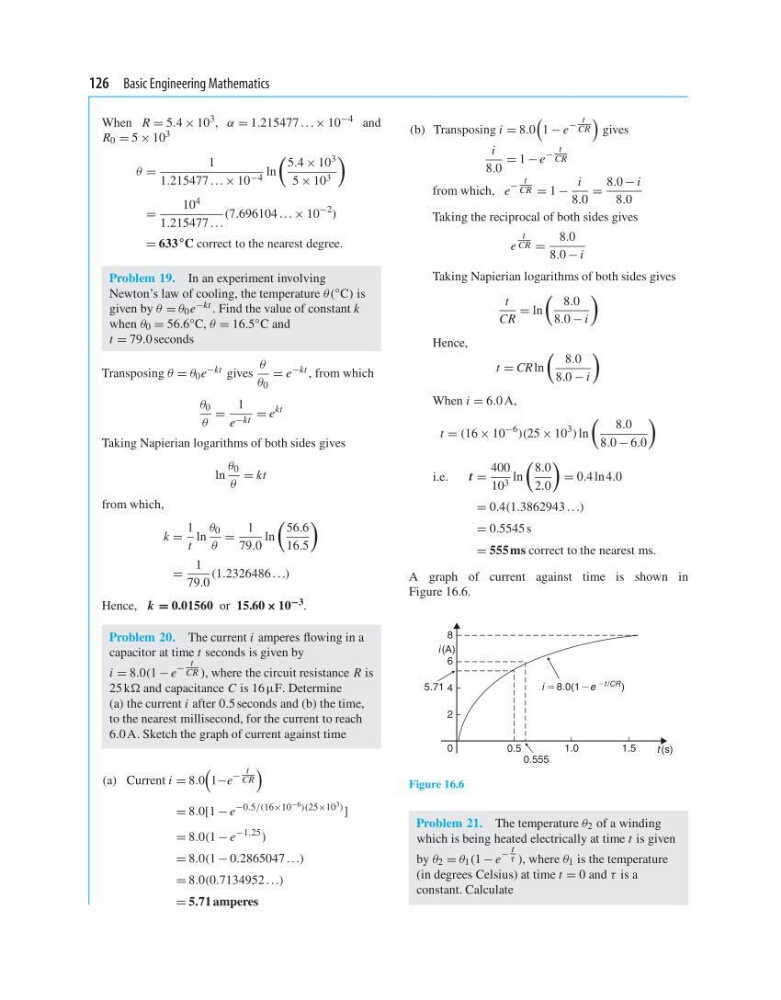
A graph of current against time is shown in
Figure 16.6.
8
6
5.71
0.555
4
2
i 5 8.0(1 2e 2t /CR )
t (s)
i (A)
0
0.5
1.0
1.5
Figure 16.6
Problem 21. The temperature θ 2 of a winding
which is being heated electrically at time t is given
by θ 2 = θ 1 (1 − e
−
t
τ ), where θ 1 is the temperature
(in degrees Celsius) at time t = 0 and τ is a
constant. Calculate
When R = 5.4 × 10
3 , α = 1.215477 ... × 10
−4 and
R 0 = 5 × 10 3
θ =
1
1.215477 ... × 10 −4 ln
5.4 × 10 3
5 × 10 3
=
10 4
1.215477 ...
(7.696104 ... × 10
−2
)
= 633
◦ C correct to the nearest degree.
Problem 19. In an experiment involving
Newton’s law of cooling, the temperature θ(
◦ C) is
given by θ = θ 0 e −kt . Find the value of constant k
when θ 0 = 56.6 ◦ C, θ = 16.5 ◦ C and
t = 79.0 seconds
Transposing θ = θ 0 e −kt gives
θ
θ 0
= e −kt , from which
θ 0
θ
=
1
e −kt = e
kt
Taking Napierian logarithms of both sides gives
ln
θ 0
θ
= kt
from which,
k =
1
t
ln
θ 0
θ
=
1
79.0
ln
56.6
16.5
=
1
79.0
(1.2326486 ...)
Hence, k = 0.01560 or 15.60 × 10 −3 .
Problem 20. The current i amperes flowing in a
capacitor at time t seconds is given by
i = 8.0(1 − e
−
t
CR ), where the circuit resistance R is
25 k and capacitance C is 16 μF. Determine
(a) the current i after 0.5 seconds and (b) the time,
to the nearest millisecond, for the current to reach
6.0 A. Sketch the graph of current against time
(a) Current i = 8.0
1−e
−
t
CR
= 8.0[1 − e
−0.5/(16×10 −6 )(25×10 3 ) ]
= 8.0(1 − e
−1.25
)
= 8.0(1 − 0.2865047 ...)
= 8.0(0.7134952 ...)
= 5.71 amperes
(b) Transposing i = 8.0
1 − e
−
t
CR
gives
i
8.0
= 1 − e
−
t
CR
from which, e
−
t
CR = 1 −
i
8.0
=
8.0 − i
8.0
Taking the reciprocal of both sides gives
e
t
CR =
8.0
8.0 − i
Taking Napierian logarithms of both sides gives
t
CR
= ln
8.0
8.0 − i
Hence,
t = CR ln
8.0
8.0 − i
When i = 6.0 A,
t = (16 × 10
−6
)(25 × 10
3
) ln
8.0
8.0 − 6.0
i.e.
t =
400
10 3 ln
8.0
2.0
= 0.4 ln4.0
= 0.4(1.3862943 ...)
= 0.5545 s
= 555 ms correct to the nearest ms.
A graph of current against time is shown in
Figure 16.6.
8
6
5.71
0.555
4
2
i 5 8.0(1 2e 2t /CR )
t (s)
i (A)
0
0.5
1.0
1.5
Figure 16.6
Problem 21. The temperature θ 2 of a winding
which is being heated electrically at time t is given
by θ 2 = θ 1 (1 − e
−
t
τ ), where θ 1 is the temperature
(in degrees Celsius) at time t = 0 and τ is a
constant. Calculate