

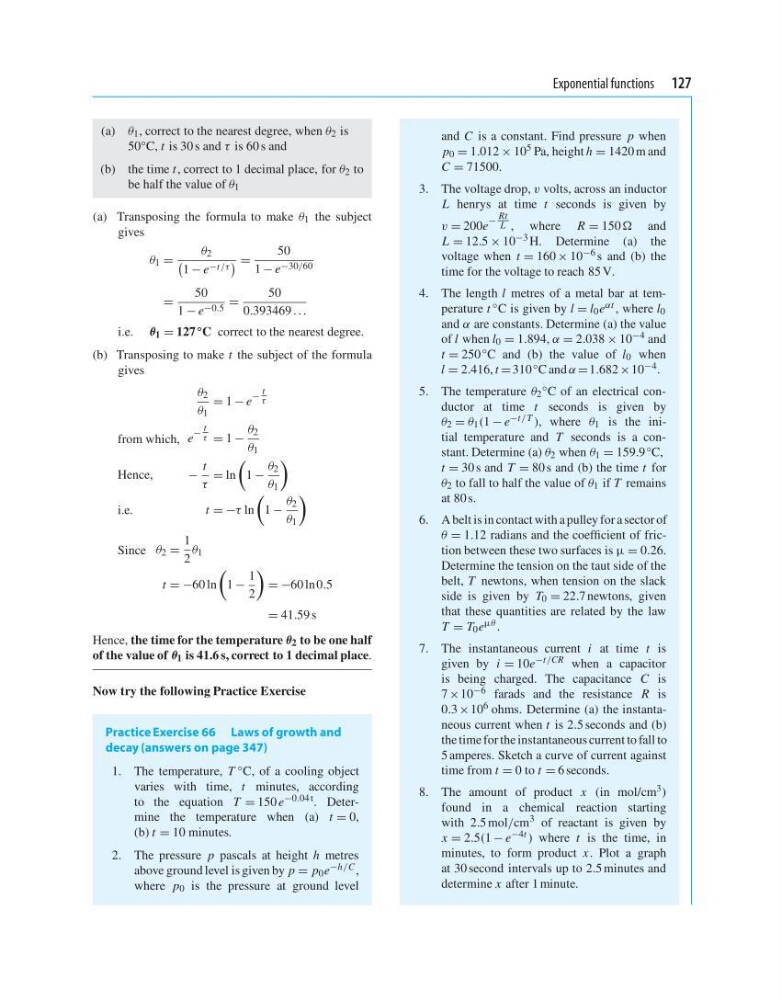
Exponential functions 127
(a) θ 1 , correct to the nearest degree, when θ 2 is
50 ◦ C, t is 30 s and τ is 60 s and
(b) the time t , correct to 1 decimal place, for θ 2 to
be half the value of θ 1
(a) Transposing the formula to make θ 1 the subject
gives
θ 1 =
θ 2
1 − e −t /τ
=
50
1 − e −30/60
=
50
1 − e −0.5 =
50
0.393469 ...
i.e. θ 1 = 127 ◦ C correct to the nearest degree.
(b) Transposing to make t the subject of the formula
gives
θ 2
θ 1
= 1 − e
−
t
τ
from which, e
−
t
τ = 1 −
θ 2
θ 1
Hence,
−
t
τ
= ln
1 −
θ 2
θ 1
i.e.
t = −τ ln
1 −
θ 2
θ 1
Since θ 2 =
1
2
θ 1
t = −60 ln
1 −
1
2
= −60 ln 0.5
= 41.59 s
Hence, the time for the temperature θ 2 to be one half
of the value of θ 1 is 41.6 s, correct to 1 decimal place.
Now try the following Practice Exercise
Practice Exercise 66 Laws of growth and
decay (answers on page 347)
1. The temperature, T ◦ C, of a cooling object
varies with time, t minutes, according
to the equation T = 150 e −0.04 t . Determine the temperature when (a) t = 0,
(b) t = 10 minutes.
2. The pressure p pascals at height h metres
above ground level is given by p = p 0 e −h/C ,
where p 0 is the pressure at ground level
and C is a constant. Find pressure p when
p 0 = 1.012 × 10 5 Pa, height h = 1420 m and
C = 71500.
3. The voltage drop, v volts, across an inductor
L henrys at time t seconds is given by
v = 200e
−
Rt
L , where R = 150 and
L = 12.5 × 10 −3 H. Determine (a) the
voltage when t = 160 × 10 −6 s and (b) the
time for the voltage to reach 85 V.
4. The length l metres of a metal bar at temperature t ◦ C is given by l = l 0 e αt , where l 0
and α are constants. Determine (a) the value
of l when l 0 = 1.894, α = 2.038 × 10 −4 and
t = 250 ◦ C and (b) the value of l 0 when
l = 2.416, t = 310 ◦ C and α = 1.682 × 10 −4 .
5. The temperature θ 2
◦ C of an electrical conductor at time t seconds is given by
θ 2 = θ 1 (1 − e −t / T ), where θ 1 is the initial temperature and T seconds is a constant. Determine (a) θ 2 when θ 1 = 159.9 ◦ C,
t = 30 s and T = 80 s and (b) the time t for
θ 2 to fall to half the value of θ 1 if T remains
at 80 s.
6. A belt is in contact with a pulley for a sector of
θ = 1.12 radians and the coefficient of friction between these two surfaces is μ = 0.26.
Determine the tension on the taut side of the
belt, T newtons, when tension on the slack
side is given by T 0 = 22.7 newtons, given
that these quantities are related by the law
T = T 0 e μθ .
7. The instantaneous current i at time t is
given by i = 10e
−t /CR when a capacitor
is being charged. The capacitance C is
7 ×10 −6 farads and the resistance R is
0.3 × 10 6 ohms. Determine (a) the instantaneous current when t is 2.5 seconds and (b)
the time for the instantaneous current to fall to
5 amperes. Sketch a curve of current against
time from t = 0 to t = 6 seconds.
8. The amount of product x (in mol/cm 3 )
found in a chemical reaction starting
with 2.5 mol/cm
3 of reactant is given by
x = 2.5(1 − e −4t ) where t is the time, in
minutes, to form product x. Plot a graph
at 30 second intervals up to 2.5 minutes and
determine x after 1 minute.
(a) θ 1 , correct to the nearest degree, when θ 2 is
50 ◦ C, t is 30 s and τ is 60 s and
(b) the time t , correct to 1 decimal place, for θ 2 to
be half the value of θ 1
(a) Transposing the formula to make θ 1 the subject
gives
θ 1 =
θ 2
1 − e −t /τ
=
50
1 − e −30/60
=
50
1 − e −0.5 =
50
0.393469 ...
i.e. θ 1 = 127 ◦ C correct to the nearest degree.
(b) Transposing to make t the subject of the formula
gives
θ 2
θ 1
= 1 − e
−
t
τ
from which, e
−
t
τ = 1 −
θ 2
θ 1
Hence,
−
t
τ
= ln
1 −
θ 2
θ 1
i.e.
t = −τ ln
1 −
θ 2
θ 1
Since θ 2 =
1
2
θ 1
t = −60 ln
1 −
1
2
= −60 ln 0.5
= 41.59 s
Hence, the time for the temperature θ 2 to be one half
of the value of θ 1 is 41.6 s, correct to 1 decimal place.
Now try the following Practice Exercise
Practice Exercise 66 Laws of growth and
decay (answers on page 347)
1. The temperature, T ◦ C, of a cooling object
varies with time, t minutes, according
to the equation T = 150 e −0.04 t . Determine the temperature when (a) t = 0,
(b) t = 10 minutes.
2. The pressure p pascals at height h metres
above ground level is given by p = p 0 e −h/C ,
where p 0 is the pressure at ground level
and C is a constant. Find pressure p when
p 0 = 1.012 × 10 5 Pa, height h = 1420 m and
C = 71500.
3. The voltage drop, v volts, across an inductor
L henrys at time t seconds is given by
v = 200e
−
Rt
L , where R = 150 and
L = 12.5 × 10 −3 H. Determine (a) the
voltage when t = 160 × 10 −6 s and (b) the
time for the voltage to reach 85 V.
4. The length l metres of a metal bar at temperature t ◦ C is given by l = l 0 e αt , where l 0
and α are constants. Determine (a) the value
of l when l 0 = 1.894, α = 2.038 × 10 −4 and
t = 250 ◦ C and (b) the value of l 0 when
l = 2.416, t = 310 ◦ C and α = 1.682 × 10 −4 .
5. The temperature θ 2
◦ C of an electrical conductor at time t seconds is given by
θ 2 = θ 1 (1 − e −t / T ), where θ 1 is the initial temperature and T seconds is a constant. Determine (a) θ 2 when θ 1 = 159.9 ◦ C,
t = 30 s and T = 80 s and (b) the time t for
θ 2 to fall to half the value of θ 1 if T remains
at 80 s.
6. A belt is in contact with a pulley for a sector of
θ = 1.12 radians and the coefficient of friction between these two surfaces is μ = 0.26.
Determine the tension on the taut side of the
belt, T newtons, when tension on the slack
side is given by T 0 = 22.7 newtons, given
that these quantities are related by the law
T = T 0 e μθ .
7. The instantaneous current i at time t is
given by i = 10e
−t /CR when a capacitor
is being charged. The capacitance C is
7 ×10 −6 farads and the resistance R is
0.3 × 10 6 ohms. Determine (a) the instantaneous current when t is 2.5 seconds and (b)
the time for the instantaneous current to fall to
5 amperes. Sketch a curve of current against
time from t = 0 to t = 6 seconds.
8. The amount of product x (in mol/cm 3 )
found in a chemical reaction starting
with 2.5 mol/cm
3 of reactant is given by
x = 2.5(1 − e −4t ) where t is the time, in
minutes, to form product x. Plot a graph
at 30 second intervals up to 2.5 minutes and
determine x after 1 minute.