

Exponential functions 125
11. 5 = 8
1 − e
−x
2
12. ln(x + 3) − ln x = ln(x − 1)
13. ln(x − 1)
2
− ln 3 = ln(x − 1)
14. ln(x + 3) + 2 = 12 − ln(x − 2)
15. e (x+1) = 3e (2x−5)
16. ln(x + 1) 2 = 1.5 − ln(x − 2) + ln(x + 1)
17. Transpose b = ln t − a ln D to make t the
subject.
18. If
P
Q
= 10 log 10
R 1
R 2
, find the value of R 1
when P = 160, Q = 8 and R 2 = 5.
19. If U 2 = U 1 e
W
P V
, make W the subject of the
formula.
16.5 Laws of growth and decay
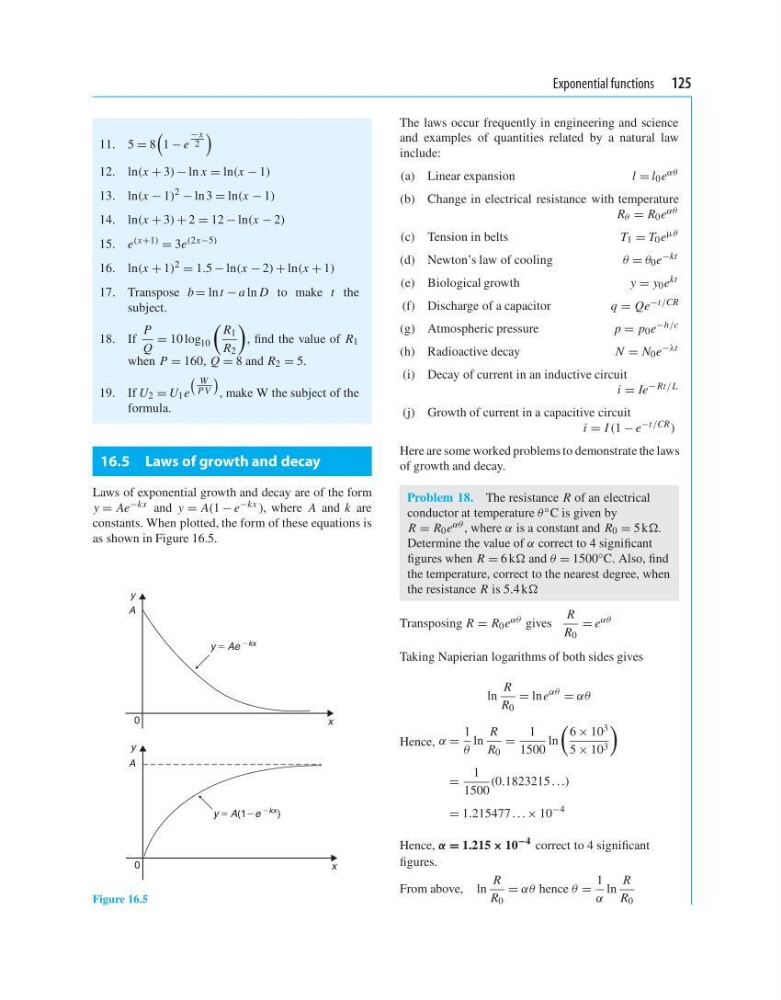
Laws of exponential growth and decay are of the form
y = Ae −kx and y = A(1 − e −kx ), where A and k are
constants. When plotted, the form of these equations is
as shown in Figure 16.5.
y
A
0
y 5 Ae 2kx
y 5 A(12e 2kx )
x
y
A
0
x
Figure 16.5
The laws occur frequently in engineering and science
and examples of quantities related by a natural law
include:
(a) Linear expansion
l = l 0 e αθ
(b) Change in electrical resistance with temperature
R θ = R 0 e αθ
(c) Tension in belts
T 1 = T 0 e μθ
(d) Newton’s law of cooling
θ = θ 0 e −kt
(e) Biological growth
y = y 0 e kt
(f) Discharge of a capacitor
q = Qe −t /CR
(g) Atmospheric pressure
p = p 0 e −h/c
(h) Radioactive decay
N = N 0 e −λt
(i) Decay of current in an inductive circuit
i = Ie − Rt/L
(j) Growth of current in a capacitive circuit
i = I (1 − e −t /CR )
Here are some worked problems to demonstrate the laws
of growth and decay.
Problem 18. The resistance R of an electrical
conductor at temperature θ ◦ C is given by
R = R 0 e αθ , where α is a constant and R 0 = 5 k.
Determine the value of α correct to 4 significant
figures when R = 6 k and θ = 1500 ◦ C. Also, find
the temperature, correct to the nearest degree, when
the resistance R is 5.4 k
Transposing R = R 0 e αθ gives
R
R 0
= e αθ
Taking Napierian logarithms of both sides gives
ln
R
R 0
= ln e
αθ
= αθ
Hence, α =
1
θ
ln
R
R 0
=
1
1500
ln
6 × 10 3
5 × 10 3
=
1
1500
(0.1823215 ...)
= 1.215477 ... × 10
−4
Hence, α = 1.215 × 10
−4 correct to 4 significant
figures.
From above, ln
R
R 0
= αθ hence θ =
1
α
ln
R
R 0
11. 5 = 8
1 − e
−x
2
12. ln(x + 3) − ln x = ln(x − 1)
13. ln(x − 1)
2
− ln 3 = ln(x − 1)
14. ln(x + 3) + 2 = 12 − ln(x − 2)
15. e (x+1) = 3e (2x−5)
16. ln(x + 1) 2 = 1.5 − ln(x − 2) + ln(x + 1)
17. Transpose b = ln t − a ln D to make t the
subject.
18. If
P
Q
= 10 log 10
R 1
R 2
, find the value of R 1
when P = 160, Q = 8 and R 2 = 5.
19. If U 2 = U 1 e
W
P V
, make W the subject of the
formula.
16.5 Laws of growth and decay
Laws of exponential growth and decay are of the form
y = Ae −kx and y = A(1 − e −kx ), where A and k are
constants. When plotted, the form of these equations is
as shown in Figure 16.5.
y
A
0
y 5 Ae 2kx
y 5 A(12e 2kx )
x
y
A
0
x
Figure 16.5
The laws occur frequently in engineering and science
and examples of quantities related by a natural law
include:
(a) Linear expansion
l = l 0 e αθ
(b) Change in electrical resistance with temperature
R θ = R 0 e αθ
(c) Tension in belts
T 1 = T 0 e μθ
(d) Newton’s law of cooling
θ = θ 0 e −kt
(e) Biological growth
y = y 0 e kt
(f) Discharge of a capacitor
q = Qe −t /CR
(g) Atmospheric pressure
p = p 0 e −h/c
(h) Radioactive decay
N = N 0 e −λt
(i) Decay of current in an inductive circuit
i = Ie − Rt/L
(j) Growth of current in a capacitive circuit
i = I (1 − e −t /CR )
Here are some worked problems to demonstrate the laws
of growth and decay.
Problem 18. The resistance R of an electrical
conductor at temperature θ ◦ C is given by
R = R 0 e αθ , where α is a constant and R 0 = 5 k.
Determine the value of α correct to 4 significant
figures when R = 6 k and θ = 1500 ◦ C. Also, find
the temperature, correct to the nearest degree, when
the resistance R is 5.4 k
Transposing R = R 0 e αθ gives
R
R 0
= e αθ
Taking Napierian logarithms of both sides gives
ln
R
R 0
= ln e
αθ
= αθ
Hence, α =
1
θ
ln
R
R 0
=
1
1500
ln
6 × 10 3
5 × 10 3
=
1
1500
(0.1823215 ...)
= 1.215477 ... × 10
−4
Hence, α = 1.215 × 10
−4 correct to 4 significant
figures.
From above, ln
R
R 0
= αθ hence θ =
1
α
ln
R
R 0