

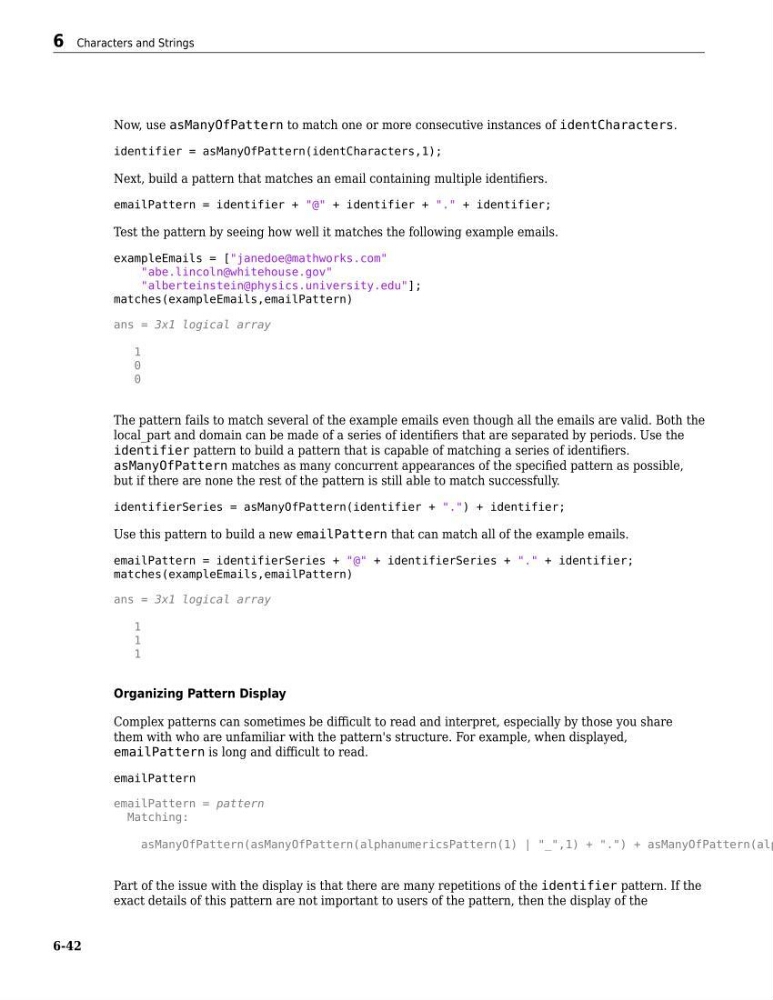
Now, use asManyOfPattern to match one or more consecutive instances of identCharacters.
identifier = asManyOfPattern(identCharacters,1);
Next, build a pattern that matches an email containing multiple identifiers.
emailPattern = identifier + "@" + identifier + "." + identifier;
Test the pattern by seeing how well it matches the following example emails.
exampleEmails = ["janedoe@mathworks.com"
"abe.lincoln@whitehouse.gov"
"alberteinstein@physics.university.edu"];
matches(exampleEmails,emailPattern)
ans = 3x1 logical array
1
0
0
The pattern fails to match several of the example emails even though all the emails are valid. Both the
local_part and domain can be made of a series of identifiers that are separated by periods. Use the
identifier pattern to build a pattern that is capable of matching a series of identifiers.
asManyOfPattern matches as many concurrent appearances of the specified pattern as possible,
but if there are none the rest of the pattern is still able to match successfully.
identifierSeries = asManyOfPattern(identifier + ".") + identifier;
Use this pattern to build a new emailPattern that can match all of the example emails.
emailPattern = identifierSeries + "@" + identifierSeries + "." + identifier;
matches(exampleEmails,emailPattern)
ans = 3x1 logical array
1
1
1
Organizing Pattern Display
Complex patterns can sometimes be difficult to read and interpret, especially by those you share
them with who are unfamiliar with the pattern's structure. For example, when displayed,
emailPattern is long and difficult to read.
emailPattern
emailPattern = pattern
Matching:
asManyOfPattern(asManyOfPattern(alphanumericsPattern(1) | "_",1) + ".") + asManyOfPattern(alp
Part of the issue with the display is that there are many repetitions of the identifier pattern. If the
exact details of this pattern are not important to users of the pattern, then the display of the
6 Characters and Strings
6-42
identifier = asManyOfPattern(identCharacters,1);
Next, build a pattern that matches an email containing multiple identifiers.
emailPattern = identifier + "@" + identifier + "." + identifier;
Test the pattern by seeing how well it matches the following example emails.
exampleEmails = ["janedoe@mathworks.com"
"abe.lincoln@whitehouse.gov"
"alberteinstein@physics.university.edu"];
matches(exampleEmails,emailPattern)
ans = 3x1 logical array
1
0
0
The pattern fails to match several of the example emails even though all the emails are valid. Both the
local_part and domain can be made of a series of identifiers that are separated by periods. Use the
identifier pattern to build a pattern that is capable of matching a series of identifiers.
asManyOfPattern matches as many concurrent appearances of the specified pattern as possible,
but if there are none the rest of the pattern is still able to match successfully.
identifierSeries = asManyOfPattern(identifier + ".") + identifier;
Use this pattern to build a new emailPattern that can match all of the example emails.
emailPattern = identifierSeries + "@" + identifierSeries + "." + identifier;
matches(exampleEmails,emailPattern)
ans = 3x1 logical array
1
1
1
Organizing Pattern Display
Complex patterns can sometimes be difficult to read and interpret, especially by those you share
them with who are unfamiliar with the pattern's structure. For example, when displayed,
emailPattern is long and difficult to read.
emailPattern
emailPattern = pattern
Matching:
asManyOfPattern(asManyOfPattern(alphanumericsPattern(1) | "_",1) + ".") + asManyOfPattern(alp
Part of the issue with the display is that there are many repetitions of the identifier pattern. If the
exact details of this pattern are not important to users of the pattern, then the display of the
6 Characters and Strings
6-42