

identifier pattern can be concealed using maskedPattern. This function creates a new pattern
where the display of identifier is masked and the variable name, "identifier", is displayed
instead. Alternatively, you can specify a different name to be displayed. The details of patterns that
are masked in this way can be accessed by clicking "Show all details" in the displayed pattern.
identifier = maskedPattern(identifier);
identifierSeries = asManyOfPattern(identifier + ".") + identifier
identifierSeries = pattern
Matching:
asManyOfPattern(identifier + ".") + identifier
Show all details
Patterns can be further organized using the namedPattern function. namedPattern designates a
pattern as a named pattern that changes how the pattern is displayed when combined with other
patterns. Email addresses have several important portions, local_part@domain.TLD, which each have
their own matching rules. Create a named pattern for each section.
localPart = namedPattern(identifierSeries,"local_part");
Named patterns can be nested, to further delineate parts of a pattern. To nest a named pattern, build
a pattern using named patterns and then designate that pattern as a named pattern. For example,
Domain.TLD can be divided into the domain, subdomains, and the top level domain (TLD). Create
named patterns for each part of domain.TLD.
subdomain = namedPattern(identifierSeries,"subdomain");
domainName = namedPattern(identifier,"domainName");
tld = namedPattern(identifier,"TLD");
Nest the named patterns for the components of domain underneath a single named pattern domain.
domain = optionalPattern(subdomain + ".") + ...
domainName + "." + ...
tld;
domain = namedPattern(domain);
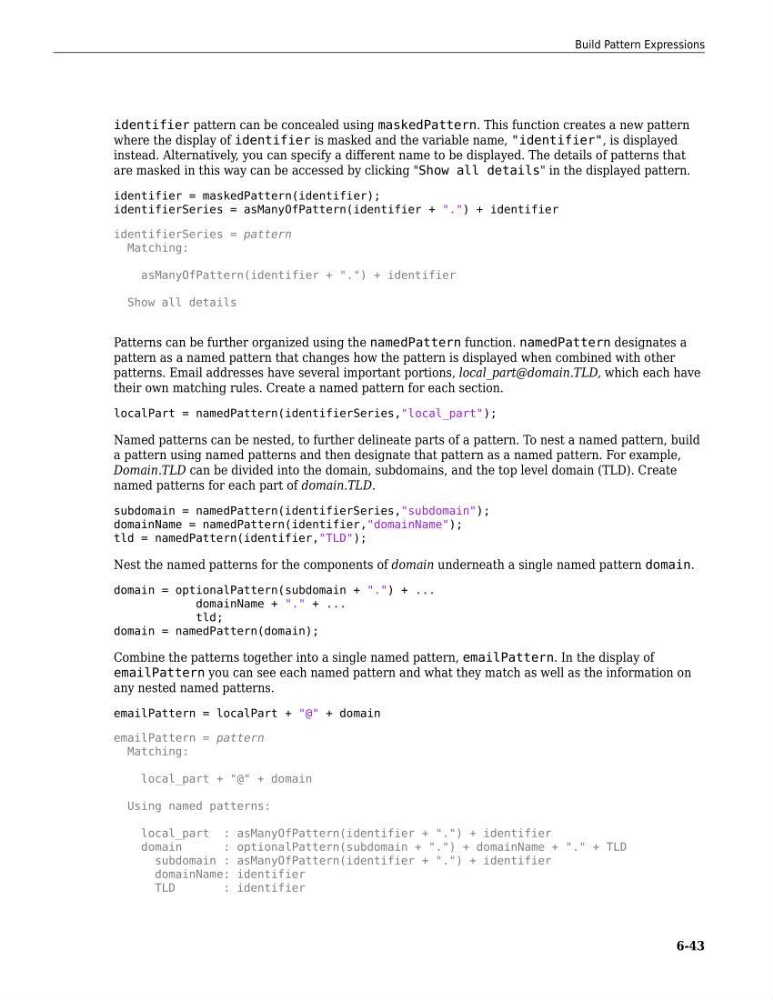
Combine the patterns together into a single named pattern, emailPattern. In the display of
emailPattern you can see each named pattern and what they match as well as the information on
any nested named patterns.
emailPattern = localPart + "@" + domain
emailPattern = pattern
Matching:
local_part + "@" + domain
Using named patterns:
local_part : asManyOfPattern(identifier + ".") + identifier
domain
: optionalPattern(subdomain + ".") + domainName + "." + TLD
subdomain : asManyOfPattern(identifier + ".") + identifier
domainName: identifier
TLD
: identifier
Build Pattern Expressions
6-43
where the display of identifier is masked and the variable name, "identifier", is displayed
instead. Alternatively, you can specify a different name to be displayed. The details of patterns that
are masked in this way can be accessed by clicking "Show all details" in the displayed pattern.
identifier = maskedPattern(identifier);
identifierSeries = asManyOfPattern(identifier + ".") + identifier
identifierSeries = pattern
Matching:
asManyOfPattern(identifier + ".") + identifier
Show all details
Patterns can be further organized using the namedPattern function. namedPattern designates a
pattern as a named pattern that changes how the pattern is displayed when combined with other
patterns. Email addresses have several important portions, local_part@domain.TLD, which each have
their own matching rules. Create a named pattern for each section.
localPart = namedPattern(identifierSeries,"local_part");
Named patterns can be nested, to further delineate parts of a pattern. To nest a named pattern, build
a pattern using named patterns and then designate that pattern as a named pattern. For example,
Domain.TLD can be divided into the domain, subdomains, and the top level domain (TLD). Create
named patterns for each part of domain.TLD.
subdomain = namedPattern(identifierSeries,"subdomain");
domainName = namedPattern(identifier,"domainName");
tld = namedPattern(identifier,"TLD");
Nest the named patterns for the components of domain underneath a single named pattern domain.
domain = optionalPattern(subdomain + ".") + ...
domainName + "." + ...
tld;
domain = namedPattern(domain);
Combine the patterns together into a single named pattern, emailPattern. In the display of
emailPattern you can see each named pattern and what they match as well as the information on
any nested named patterns.
emailPattern = localPart + "@" + domain
emailPattern = pattern
Matching:
local_part + "@" + domain
Using named patterns:
local_part : asManyOfPattern(identifier + ".") + identifier
domain
: optionalPattern(subdomain + ".") + domainName + "." + TLD
subdomain : asManyOfPattern(identifier + ".") + identifier
domainName: identifier
TLD
: identifier
Build Pattern Expressions
6-43