

Fourier series over any range 631
Period L 5 8 ms
0
10
v (t)
t (ms)
24
4
8
12
28
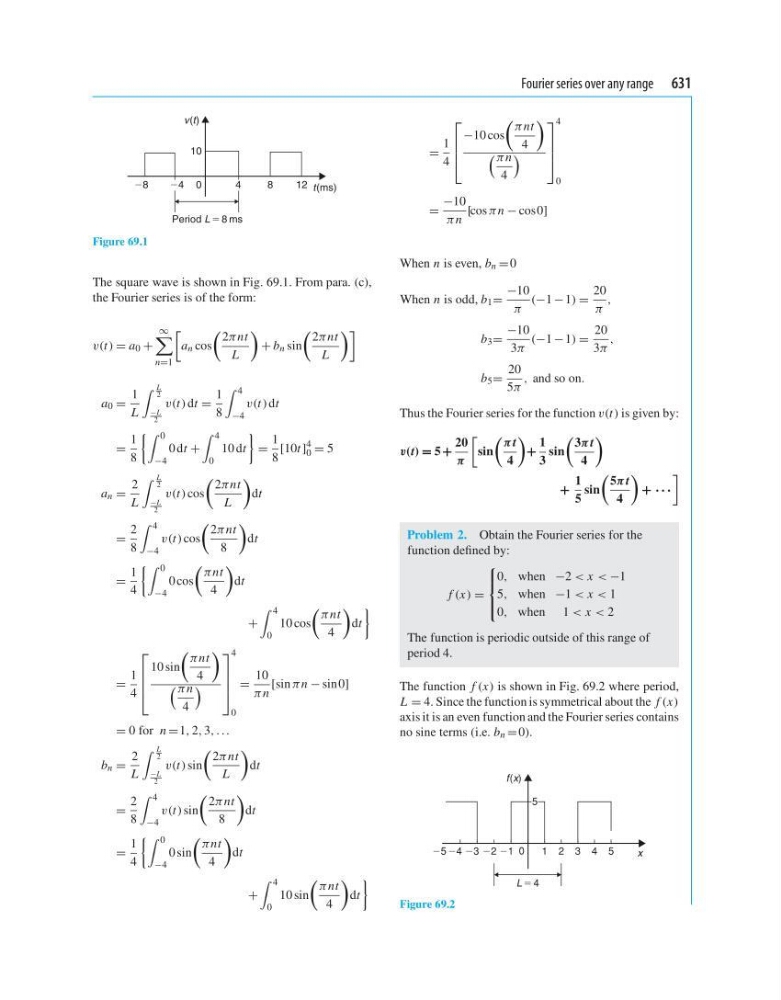
Figure 69.1
The square wave is shown in Fig. 69.1. From para. (c),
the Fourier series is of the form:
v(t ) = a 0 +
∞
n=1
a n cos
2πnt
L
+ b n sin
2πnt
L
a 0 =
1
L
L
2
−L
2
v(t ) dt =
1
8
4
−4
v(t ) dt
=
1
8
0
−4
0 dt +
4
0
10 dt
=
1
8
[10t ]
4
0 = 5
a n =
2
L
L
2
−L
2
v(t ) cos
2πnt
L
dt
=
2
8
4
−4
v(t ) cos
2πnt
8
dt
=
1
4
0
−4
0 cos
πnt
4
dt
+
4
0
10 cos
πnt
4
dt
=
1
4
⎡
⎢
⎢
⎣
10 sin
πnt
4
πn
4
⎤
⎥
⎥
⎦
4
0
=
10
πn
[sin πn − sin 0]
= 0 for n =1, 2, 3, ...
b n =
2
L
L
2
−L
2
v(t ) sin
2πnt
L
dt
=
2
8
4
−4
v(t ) sin
2πnt
8
dt
=
1
4
0
−4
0 sin
πnt
4
dt
+
4
0
10 sin
πnt
4
dt
=
1
4
⎡
⎢
⎢
⎣
−10 cos
πnt
4
πn
4
⎤
⎥
⎥
⎦
4
0
=
−10
πn
[cos πn − cos0]
When n is even, b n = 0
When n is odd, b 1 =
−10
π
(−1 − 1) =
20
π
,
b 3 =
−10
3π
(−1 − 1) =
20
3π
,
b 5 =
20
5π
, and so on.
Thus the Fourier series for the function v(t ) is given by:
v(t) = 5 +
20
π
sin
πt
4
+
1
3
sin
3πt
4
+
1
5
sin
5πt
4
+ · · ·
Problem 2. Obtain the Fourier series for the
function defined by:
f (x) =
⎧
⎪ ⎨
⎪ ⎩
0, when −2 < x < −1
5, when −1 < x < 1
0, when 1 < x < 2
The function is periodic outside of this range of
period 4.
The function f (x) is shown in Fig. 69.2 where period,
L = 4. Since the function is symmetrical about the f (x)
axis it is an even function and the Fourier series contains
no sine terms (i.e. b n = 0).
L 5 4
5
f (x)
x
22 21 0
1 2 3 4 5
25 24 23
Figure 69.2