

632 Higher Engineering Mathematics
Thus, from para. (c),
f (x) = a 0 +
∞
n=1
a n cos
2πnx
L
a 0 =
1
L
L
2
−L
2
f (x) dx =
1
4
2
−2
f (x) dx
=
1
4
−1
−2
0 dx +
1
−1
5 dx +
2
1
0 dx
=
1
4
[5x]
1
−1 =
1
4
[(5) − (−5)] =
10
4
=
5
2
a n =
2
L
L
2
−L
2
f (x) cos
2πnx
L
dx
=
2
4
2
−2
f (x) cos
2πnx
4
dx
=
1
2
−1
−2
0 cos
πnx
2
dx
+
1
−1
5 cos
πnx
2
dx
+
2
1
0 cos
πnx
2
dx
=
5
2
⎡
⎢
⎣
sin
πnx
2
πn
2
⎤
⎥
⎦
1
−1
=
5
πn
sin
πn
2
− sin
−πn
2
When n is even, a n = 0
When n is odd,
a 1 =
5
π
(1 − (−1)) =
10
π
a 3 =
5
3π
(−1 − 1) =
−10
3π
a 5 =
5
5π
(1 − (−1)) =
10
5π
and so on.
Hence the Fourier series for the function f (x) is
given by:
f (x) =
5
2
+
10
π
cos
πx
2
−
1
3
cos
3πx
2
+
1
5
cos
5πx
2
−
1
7
cos
7πx
2
+ · · ·
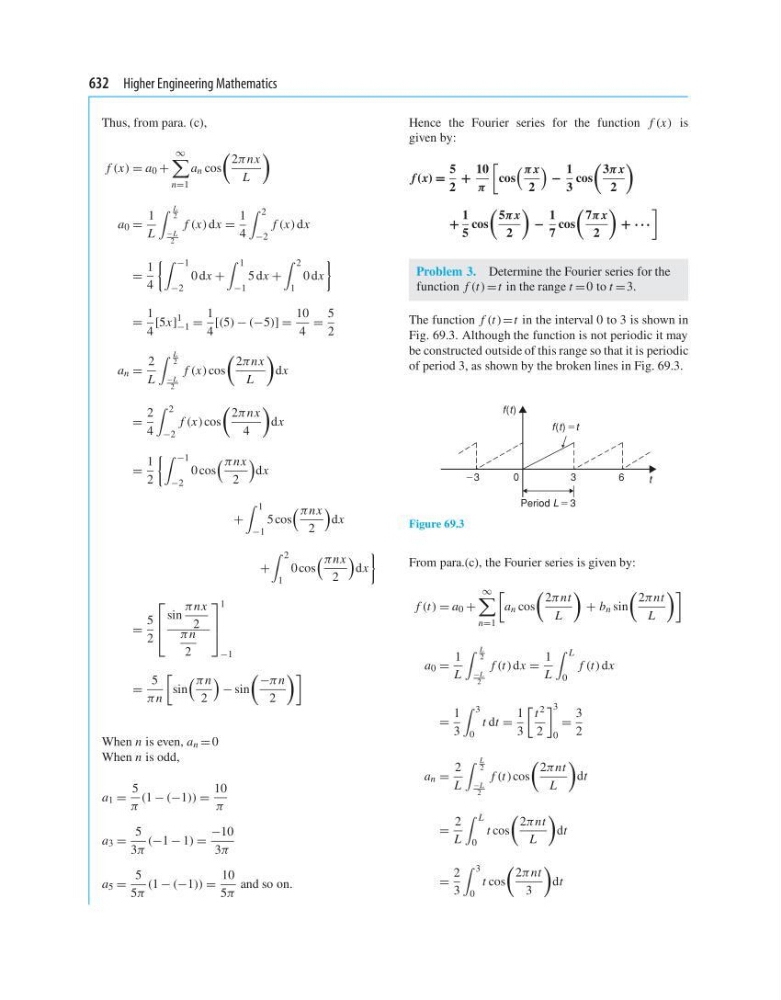
Problem 3. Determine the Fourier series for the
function f (t ) = t in the range t = 0 to t = 3.
The function f (t ) =t in the interval 0 to 3 is shown in
Fig. 69.3. Although the function is not periodic it may
be constructed outside of this range so that it is periodic
of period 3, as shown by the broken lines in Fig. 69.3.
Period L 5 3
f (t )
f (t ) 5t
t
23
3
0
6
Figure 69.3
From para.(c), the Fourier series is given by:
f (t ) = a 0 +
∞
n=1
a n cos
2πnt
L
+ b n sin
2πnt
L
a 0 =
1
L
L
2
−L
2
f (t ) dx =
1
L
L
0
f (t ) dx
=
1
3
3
0
t dt =
1
3
t 2
2
3
0
=
3
2
a n =
2
L
L
2
−L
2
f (t ) cos
2πnt
L
dt
=
2
L
L
0
t cos
2πnt
L
dt
=
2
3
3
0
t cos
2πnt
3
dt