

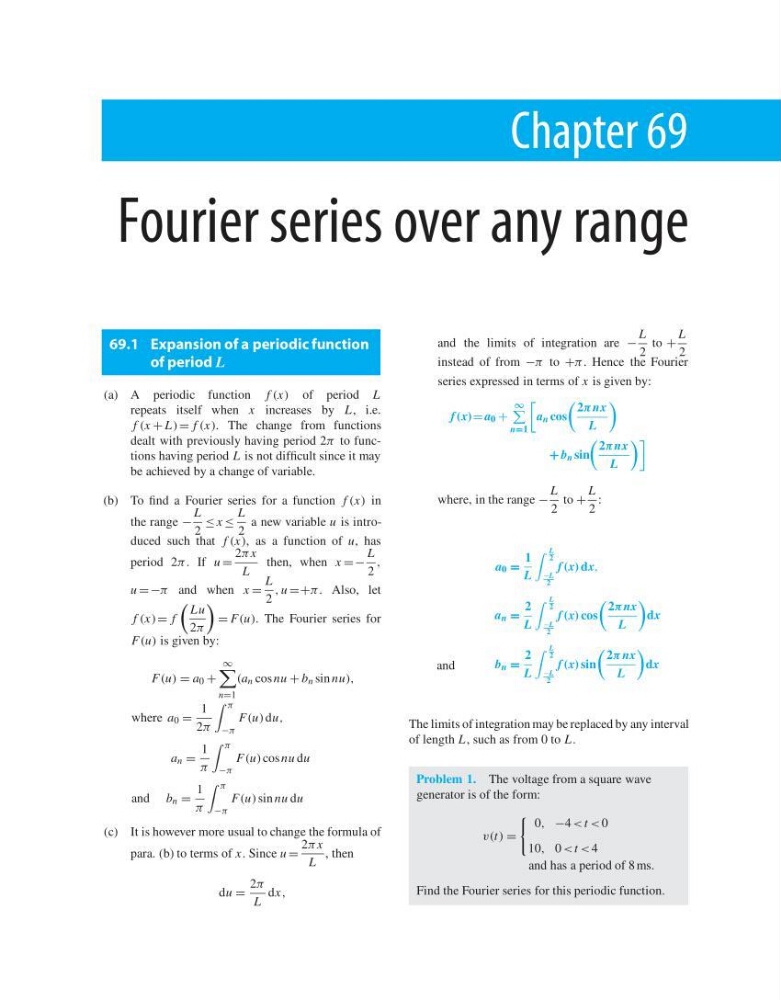
Chapter 69
Fourier series over any range
69.1 Expansion of a periodic function
of period L
(a) A periodic function f (x) of period L
repeats itself when x increases by L, i.e.
f (x + L) = f (x). The change from functions
dealt with previously having period 2π to functions having period L is not difficult since it may
be achieved by a change of variable.
(b) To find a Fourier series for a function f (x) in
the range −
L
2
≤ x ≤
L
2
a new variable u is introduced such that f (x), as a function of u, has
period 2π. If u =
2π x
L
then, when x =−
L
2
,
u =−π and when x =
L
2
, u =+π. Also, let
f (x) = f
Lu
2π
= F(u). The Fourier series for
F(u) is given by:
F(u) = a 0 +
∞
n=1
(a n cos nu + b n sin nu),
where a 0 =
1
2π
π
−π
F(u) du,
a n =
1
π
π
−π
F(u) cos nu du
and b n =
1
π
π
−π
F(u) sin nu du
(c) It is however more usual to change the formula of
para. (b) to terms of x. Since u =
2π x
L
, then
du =
2π
L
dx,
and the limits of integration are −
L
2
to +
L
2
instead of from −π to +π. Hence the Fourier
series expressed in terms of x is given by:
f (x)= a 0 +
∞
n=1
a n cos
2πnx
L
+ b n sin
2πnx
L
where, in the range −
L
2
to +
L
2
:
and
a 0 =
1
L
L
2
−L
2
f (x) dx,
a n =
2
L
L
2
−L
2
f (x) cos
2πnx
L
dx
b n =
2
L
L
2
−L
2
f (x) sin
2π nx
L
dx
The limits of integration may be replaced by any interval
of length L, such as from 0 to L.
Problem 1. The voltage from a square wave
generator is of the form:
v(t ) =
0, −4 < t < 0
10, 0 < t < 4
and has a period of 8 ms.
Find the Fourier series for this periodic function.