

620 Higher Engineering Mathematics
and phase angle,
α = tan
−1
⎛
⎜
⎝
−2
3 2 π
1
3
⎞
⎟
⎠
= −11.98
◦ or −0.209 radians
Hence the third harmonic is given by
0.341 sin(3x −0.209)
(c) When x = 0, f (x) = 0 (see Fig. 67.3).
Hence, from the Fourier series:
0 =
π
4
−
2
π
cos 0 +
1
3 2 cos 0 +
1
5 2 cos 0 +· · ·
+ (0)
i.e. −
π
4
= −
2
π
1 +
1
3 2 +
1
5 2 +
1
7 2 + · · ·
Hence
π 2
8
= 1 +
1
3 2 +
1
5 2 +
1
7 2 +· · ·
Problem 5. Deduce the Fourier series for the
function f (θ) = θ 2 in the range 0 to 2π.
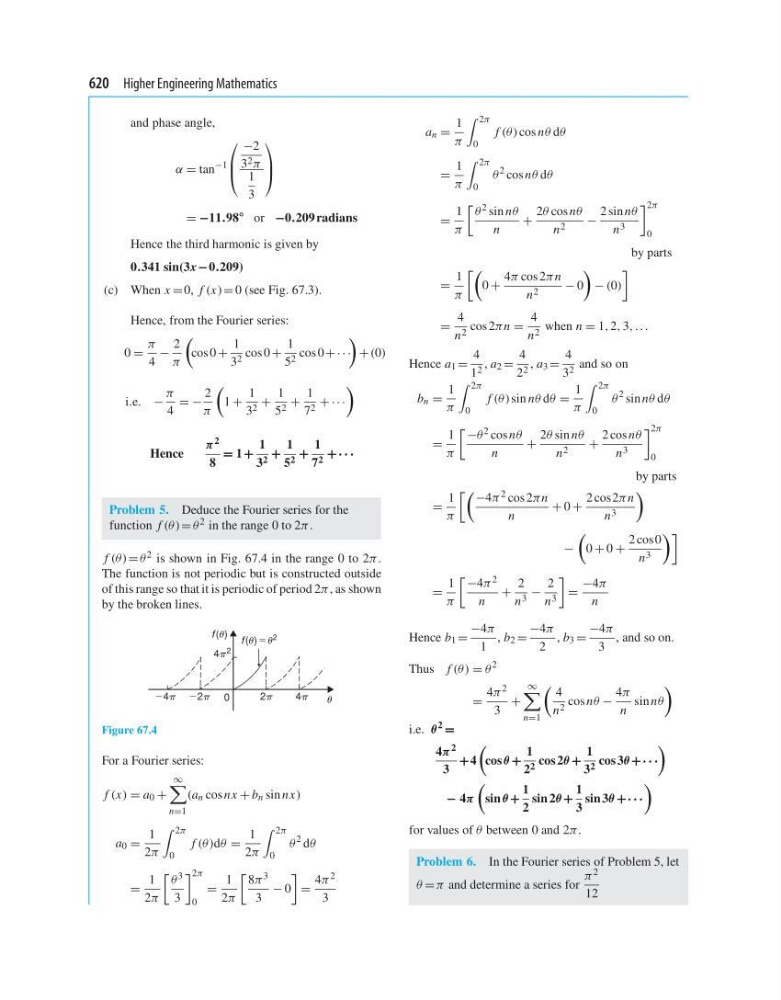
f (θ) = θ 2 is shown in Fig. 67.4 in the range 0 to 2π.
The function is not periodic but is constructed outside
of this range so that it is periodic of period 2π, as shown
by the broken lines.
f () f ()5 2
0
24 22
2
4
4
2
Figure 67.4
For a Fourier series:
f (x) = a 0 +
∞
n=1
(a n cos nx + b n sin nx)
a 0 =
1
2π
2π
0
f (θ)dθ =
1
2π
2π
0
θ
2 dθ
=
1
2π
θ 3
3
2π
0
=
1
2π
8π 3
3
− 0
=
4π 2
3
a n =
1
π
2π
0
f (θ) cos nθ dθ
=
1
π
2π
0
θ
2 cos nθ dθ
=
1
π
θ 2 sin nθ
n
+
2θ cos nθ
n 2
−
2 sinnθ
n 3
2π
0
by parts
=
1
π
0 +
4π cos 2πn
n 2
− 0
− (0)
=
4
n 2 cos 2πn =
4
n 2 when n = 1, 2, 3, ...
Hence a 1 =
4
1 2 , a 2 =
4
2 2 , a 3 =
4
3 2 and so on
b n =
1
π
2π
0
f (θ) sin nθ dθ =
1
π
2π
0
θ
2 sin nθ dθ
=
1
π
−θ 2 cos nθ
n
+
2θ sin nθ
n 2
+
2 cos nθ
n 3
2π
0
by parts
=
1
π
−4π 2 cos 2πn
n
+ 0 +
2 cos2πn
n 3
−
0 + 0 +
2 cos0
n 3
=
1
π
−4π 2
n
+
2
n 3 −
2
n 3
=
−4π
n
Hence b 1 =
−4π
1
, b 2 =
−4π
2
, b 3 =
−4π
3
, and so on.
Thus f (θ) = θ
2
=
4π 2
3
+
∞
n=1
4
n 2 cos nθ −
4π
n
sin nθ
i.e. θ
2
=
4π 2
3
+4
cos θ +
1
2 2 cos 2θ +
1
3 2 cos 3θ +· · ·
− 4π
sin θ +
1
2
sin 2θ +
1
3
sin 3θ +· · ·
for values of θ between 0 and 2π.
Problem 6. In the Fourier series of Problem 5, let
θ = π and determine a series for
π 2
12