

Fourier series for a non-periodic function over range 2π 621
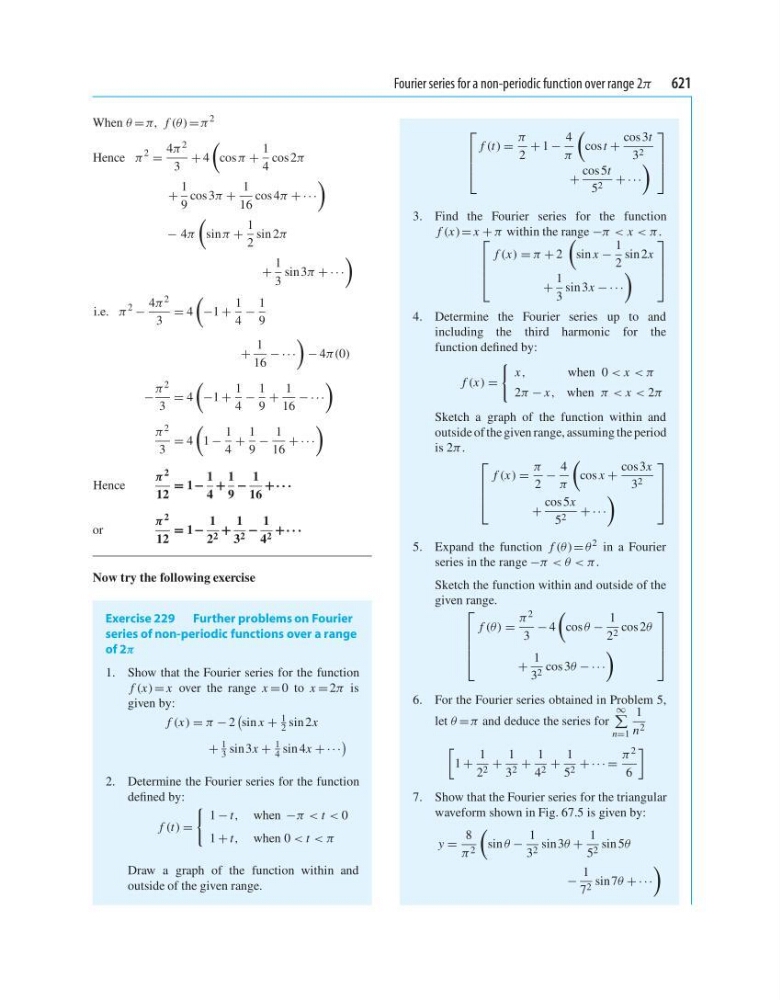
When θ = π, f (θ) = π
2
Hence π
2
=
4π 2
3
+ 4
cos π +
1
4
cos 2π
+
1
9
cos 3π +
1
16
cos 4π + · · ·
− 4π
sin π +
1
2
sin 2π
+
1
3
sin 3π + · · ·
i.e. π
2
−
4π 2
3
= 4
−1 +
1
4
−
1
9
+
1
16
− · · ·
− 4π(0)
−
π 2
3
= 4
−1 +
1
4
−
1
9
+
1
16
− · · ·
π 2
3
= 4
1 −
1
4
+
1
9
−
1
16
+ · · ·
Hence
π 2
12
= 1−
1
4
+
1
9
−
1
16
+· · ·
or
π 2
12
= 1−
1
2 2 +
1
3 2 −
1
4 2 +· · ·
Now try the following exercise
Exercise 229 Further problems on Fourier
series of non-periodic functions over a range
of 2π
1. Show that the Fourier series for the function
f (x) = x over the range x = 0 to x = 2π is
given by:
f (x) = π − 2
sin x +
1
2 sin 2x
+
1
3 sin 3x +
1
4 sin 4x + · · ·
2. Determine the Fourier series for the function
defined by:
f (t ) =
1 − t, when −π < t < 0
1 + t, when 0 < t < π
Draw a graph of the function within and
outside of the given range.
⎡
⎢
⎢
⎣
f (t ) =
π
2
+ 1 −
4
π
cos t +
cos 3t
3 2
+
cos 5t
5 2 + · · ·
⎤
⎥
⎥
⎦
3. Find the Fourier series for the function
f (x) = x + π within the range −π < x < π.
⎡
⎢
⎢
⎣
f (x) = π + 2
sin x −
1
2
sin 2x
+
1
3
sin 3x − · · ·
⎤
⎥
⎥
⎦
4. Determine the Fourier series up to and
including the third harmonic for the
function defined by:
f (x) =
x,
when 0 < x < π
2π − x, when π < x < 2π
Sketch a graph of the function within and
outside of the given range, assuming the period
is 2π.
⎡
⎢
⎢
⎣
f (x) =
π
2
−
4
π
cos x +
cos3x
3 2
+
cos 5x
5 2 + · · ·
⎤
⎥
⎥
⎦
5. Expand the function f (θ) = θ
2 in a Fourier
series in the range −π < θ < π.
Sketch the function within and outside of the
given range.
⎡
⎢
⎢
⎢
⎣
f (θ) =
π 2
3
− 4
cos θ −
1
2 2 cos 2θ
+
1
3 2 cos 3θ − · · ·
⎤
⎥
⎥
⎥
⎦
6. For the Fourier series obtained in Problem 5,
let θ = π and deduce the series for
∞
n=1
1
n 2
1 +
1
2 2 +
1
3 2 +
1
4 2 +
1
5 2 + · · · =
π 2
6
7. Show that the Fourier series for the triangular
waveform shown in Fig. 67.5 is given by:
y =
8
π 2
sin θ −
1
3 2 sin 3θ +
1
5 2 sin 5θ
−
1
7 2 sin 7θ + · · ·