

Fourier series for a non-periodic function over range 2π 619
x
f (x)
f (x) 5 x
0
2
22
2
3
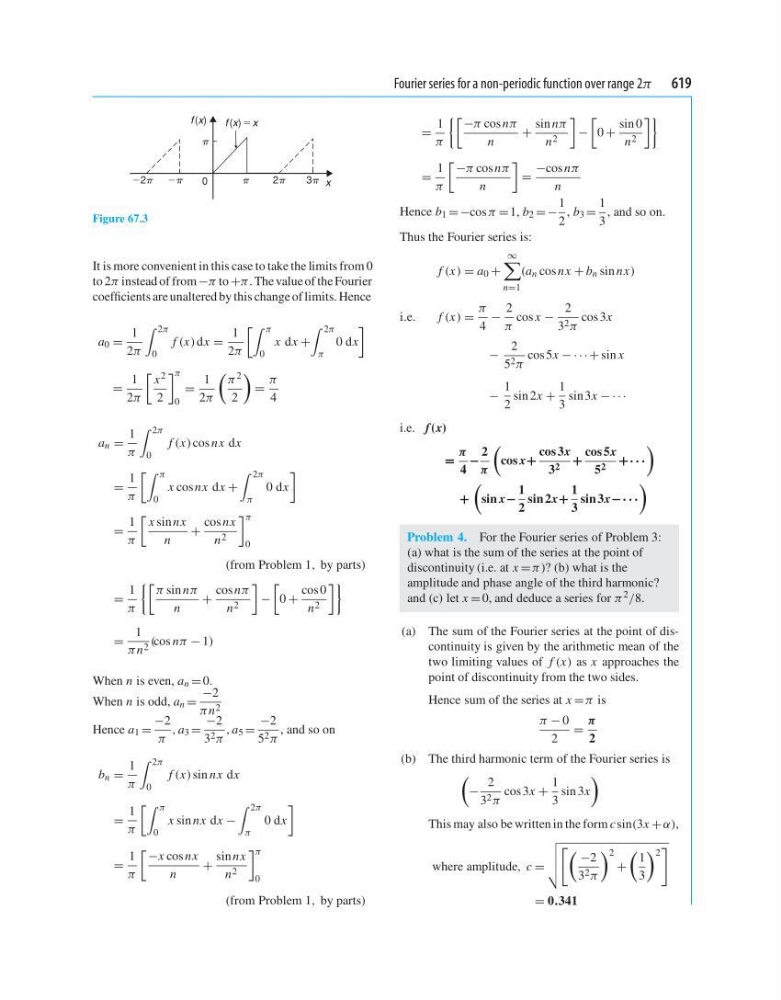
Figure 67.3
It is more convenient in this case to take the limits from 0
to 2π instead of from −π to +π. The value of the Fourier
coefficients are unaltered by this change of limits. Hence
a 0 =
1
2π
2π
0
f (x) dx =
1
2π
π
0
x dx +
2π
π
0 dx
=
1
2π
x 2
2
π
0
=
1
2π
π 2
2
=
π
4
a n =
1
π
2π
0
f (x) cos nx dx
=
1
π
π
0
x cos nx dx +
2π
π
0 dx
=
1
π
x sin nx
n
+
cos nx
n 2
π
0
(from Problem 1, by parts)
=
1
π
π sin nπ
n
+
cos nπ
n 2
−
0 +
cos 0
n 2
=
1
πn 2 (cos nπ − 1)
When n is even, a n = 0.
When n is odd, a n =
−2
πn 2
Hence a 1 =
−2
π
, a 3 =
−2
3 2 π
, a 5 =
−2
5 2 π
, and so on
b n =
1
π
2π
0
f (x) sin nx dx
=
1
π
π
0
x sin nx dx −
2π
π
0 dx
=
1
π
−x cos nx
n
+
sin nx
n 2
π
0
(from Problem 1, by parts)
=
1
π
−π cos nπ
n
+
sin nπ
n 2
−
0 +
sin 0
n 2
=
1
π
−π cos nπ
n
=
−cos nπ
n
Hence b 1 =−cos π = 1, b 2 =−
1
2
, b 3 =
1
3
, and so on.
Thus the Fourier series is:
f (x) = a 0 +
∞
n=1
(a n cos nx + b n sin nx)
i.e.
f (x) =
π
4
−
2
π
cos x −
2
3 2 π
cos 3x
−
2
5 2 π
cos 5x − · · · + sin x
−
1
2
sin 2x +
1
3
sin 3x − · · ·
i.e. f (x)
=
π
4
−
2
π
cos x+
cos 3x
3 2 +
cos 5x
5 2 +· · ·
+
sin x−
1
2
sin 2x+
1
3
sin 3x−· · ·
Problem 4. For the Fourier series of Problem 3:
(a) what is the sum of the series at the point of
discontinuity (i.e. at x = π)? (b) what is the
amplitude and phase angle of the third harmonic?
and (c) let x = 0, and deduce a series for π 2 /8.
(a) The sum of the Fourier series at the point of discontinuity is given by the arithmetic mean of the
two limiting values of f (x) as x approaches the
point of discontinuity from the two sides.
Hence sum of the series at x = π is
π − 0
2
=
π
2
(b) The third harmonic term of the Fourier series is
−
2
3 2 π
cos 3x +
1
3
sin 3x
This may also be written in the form c sin(3x + α),
where amplitude, c =
−2
3 2 π
2
+
1
3
2
= 0.341