

524 Higher Engineering Mathematics
If ln T =− p
2 c
2 t + c 1 then
T = e − p 2 c 2 t +c 1 = e − p 2 c 2 t e c 1 i.e. T = k e −p 2 c 2 t (where
constant k = e c 1 ).
Hence, u(x, t ) = XT ={A cos px + B sin px}k e − p 2 c 2 t
i.e. u(x, t ) ={P cos px + Q sin px}e − p 2 c 2 t where
P = Ak and Q = Bk.
Applying the boundary conditions u(0, t ) =0 gives:
0={P cos 0+ Q sin 0}e − p 2 c 2 t = P e − p 2 c 2 t from which,
P = 0 and u(x, t ) = Q sin px e − p 2 c 2 t .
Also, u(L , t ) =0 thus, 0 = Q sin pL e − p 2 c 2 t and since
Q = 0 then sin pL =0 from which, pL =nπ or p =
nπ
L
where n =1, 2, 3, ...
There are therefore many values of u(x, t ).
Thus, in general,
u(x, t ) =
∞
n=1
Q n e
− p 2 c 2 t sin
nπ x
L
Applying the remaining boundary condition, that when
t = 0, u(x, t ) = f (x) for 0 ≤ x ≤ L, gives:
f (x) =
∞
n=1
Q n sin
nπ x
L
From Fourier series, Q n = 2 × mean value of
f (x) sin
nπ x
L
from x to L.
Hence,
Q n =
2
L
L
0
f (x) sin
nπ x
L
dx
Thus, u(x, t ) =
2
L
∞
n=1
L
0
f (x) sin
nπ x
L
dx
e
− p 2 c 2 t sin
nπ x
L
This method of solution is demonstrated in the following
worked problem.
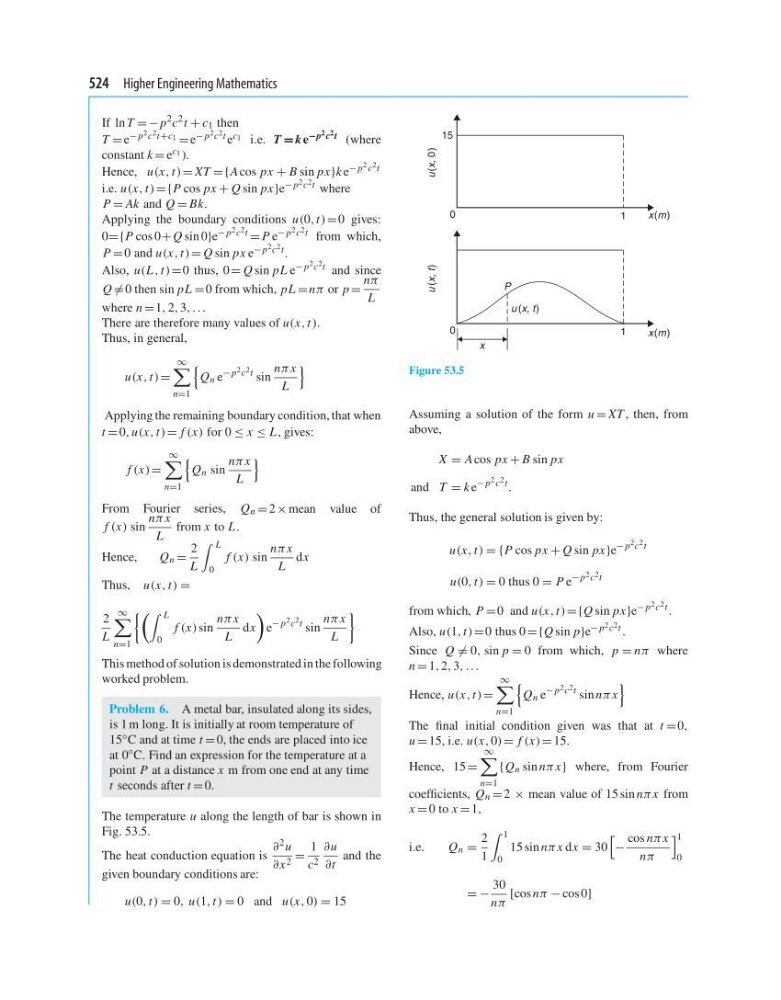
Problem 6. A metal bar, insulated along its sides,
is 1 m long. It is initially at room temperature of
15 ◦ C and at time t = 0, the ends are placed into ice
at 0
◦ C. Find an expression for the temperature at a
point P at a distance x m from one end at any time
t seconds after t = 0.
The temperature u along the length of bar is shown in
Fig. 53.5.
The heat conduction equation is
∂
2 u
∂x 2 =
1
c 2
∂u
∂t
and the
given boundary conditions are:
u(0, t ) = 0, u(1, t ) = 0 and u(x, 0) = 15
0
1
1
15
x
u (x, 0 )
x (m )
x (m )
0
P
u (x, t )
u (x, t )
Figure 53.5
Assuming a solution of the form u = XT , then, from
above,
X = A cos px + B sin px
and T = k e
− p 2 c 2 t
.
Thus, the general solution is given by:
u(x, t ) = {P cos px + Q sin px}e
− p 2 c 2 t
u(0, t ) = 0 thus 0 = P e
− p 2 c 2 t
from which, P = 0 and u(x, t ) ={Q sin px}e − p 2 c 2 t .
Also, u(1, t ) =0 thus 0 ={Q sin p}e − p 2 c 2 t .
Since Q = 0, sin p = 0 from which, p = nπ where
n = 1, 2, 3, ...
Hence, u(x, t ) =
∞
n=1
Q n e
− p 2 c 2 t sin nπ x
The final initial condition given was that at t = 0,
u = 15, i.e. u(x, 0) = f (x) = 15.
Hence, 15 =
∞
n=1
{Q n sin nπ x} where, from Fourier
coefficients, Q n = 2 × mean value of 15 sin nπ x from
x = 0 to x = 1,
i.e.
Q n =
2
1
1
0
15 sin nπ x dx = 30
−
cos nπ x
nπ
1
0
= −
30
nπ
[cos nπ − cos 0]
If ln T =− p
2 c
2 t + c 1 then
T = e − p 2 c 2 t +c 1 = e − p 2 c 2 t e c 1 i.e. T = k e −p 2 c 2 t (where
constant k = e c 1 ).
Hence, u(x, t ) = XT ={A cos px + B sin px}k e − p 2 c 2 t
i.e. u(x, t ) ={P cos px + Q sin px}e − p 2 c 2 t where
P = Ak and Q = Bk.
Applying the boundary conditions u(0, t ) =0 gives:
0={P cos 0+ Q sin 0}e − p 2 c 2 t = P e − p 2 c 2 t from which,
P = 0 and u(x, t ) = Q sin px e − p 2 c 2 t .
Also, u(L , t ) =0 thus, 0 = Q sin pL e − p 2 c 2 t and since
Q = 0 then sin pL =0 from which, pL =nπ or p =
nπ
L
where n =1, 2, 3, ...
There are therefore many values of u(x, t ).
Thus, in general,
u(x, t ) =
∞
n=1
Q n e
− p 2 c 2 t sin
nπ x
L
Applying the remaining boundary condition, that when
t = 0, u(x, t ) = f (x) for 0 ≤ x ≤ L, gives:
f (x) =
∞
n=1
Q n sin
nπ x
L
From Fourier series, Q n = 2 × mean value of
f (x) sin
nπ x
L
from x to L.
Hence,
Q n =
2
L
L
0
f (x) sin
nπ x
L
dx
Thus, u(x, t ) =
2
L
∞
n=1
L
0
f (x) sin
nπ x
L
dx
e
− p 2 c 2 t sin
nπ x
L
This method of solution is demonstrated in the following
worked problem.
Problem 6. A metal bar, insulated along its sides,
is 1 m long. It is initially at room temperature of
15 ◦ C and at time t = 0, the ends are placed into ice
at 0
◦ C. Find an expression for the temperature at a
point P at a distance x m from one end at any time
t seconds after t = 0.
The temperature u along the length of bar is shown in
Fig. 53.5.
The heat conduction equation is
∂
2 u
∂x 2 =
1
c 2
∂u
∂t
and the
given boundary conditions are:
u(0, t ) = 0, u(1, t ) = 0 and u(x, 0) = 15
0
1
1
15
x
u (x, 0 )
x (m )
x (m )
0
P
u (x, t )
u (x, t )
Figure 53.5
Assuming a solution of the form u = XT , then, from
above,
X = A cos px + B sin px
and T = k e
− p 2 c 2 t
.
Thus, the general solution is given by:
u(x, t ) = {P cos px + Q sin px}e
− p 2 c 2 t
u(0, t ) = 0 thus 0 = P e
− p 2 c 2 t
from which, P = 0 and u(x, t ) ={Q sin px}e − p 2 c 2 t .
Also, u(1, t ) =0 thus 0 ={Q sin p}e − p 2 c 2 t .
Since Q = 0, sin p = 0 from which, p = nπ where
n = 1, 2, 3, ...
Hence, u(x, t ) =
∞
n=1
Q n e
− p 2 c 2 t sin nπ x
The final initial condition given was that at t = 0,
u = 15, i.e. u(x, 0) = f (x) = 15.
Hence, 15 =
∞
n=1
{Q n sin nπ x} where, from Fourier
coefficients, Q n = 2 × mean value of 15 sin nπ x from
x = 0 to x = 1,
i.e.
Q n =
2
1
1
0
15 sin nπ x dx = 30
−
cos nπ x
nπ
1
0
= −
30
nπ
[cos nπ − cos 0]