

An introduction to partial differential equations 523
Now try the following exercise
Exercise 201 Further problems on the
wave equation
1. An elastic string is stretched between two
points 40 cm apart. Its centre point is displaced
1.5 cm from its position of rest at right angles
to the original direction of the string and then
released with zero velocity. Determine the subsequent motion u(x, t ) by applying the wave
equation
∂ 2 u
∂x 2 =
1
c 2
∂ 2 u
∂t 2 with c
2
= 9.
u(x, t ) =
12
π 2
∞
n=1
1
n 2 sin
nπ
2
sin
nπ x
40
cos
3nπt
40
2. The centre point of an elastic string between
two points P and Q, 80 cm apart, is deflected
a distance of 1 cm from its position of
rest perpendicular to P Q and released initially with zero velocity. Apply the wave
equation
∂ 2 u
∂x 2 =
1
c 2
∂ 2 u
∂t 2 where c = 8, to determine the motion of a point distance x from P at
time t .
u(x, t ) =
8
π 2
∞
n=1
1
n 2 sin
nπ
2
sin
nπ x
80
cos
nπt
10
53.7 The heat conduction equation
The heat conduction equation
∂ 2 u
∂x 2 =
1
c 2
∂u
∂t
is solved
in a similar manner to that for the wave equation; the
equation differs only in that the right hand side contains
a first partial derivative instead of the second.
The conduction of heat in a uniform bar depends on
the initial distribution of temperature and on the physical properties of the bar, i.e. the thermal conductivity,
h, the specific heat of the material, σ , and the mass
per unit length, ρ, of the bar. In the above equation,
c 2 =
h
σρ
With a uniform bar insulated, except at its ends, any heat
flow is along the bar and, at any instant, the temperature
u at a point P is a function of its distance x from one
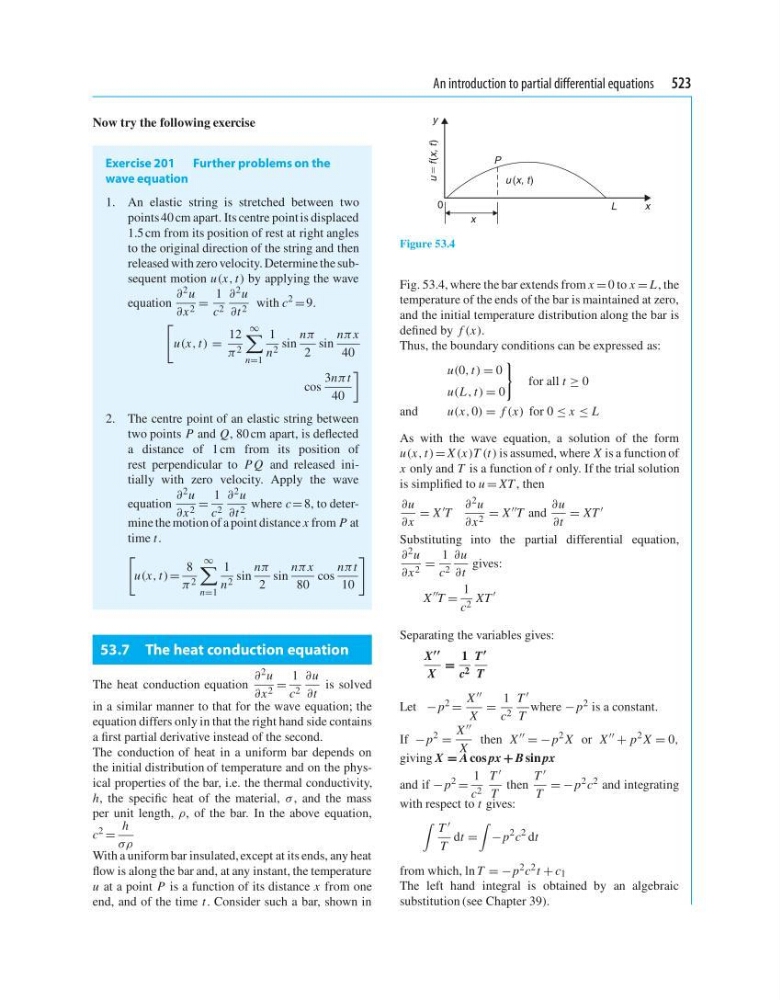
end, and of the time t . Consider such a bar, shown in
0
x
x
y
P
L
u (x, t )
u
5 f (x, t )
Figure 53.4
Fig. 53.4, where the bar extends from x = 0 to x = L, the
temperature of the ends of the bar is maintained at zero,
and the initial temperature distribution along the bar is
defined by f (x).
Thus, the boundary conditions can be expressed as:
u(0, t ) = 0
u(L , t ) = 0
for all t ≥ 0
and
u(x, 0) = f (x) for 0 ≤ x ≤ L
As with the wave equation, a solution of the form
u(x, t ) = X (x)T (t ) is assumed, where X is a function of
x only and T is a function of t only. If the trial solution
is simplified to u = XT , then
∂u
∂x
= X T
∂ 2 u
∂x 2 = X T and
∂u
∂t
= XT
Substituting into the partial differential equation,
∂ 2 u
∂x 2 =
1
c 2
∂u
∂t
gives:
X
T =
1
c 2 XT
Separating the variables gives:
X
X
=
1
c 2
T
T
Let − p 2 =
X
X
=
1
c 2
T
T
where − p 2 is a constant.
If − p
2
=
X
X
then X
= −p
2 X or X
+ p
2 X = 0,
giving X = A cos px + B sinpx
and if − p 2 =
1
c 2
T
T
then
T
T
= −p 2 c 2 and integrating
with respect to t gives:
T
T
dt =
− p
2 c
2 dt
from which, ln T = −p 2 c 2 t + c 1
The left hand integral is obtained by an algebraic
substitution (see Chapter 39).
Now try the following exercise
Exercise 201 Further problems on the
wave equation
1. An elastic string is stretched between two
points 40 cm apart. Its centre point is displaced
1.5 cm from its position of rest at right angles
to the original direction of the string and then
released with zero velocity. Determine the subsequent motion u(x, t ) by applying the wave
equation
∂ 2 u
∂x 2 =
1
c 2
∂ 2 u
∂t 2 with c
2
= 9.
u(x, t ) =
12
π 2
∞
n=1
1
n 2 sin
nπ
2
sin
nπ x
40
cos
3nπt
40
2. The centre point of an elastic string between
two points P and Q, 80 cm apart, is deflected
a distance of 1 cm from its position of
rest perpendicular to P Q and released initially with zero velocity. Apply the wave
equation
∂ 2 u
∂x 2 =
1
c 2
∂ 2 u
∂t 2 where c = 8, to determine the motion of a point distance x from P at
time t .
u(x, t ) =
8
π 2
∞
n=1
1
n 2 sin
nπ
2
sin
nπ x
80
cos
nπt
10
53.7 The heat conduction equation
The heat conduction equation
∂ 2 u
∂x 2 =
1
c 2
∂u
∂t
is solved
in a similar manner to that for the wave equation; the
equation differs only in that the right hand side contains
a first partial derivative instead of the second.
The conduction of heat in a uniform bar depends on
the initial distribution of temperature and on the physical properties of the bar, i.e. the thermal conductivity,
h, the specific heat of the material, σ , and the mass
per unit length, ρ, of the bar. In the above equation,
c 2 =
h
σρ
With a uniform bar insulated, except at its ends, any heat
flow is along the bar and, at any instant, the temperature
u at a point P is a function of its distance x from one
end, and of the time t . Consider such a bar, shown in
0
x
x
y
P
L
u (x, t )
u
5 f (x, t )
Figure 53.4
Fig. 53.4, where the bar extends from x = 0 to x = L, the
temperature of the ends of the bar is maintained at zero,
and the initial temperature distribution along the bar is
defined by f (x).
Thus, the boundary conditions can be expressed as:
u(0, t ) = 0
u(L , t ) = 0
for all t ≥ 0
and
u(x, 0) = f (x) for 0 ≤ x ≤ L
As with the wave equation, a solution of the form
u(x, t ) = X (x)T (t ) is assumed, where X is a function of
x only and T is a function of t only. If the trial solution
is simplified to u = XT , then
∂u
∂x
= X T
∂ 2 u
∂x 2 = X T and
∂u
∂t
= XT
Substituting into the partial differential equation,
∂ 2 u
∂x 2 =
1
c 2
∂u
∂t
gives:
X
T =
1
c 2 XT
Separating the variables gives:
X
X
=
1
c 2
T
T
Let − p 2 =
X
X
=
1
c 2
T
T
where − p 2 is a constant.
If − p
2
=
X
X
then X
= −p
2 X or X
+ p
2 X = 0,
giving X = A cos px + B sinpx
and if − p 2 =
1
c 2
T
T
then
T
T
= −p 2 c 2 and integrating
with respect to t gives:
T
T
dt =
− p
2 c
2 dt
from which, ln T = −p 2 c 2 t + c 1
The left hand integral is obtained by an algebraic
substitution (see Chapter 39).