

522 Higher Engineering Mathematics
from which,
X − μX = 0 and T − μT = 0.
4. Letting μ =−p 2 to give an oscillatory solution
gives:
X
+ p
2 X = 0 and T
+ p
2 T = 0
The auxiliary equation for each is: m 2 + p 2 = 0
from which, m =
− p 2 = ± j p.
5. Solving each equation gives:
X = A cos px + B sin px, and
T = C cos pt + D sin pt .
Thus,
u(x, t ) ={A cos px+B sin px}{C cos pt +D sin pt }.
6. Applying the boundary conditions to determine
constants A and B gives:
(i) u(0, t ) =0,hence 0 = A{C cos pt + D sin pt }
from which we conclude that A = 0.
Therefore,
u(x, t ) = B sin px{C cos pt + D sin pt } (a)
(ii) u(50, t ) = 0, hence
0 = B sin 50 p{C cos pt + D sin pt }. B = 0,
hence sin 50 p =0 from which, 50 p =nπ and
p =
nπ
50
7. Substituting in equation (a) gives:
u(x, t ) = B sin
nπ x
50
C cos
nπt
50
+ D sin
nπt
50
or, more generally,
u n (x, t ) =
∞
n=1
sin
nπ x
50
A n cos
nπt
50
+ B n sin
nπt
50
(b)
where A n = BC and B n = B D.
8. From equation (8),
A n =
2
L
L
0
f (x) sin
nπ x
L
dx
=
2
50
25
0
2
25
x
sin
nπ x
50
dx
+
50
25
100 − 2x
25
sin
nπ x
50
dx
Each integral is determined using integration by
parts (see Chapter 43, page 420) with the result:
A n =
16
n 2 π 2 sin
nπ
2
From equation (9),
B n =
2
cnπ
L
0
g(x) sin
nπ x
L
dx
∂u
∂t
t =0
= 0 = g(x) thus, B n = 0
Substituting into equation (b) gives:
u n (x, t ) =
∞
n=1
sin
nπ x
50
A n cos
nπt
50
+ B n sin
nπt
50
=
∞
n=1
sin
nπ x
50
16
n 2 π 2 sin
nπ
2
cos
nπt
50
+ (0) sin
nπt
50
Hence,
u(x, t) =
16
π 2
∞
n=1
1
n 2 sin
nπx
50
sin
nπ
2
cos
nπ t
50
For stretched string problems as in problem 5 above, the
main parts of the procedure are:
1. Determine A n from equation (8).
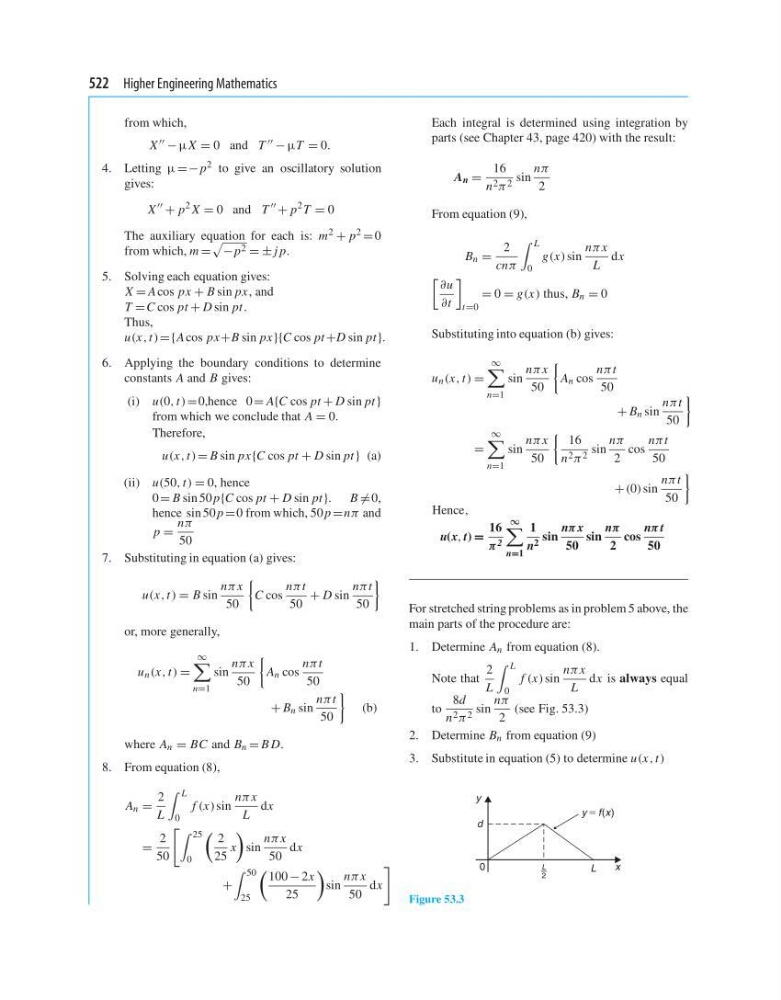
Note that
2
L
L
0
f (x) sin
nπ x
L
dx is always equal
to
8d
n 2 π 2 sin
nπ
2
(see Fig. 53.3)
2. Determine B n from equation (9)
3. Substitute in equation (5) to determine u(x, t )
0
x
y 5 f (x )
L
d
y
L
2
Figure 53.3
from which,
X − μX = 0 and T − μT = 0.
4. Letting μ =−p 2 to give an oscillatory solution
gives:
X
+ p
2 X = 0 and T
+ p
2 T = 0
The auxiliary equation for each is: m 2 + p 2 = 0
from which, m =
− p 2 = ± j p.
5. Solving each equation gives:
X = A cos px + B sin px, and
T = C cos pt + D sin pt .
Thus,
u(x, t ) ={A cos px+B sin px}{C cos pt +D sin pt }.
6. Applying the boundary conditions to determine
constants A and B gives:
(i) u(0, t ) =0,hence 0 = A{C cos pt + D sin pt }
from which we conclude that A = 0.
Therefore,
u(x, t ) = B sin px{C cos pt + D sin pt } (a)
(ii) u(50, t ) = 0, hence
0 = B sin 50 p{C cos pt + D sin pt }. B = 0,
hence sin 50 p =0 from which, 50 p =nπ and
p =
nπ
50
7. Substituting in equation (a) gives:
u(x, t ) = B sin
nπ x
50
C cos
nπt
50
+ D sin
nπt
50
or, more generally,
u n (x, t ) =
∞
n=1
sin
nπ x
50
A n cos
nπt
50
+ B n sin
nπt
50
(b)
where A n = BC and B n = B D.
8. From equation (8),
A n =
2
L
L
0
f (x) sin
nπ x
L
dx
=
2
50
25
0
2
25
x
sin
nπ x
50
dx
+
50
25
100 − 2x
25
sin
nπ x
50
dx
Each integral is determined using integration by
parts (see Chapter 43, page 420) with the result:
A n =
16
n 2 π 2 sin
nπ
2
From equation (9),
B n =
2
cnπ
L
0
g(x) sin
nπ x
L
dx
∂u
∂t
t =0
= 0 = g(x) thus, B n = 0
Substituting into equation (b) gives:
u n (x, t ) =
∞
n=1
sin
nπ x
50
A n cos
nπt
50
+ B n sin
nπt
50
=
∞
n=1
sin
nπ x
50
16
n 2 π 2 sin
nπ
2
cos
nπt
50
+ (0) sin
nπt
50
Hence,
u(x, t) =
16
π 2
∞
n=1
1
n 2 sin
nπx
50
sin
nπ
2
cos
nπ t
50
For stretched string problems as in problem 5 above, the
main parts of the procedure are:
1. Determine A n from equation (8).
Note that
2
L
L
0
f (x) sin
nπ x
L
dx is always equal
to
8d
n 2 π 2 sin
nπ
2
(see Fig. 53.3)
2. Determine B n from equation (9)
3. Substitute in equation (5) to determine u(x, t )
0
x
y 5 f (x )
L
d
y
L
2
Figure 53.3