

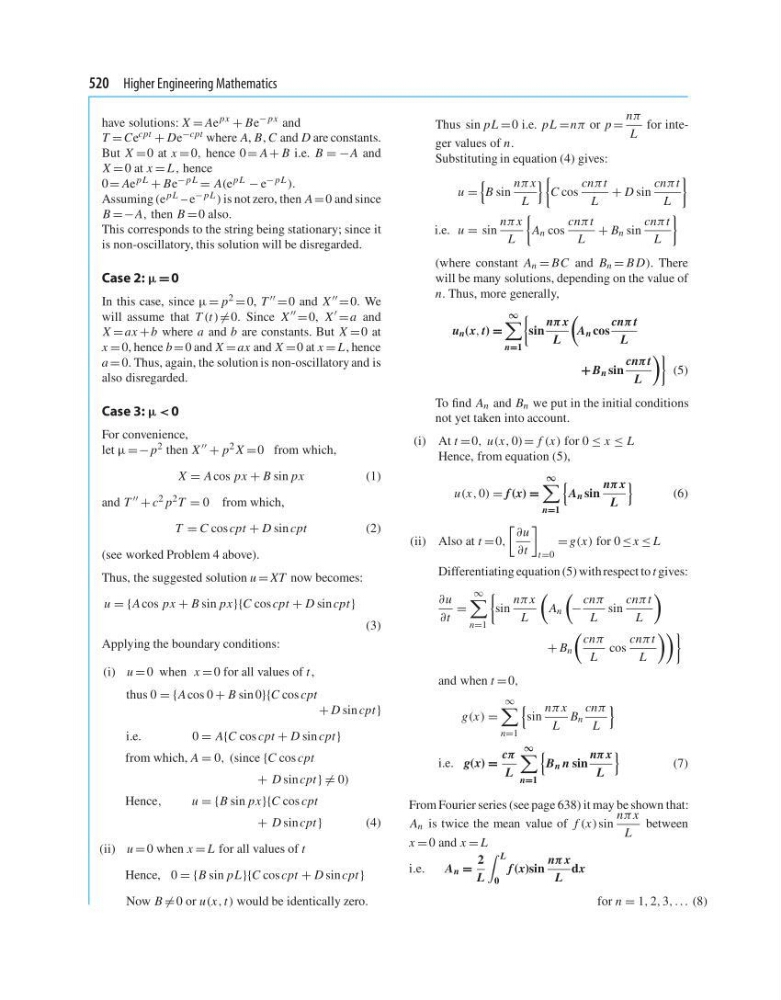
520 Higher Engineering Mathematics
have solutions: X = Ae
px
+ Be
− px and
T = Ce cpt + De −cpt where A, B, C and D are constants.
But X =0 at x = 0, hence 0 = A + B i.e. B = −A and
X = 0 at x = L , hence
0 = Ae pL + Be − pL = A(e pL − e − pL ).
Assuming (e pL – e − pL ) is not zero, then A = 0 and since
B =−A, then B = 0 also.
This corresponds to the string being stationary; since it
is non-oscillatory, this solution will be disregarded.
Case 2: μ = 0
In this case, since μ = p 2 = 0, T = 0 and X = 0. We
will assume that T (t ) =0. Since X
= 0, X
= a and
X = ax + b where a and b are constants. But X =0 at
x = 0, hence b = 0 and X = ax and X =0 at x = L, hence
a = 0. Thus, again, the solution is non-oscillatory and is
also disregarded.
Case 3: μ < 0
For convenience,
let μ =− p 2 then X + p 2 X =0 from which,
X = A cos px + B sin px
(1)
and T + c 2 p 2 T = 0 from which,
T = C cos cpt + D sin cpt
(2)
(see worked Problem 4 above).
Thus, the suggested solution u = XT now becomes:
u = {A cos px + B sin px}{C cos cpt + D sin cpt }
(3)
Applying the boundary conditions:
(i) u = 0 when x = 0 for all values of t ,
thus 0 = {A cos 0 + B sin 0}{C cos cpt
+ D sin cpt }
i.e.
0 = A{C cos cpt + D sin cpt }
from which, A = 0, (since {C cos cpt
+ D sin cpt } } = 0)
Hence,
u = {B sin px}{C cos cpt
+ D sin cpt }
(4)
(ii) u = 0 when x = L for all values of t
Hence, 0 = {B sin pL}{C cos cpt + D sin cpt }
Now B = 0 or u(x, t ) would be identically zero.
Thus sin pL =0 i.e. pL =nπ or p =
nπ
L
for integer values of n.
Substituting in equation (4) gives:
u =
B sin
nπ x
L
C cos
cnπt
L
+ D sin
cnπt
L
i.e. u = sin
nπ x
L
A n cos
cnπt
L
+ B n sin
cnπt
L
(where constant A n = BC and B n = B D). There
will be many solutions, depending on the value of
n. Thus, more generally,
u n (x, t) =
∞
n=1
sin
nπx
L
A n cos
cnπ t
L
+ B n sin
cnπt
L
(5)
To find A n and B n we put in the initial conditions
not yet taken into account.
(i) At t = 0, u(x, 0) = f (x) for 0 ≤ x ≤ L
Hence, from equation (5),
u(x, 0) = f (x) =
∞
n=1
A n sin
nπx
L
(6)
(ii) Also at t = 0,
∂u
∂t
t =0
= g(x) for 0 ≤ x ≤ L
Differentiating equation (5) with respect to t gives:
∂u
∂t
=
∞
n=1
sin
nπ x
L
A n
−
cnπ
L
sin
cnπt
L
+ B n
cnπ
L
cos
cnπt
L
and when t = 0,
g(x) =
∞
n=1
sin
nπ x
L
B n
cnπ
L
i.e. g(x) =
cπ
L
∞
n=1
B n n sin
nπx
L
(7)
From Fourier series (see page 638) it may be shown that:
A n is twice the mean value of f (x) sin
nπ x
L
between
x = 0 and x = L
i.e.
A n =
2
L
L
0
f (x)sin
nπ x
L
dx
for n = 1, 2, 3, ... (8)
have solutions: X = Ae
px
+ Be
− px and
T = Ce cpt + De −cpt where A, B, C and D are constants.
But X =0 at x = 0, hence 0 = A + B i.e. B = −A and
X = 0 at x = L , hence
0 = Ae pL + Be − pL = A(e pL − e − pL ).
Assuming (e pL – e − pL ) is not zero, then A = 0 and since
B =−A, then B = 0 also.
This corresponds to the string being stationary; since it
is non-oscillatory, this solution will be disregarded.
Case 2: μ = 0
In this case, since μ = p 2 = 0, T = 0 and X = 0. We
will assume that T (t ) =0. Since X
= 0, X
= a and
X = ax + b where a and b are constants. But X =0 at
x = 0, hence b = 0 and X = ax and X =0 at x = L, hence
a = 0. Thus, again, the solution is non-oscillatory and is
also disregarded.
Case 3: μ < 0
For convenience,
let μ =− p 2 then X + p 2 X =0 from which,
X = A cos px + B sin px
(1)
and T + c 2 p 2 T = 0 from which,
T = C cos cpt + D sin cpt
(2)
(see worked Problem 4 above).
Thus, the suggested solution u = XT now becomes:
u = {A cos px + B sin px}{C cos cpt + D sin cpt }
(3)
Applying the boundary conditions:
(i) u = 0 when x = 0 for all values of t ,
thus 0 = {A cos 0 + B sin 0}{C cos cpt
+ D sin cpt }
i.e.
0 = A{C cos cpt + D sin cpt }
from which, A = 0, (since {C cos cpt
+ D sin cpt } } = 0)
Hence,
u = {B sin px}{C cos cpt
+ D sin cpt }
(4)
(ii) u = 0 when x = L for all values of t
Hence, 0 = {B sin pL}{C cos cpt + D sin cpt }
Now B = 0 or u(x, t ) would be identically zero.
Thus sin pL =0 i.e. pL =nπ or p =
nπ
L
for integer values of n.
Substituting in equation (4) gives:
u =
B sin
nπ x
L
C cos
cnπt
L
+ D sin
cnπt
L
i.e. u = sin
nπ x
L
A n cos
cnπt
L
+ B n sin
cnπt
L
(where constant A n = BC and B n = B D). There
will be many solutions, depending on the value of
n. Thus, more generally,
u n (x, t) =
∞
n=1
sin
nπx
L
A n cos
cnπ t
L
+ B n sin
cnπt
L
(5)
To find A n and B n we put in the initial conditions
not yet taken into account.
(i) At t = 0, u(x, 0) = f (x) for 0 ≤ x ≤ L
Hence, from equation (5),
u(x, 0) = f (x) =
∞
n=1
A n sin
nπx
L
(6)
(ii) Also at t = 0,
∂u
∂t
t =0
= g(x) for 0 ≤ x ≤ L
Differentiating equation (5) with respect to t gives:
∂u
∂t
=
∞
n=1
sin
nπ x
L
A n
−
cnπ
L
sin
cnπt
L
+ B n
cnπ
L
cos
cnπt
L
and when t = 0,
g(x) =
∞
n=1
sin
nπ x
L
B n
cnπ
L
i.e. g(x) =
cπ
L
∞
n=1
B n n sin
nπx
L
(7)
From Fourier series (see page 638) it may be shown that:
A n is twice the mean value of f (x) sin
nπ x
L
between
x = 0 and x = L
i.e.
A n =
2
L
L
0
f (x)sin
nπ x
L
dx
for n = 1, 2, 3, ... (8)