

Solution of first order differential equations by separation of variables 445
x
10
20
30
y
y ϭ 2 x 2
ϩ 1 5
y ϭ 2 x 2
ϩ 8
y
ϭ 2 x 2
Ϫ 6
y ϭ 2 x 2
Ϫ1
Ϫ10
Ϫ2
Ϫ3
Ϫ4
1
0
2
3
4
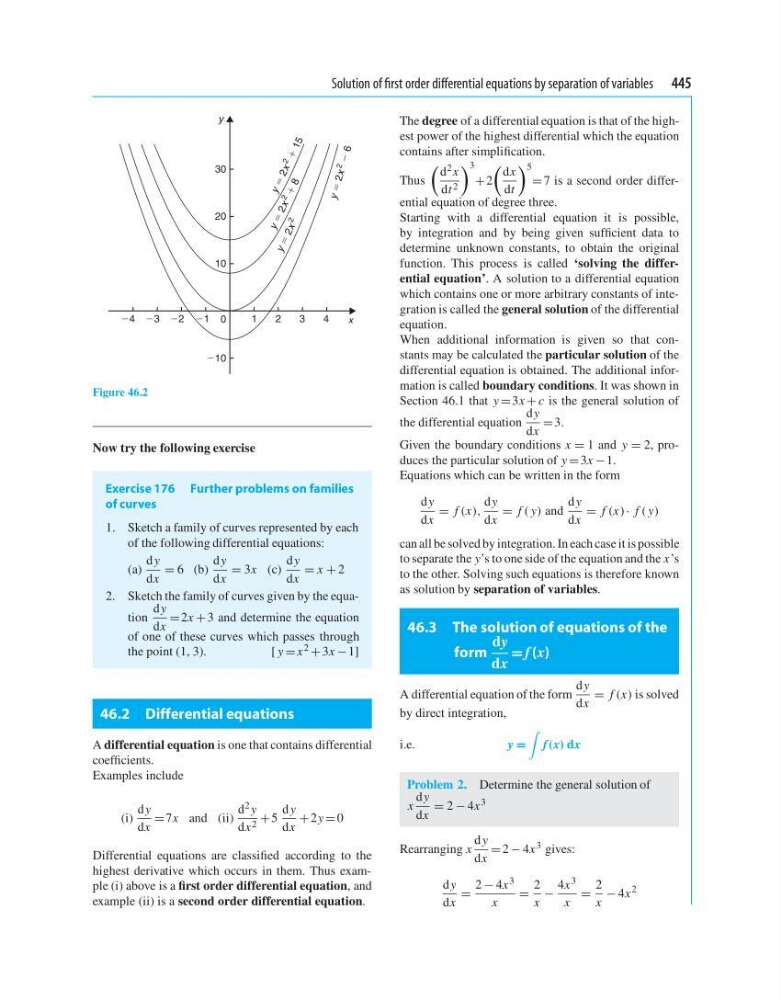
Figure 46.2
Now try the following exercise
Exercise 176 Further problems on families
of curves
1. Sketch a family of curves represented by each
of the following differential equations:
(a)
d y
dx
= 6 (b)
d y
dx
= 3x (c)
d y
dx
= x + 2
2. Sketch the family of curves given by the equation
d y
dx
= 2x + 3 and determine the equation
of one of these curves which passes through
the point (1, 3).
[ y = x 2 + 3x − 1]
46.2 Differential equations
A differential equation is one that contains differential
coefficients.
Examples include
(i)
d y
dx
= 7x and (ii)
d 2 y
dx 2 + 5
d y
dx
+ 2y = 0
Differential equations are classified according to the
highest derivative which occurs in them. Thus example (i) above is a first order differential equation, and
example (ii) is a second order differential equation.
The degree of a differential equation is that of the highest power of the highest differential which the equation
contains after simplification.
Thus
d 2 x
dt 2
3
+ 2
dx
dt
5
= 7 is a second order differential equation of degree three.
Starting with a differential equation it is possible,
by integration and by being given sufficient data to
determine unknown constants, to obtain the original
function. This process is called ‘solving the differential equation’. A solution to a differential equation
which contains one or more arbitrary constants of integration is called the general solution of the differential
equation.
When additional information is given so that constants may be calculated the particular solution of the
differential equation is obtained. The additional information is called boundary conditions. It was shown in
Section 46.1 that y = 3x + c is the general solution of
the differential equation
d y
dx
= 3.
Given the boundary conditions x = 1 and y = 2, produces the particular solution of y = 3x − 1.
Equations which can be written in the form
d y
dx
= f (x),
d y
dx
= f ( y) and
d y
dx
= f (x) · f ( y)
can all be solved by integration. In each case it is possible
to separate the y’s to one side of the equation and the x’s
to the other. Solving such equations is therefore known
as solution by separation of variables.
46.3 The solution of equations of the
form
dy
dx
= f (x)
A differential equation of the form
d y
dx
= f (x) is solved
by direct integration,
i.e.
y =
f (x) dx
Problem 2. Determine the general solution of
x
d y
dx
= 2 − 4x 3
Rearranging x
d y
dx
= 2 − 4x 3 gives:
d y
dx
=
2 − 4x 3
x
=
2
x
−
4x 3
x
=
2
x
− 4x
2
x
10
20
30
y
y ϭ 2 x 2
ϩ 1 5
y ϭ 2 x 2
ϩ 8
y
ϭ 2 x 2
Ϫ 6
y ϭ 2 x 2
Ϫ1
Ϫ10
Ϫ2
Ϫ3
Ϫ4
1
0
2
3
4
Figure 46.2
Now try the following exercise
Exercise 176 Further problems on families
of curves
1. Sketch a family of curves represented by each
of the following differential equations:
(a)
d y
dx
= 6 (b)
d y
dx
= 3x (c)
d y
dx
= x + 2
2. Sketch the family of curves given by the equation
d y
dx
= 2x + 3 and determine the equation
of one of these curves which passes through
the point (1, 3).
[ y = x 2 + 3x − 1]
46.2 Differential equations
A differential equation is one that contains differential
coefficients.
Examples include
(i)
d y
dx
= 7x and (ii)
d 2 y
dx 2 + 5
d y
dx
+ 2y = 0
Differential equations are classified according to the
highest derivative which occurs in them. Thus example (i) above is a first order differential equation, and
example (ii) is a second order differential equation.
The degree of a differential equation is that of the highest power of the highest differential which the equation
contains after simplification.
Thus
d 2 x
dt 2
3
+ 2
dx
dt
5
= 7 is a second order differential equation of degree three.
Starting with a differential equation it is possible,
by integration and by being given sufficient data to
determine unknown constants, to obtain the original
function. This process is called ‘solving the differential equation’. A solution to a differential equation
which contains one or more arbitrary constants of integration is called the general solution of the differential
equation.
When additional information is given so that constants may be calculated the particular solution of the
differential equation is obtained. The additional information is called boundary conditions. It was shown in
Section 46.1 that y = 3x + c is the general solution of
the differential equation
d y
dx
= 3.
Given the boundary conditions x = 1 and y = 2, produces the particular solution of y = 3x − 1.
Equations which can be written in the form
d y
dx
= f (x),
d y
dx
= f ( y) and
d y
dx
= f (x) · f ( y)
can all be solved by integration. In each case it is possible
to separate the y’s to one side of the equation and the x’s
to the other. Solving such equations is therefore known
as solution by separation of variables.
46.3 The solution of equations of the
form
dy
dx
= f (x)
A differential equation of the form
d y
dx
= f (x) is solved
by direct integration,
i.e.
y =
f (x) dx
Problem 2. Determine the general solution of
x
d y
dx
= 2 − 4x 3
Rearranging x
d y
dx
= 2 − 4x 3 gives:
d y
dx
=
2 − 4x 3
x
=
2
x
−
4x 3
x
=
2
x
− 4x
2