

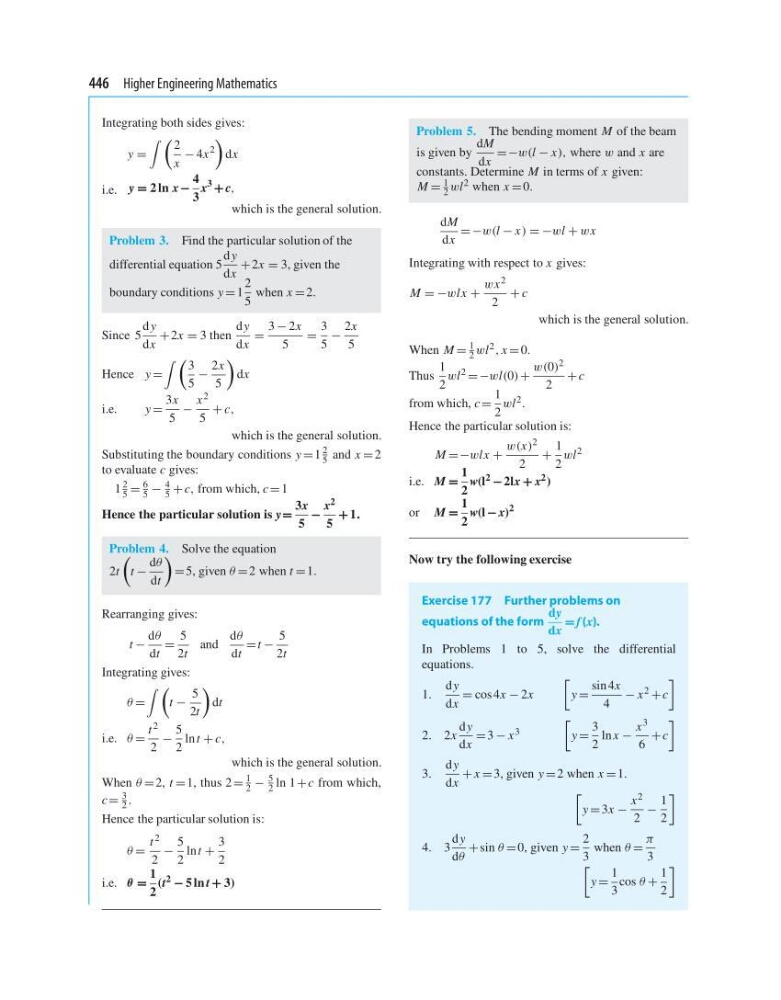
446 Higher Engineering Mathematics
Integrating both sides gives:
y =
2
x
− 4x
2
dx
i.e. y = 2 ln x −
4
3
x
3
+ c,
which is the general solution.
Problem 3. Find the particular solution of the
differential equation 5
d y
dx
+ 2x = 3, given the
boundary conditions y = 1
2
5
when x = 2.
Since 5
d y
dx
+ 2x = 3 then
d y
dx
=
3 − 2x
5
=
3
5
−
2x
5
Hence y =
3
5
−
2x
5
dx
i.e.
y =
3x
5
−
x 2
5
+ c,
which is the general solution.
Substituting the boundary conditions y = 1
2
5 and x = 2
to evaluate c gives:
1
2
5 =
6
5 −
4
5 + c, from which, c = 1
Hence the particular solution is y =
3x
5
−
x 2
5
+ 1.
Problem 4. Solve the equation
2t
t −
dθ
dt
= 5, given θ = 2 when t = 1.
Rearranging gives:
t −
dθ
dt
=
5
2t
and
dθ
dt
= t −
5
2t
Integrating gives:
θ =
t −
5
2t
dt
i.e. θ =
t 2
2
−
5
2
ln t + c,
which is the general solution.
When θ = 2, t = 1, thus 2 =
1
2 −
5
2 ln 1 + c from which,
c =
3
2 .
Hence the particular solution is:
θ =
t 2
2
−
5
2
ln t +
3
2
i.e. θ =
1
2
(t 2 − 5 ln t + 3)
Problem 5. The bending moment M of the beam
is given by
dM
dx
=−w(l − x), where w and x are
constants. Determine M in terms of x given:
M =
1
2 wl 2 when x = 0.
dM
dx
=−w(l − x) = −wl + wx
Integrating with respect to x gives:
M = −wlx +
wx 2
2
+ c
which is the general solution.
When M =
1
2 wl 2 , x = 0.
Thus
1
2
wl 2 =−wl(0) +
w(0) 2
2
+ c
from which, c =
1
2
wl 2 .
Hence the particular solution is:
M =−wlx +
w(x) 2
2
+
1
2
wl 2
i.e. M =
1
2
w(l 2 − 2lx + x 2 )
or M =
1
2
w(l − x)
2
Now try the following exercise
Exercise 177 Further problems on
equations of the form
dy
dx
= f (x).
In Problems 1 to 5, solve the differential
equations.
1.
d y
dx
= cos 4x − 2x
y =
sin 4x
4
− x 2 + c
2. 2x
d y
dx
= 3 − x 3
y =
3
2
ln x −
x
3
6
+ c
3.
d y
dx
+ x = 3, given y = 2 when x = 1.
y = 3x −
x 2
2
−
1
2
4. 3
d y
dθ
+ sin θ = 0, given y =
2
3
when θ =
π
3
y =
1
3
cos θ +
1
2
Integrating both sides gives:
y =
2
x
− 4x
2
dx
i.e. y = 2 ln x −
4
3
x
3
+ c,
which is the general solution.
Problem 3. Find the particular solution of the
differential equation 5
d y
dx
+ 2x = 3, given the
boundary conditions y = 1
2
5
when x = 2.
Since 5
d y
dx
+ 2x = 3 then
d y
dx
=
3 − 2x
5
=
3
5
−
2x
5
Hence y =
3
5
−
2x
5
dx
i.e.
y =
3x
5
−
x 2
5
+ c,
which is the general solution.
Substituting the boundary conditions y = 1
2
5 and x = 2
to evaluate c gives:
1
2
5 =
6
5 −
4
5 + c, from which, c = 1
Hence the particular solution is y =
3x
5
−
x 2
5
+ 1.
Problem 4. Solve the equation
2t
t −
dθ
dt
= 5, given θ = 2 when t = 1.
Rearranging gives:
t −
dθ
dt
=
5
2t
and
dθ
dt
= t −
5
2t
Integrating gives:
θ =
t −
5
2t
dt
i.e. θ =
t 2
2
−
5
2
ln t + c,
which is the general solution.
When θ = 2, t = 1, thus 2 =
1
2 −
5
2 ln 1 + c from which,
c =
3
2 .
Hence the particular solution is:
θ =
t 2
2
−
5
2
ln t +
3
2
i.e. θ =
1
2
(t 2 − 5 ln t + 3)
Problem 5. The bending moment M of the beam
is given by
dM
dx
=−w(l − x), where w and x are
constants. Determine M in terms of x given:
M =
1
2 wl 2 when x = 0.
dM
dx
=−w(l − x) = −wl + wx
Integrating with respect to x gives:
M = −wlx +
wx 2
2
+ c
which is the general solution.
When M =
1
2 wl 2 , x = 0.
Thus
1
2
wl 2 =−wl(0) +
w(0) 2
2
+ c
from which, c =
1
2
wl 2 .
Hence the particular solution is:
M =−wlx +
w(x) 2
2
+
1
2
wl 2
i.e. M =
1
2
w(l 2 − 2lx + x 2 )
or M =
1
2
w(l − x)
2
Now try the following exercise
Exercise 177 Further problems on
equations of the form
dy
dx
= f (x).
In Problems 1 to 5, solve the differential
equations.
1.
d y
dx
= cos 4x − 2x
y =
sin 4x
4
− x 2 + c
2. 2x
d y
dx
= 3 − x 3
y =
3
2
ln x −
x
3
6
+ c
3.
d y
dx
+ x = 3, given y = 2 when x = 1.
y = 3x −
x 2
2
−
1
2
4. 3
d y
dθ
+ sin θ = 0, given y =
2
3
when θ =
π
3
y =
1
3
cos θ +
1
2