

Chapter 46
Solution of first order
differential equations by
separation of variables
46.1 Family of curves
Integrating both sides of the derivative
dy
dx
= 3 with
respect to x gives y =
3 dx, i.e., y = 3x + c, where c
is an arbitrary constant.
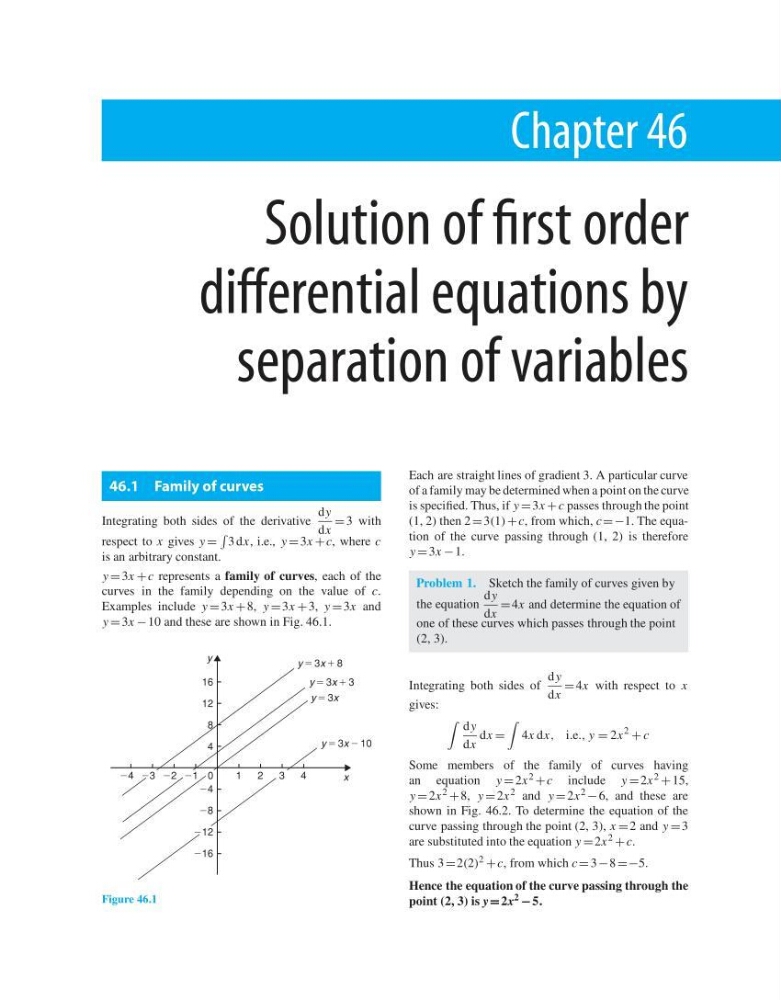
y = 3x + c represents a family of curves, each of the
curves in the family depending on the value of c.
Examples include y = 3x + 8, y = 3x + 3, y = 3x and
y = 3x − 10 and these are shown in Fig. 46.1.
216
212
28
24
21
22
23
24
4
x
8
12
16
y
y 5 3x 1 8
y 5 3x 1 3
y 5 3x 2 10
y 5 3x
1
0
2
3
4
Figure 46.1
Each are straight lines of gradient 3. A particular curve
of a family may be determined when a point on the curve
is specified. Thus, if y = 3x + c passes through the point
(1, 2) then 2 = 3(1) + c, from which, c =−1. The equation of the curve passing through (1, 2) is therefore
y = 3x − 1.
Problem 1. Sketch the family of curves given by
the equation
d y
dx
= 4x and determine the equation of
one of these curves which passes through the point
(2, 3).
Integrating both sides of
d y
dx
= 4x with respect to x
gives:
d y
dx
dx =
4x dx, i.e., y = 2x
2
+ c
Some members of the family of curves having
an equation y = 2x 2 + c include y = 2x 2 + 15,
y = 2x 2 + 8, y = 2x 2 and y = 2x 2 − 6, and these are
shown in Fig. 46.2. To determine the equation of the
curve passing through the point (2, 3), x = 2 and y = 3
are substituted into the equation y = 2x 2 + c.
Thus 3 =2(2) 2 + c, from which c = 3 −8 =−5.
Hence the equation of the curve passing through the
point (2, 3) is y = 2x 2 − 5.
Solution of first order
differential equations by
separation of variables
46.1 Family of curves
Integrating both sides of the derivative
dy
dx
= 3 with
respect to x gives y =
3 dx, i.e., y = 3x + c, where c
is an arbitrary constant.
y = 3x + c represents a family of curves, each of the
curves in the family depending on the value of c.
Examples include y = 3x + 8, y = 3x + 3, y = 3x and
y = 3x − 10 and these are shown in Fig. 46.1.
216
212
28
24
21
22
23
24
4
x
8
12
16
y
y 5 3x 1 8
y 5 3x 1 3
y 5 3x 2 10
y 5 3x
1
0
2
3
4
Figure 46.1
Each are straight lines of gradient 3. A particular curve
of a family may be determined when a point on the curve
is specified. Thus, if y = 3x + c passes through the point
(1, 2) then 2 = 3(1) + c, from which, c =−1. The equation of the curve passing through (1, 2) is therefore
y = 3x − 1.
Problem 1. Sketch the family of curves given by
the equation
d y
dx
= 4x and determine the equation of
one of these curves which passes through the point
(2, 3).
Integrating both sides of
d y
dx
= 4x with respect to x
gives:
d y
dx
dx =
4x dx, i.e., y = 2x
2
+ c
Some members of the family of curves having
an equation y = 2x 2 + c include y = 2x 2 + 15,
y = 2x 2 + 8, y = 2x 2 and y = 2x 2 − 6, and these are
shown in Fig. 46.2. To determine the equation of the
curve passing through the point (2, 3), x = 2 and y = 3
are substituted into the equation y = 2x 2 + c.
Thus 3 =2(2) 2 + c, from which c = 3 −8 =−5.
Hence the equation of the curve passing through the
point (2, 3) is y = 2x 2 − 5.