

Some applications of integration 389
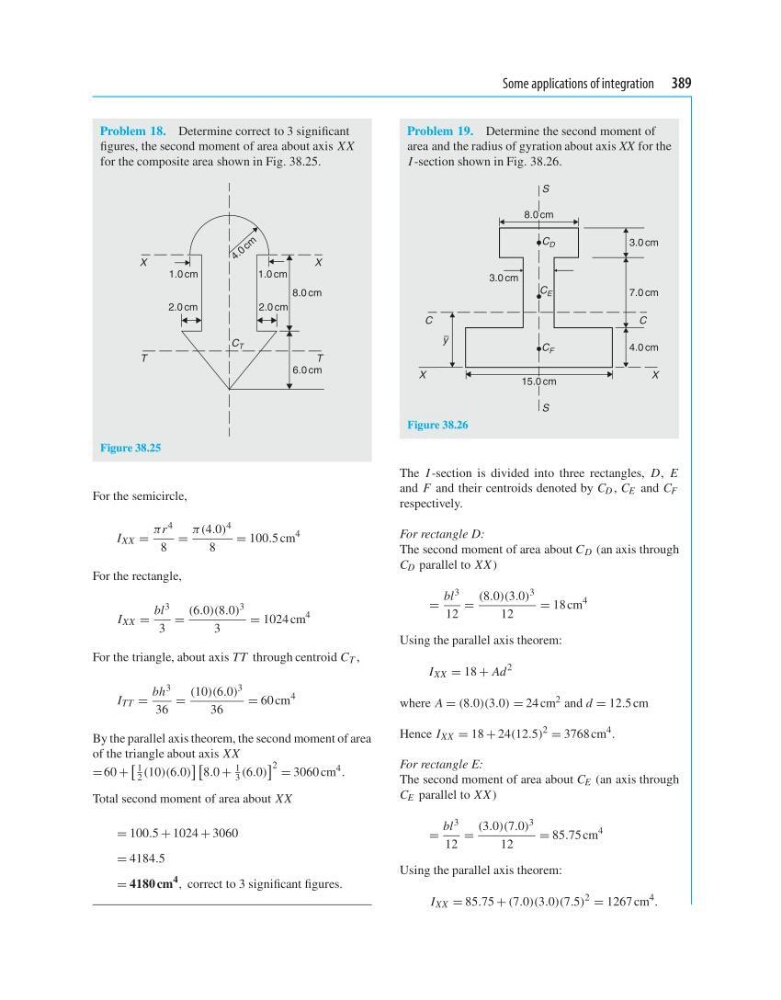
Problem 18. Determine correct to 3 significant
figures, the second moment of area about axis XX
for the composite area shown in Fig. 38.25.
4 . 0 c m
1.0 cm
1.0 cm
8.0 cm
C T
X
X
2.0 cm
6.0 cm
2.0 cm
T
T
Figure 38.25
For the semicircle,
I XX =
πr 4
8
=
π(4.0) 4
8
= 100.5 cm
4
For the rectangle,
I XX =
bl 3
3
=
(6.0)(8.0) 3
3
= 1024 cm
4
For the triangle, about axis TT through centroid C T ,
I TT =
bh 3
36
=
(10)(6.0) 3
36
= 60 cm
4
By the parallel axis theorem, the second moment of area
of the triangle about axis XX
= 60 +
1
2 (10)(6.0)
8.0 +
1
3 (6.0)
2 = 3060 cm
4
.
Total second moment of area about XX
= 100.5 + 1024 + 3060
= 4184.5
= 4180 cm
4
, correct to 3 significant figures.
Problem 19. Determine the second moment of
area and the radius of gyration about axis XX for the
I -section shown in Fig. 38.26.
C F
C E
C D
3.0 cm
7.0 cm
4.0 cm
3.0 cm
y
C
C
X
X
S
S
15.0 cm
8.0 cm
Figure 38.26
The I -section is divided into three rectangles, D, E
and F and their centroids denoted by C D , C E and C F
respectively.
For rectangle D:
The second moment of area about C D (an axis through
C D parallel to XX )
=
bl 3
12
=
(8.0)(3.0) 3
12
= 18 cm
4
Using the parallel axis theorem:
I XX = 18 + Ad
2
where A = (8.0)(3.0) = 24 cm 2 and d = 12.5 cm
Hence I XX = 18 + 24(12.5)
2
= 3768 cm
4
.
For rectangle E:
The second moment of area about C E (an axis through
C E parallel to XX )
=
bl 3
12
=
(3.0)(7.0) 3
12
= 85.75 cm
4
Using the parallel axis theorem:
I XX = 85.75 + (7.0)(3.0)(7.5)
2
= 1267 cm
4
.
Problem 18. Determine correct to 3 significant
figures, the second moment of area about axis XX
for the composite area shown in Fig. 38.25.
4 . 0 c m
1.0 cm
1.0 cm
8.0 cm
C T
X
X
2.0 cm
6.0 cm
2.0 cm
T
T
Figure 38.25
For the semicircle,
I XX =
πr 4
8
=
π(4.0) 4
8
= 100.5 cm
4
For the rectangle,
I XX =
bl 3
3
=
(6.0)(8.0) 3
3
= 1024 cm
4
For the triangle, about axis TT through centroid C T ,
I TT =
bh 3
36
=
(10)(6.0) 3
36
= 60 cm
4
By the parallel axis theorem, the second moment of area
of the triangle about axis XX
= 60 +
1
2 (10)(6.0)
8.0 +
1
3 (6.0)
2 = 3060 cm
4
.
Total second moment of area about XX
= 100.5 + 1024 + 3060
= 4184.5
= 4180 cm
4
, correct to 3 significant figures.
Problem 19. Determine the second moment of
area and the radius of gyration about axis XX for the
I -section shown in Fig. 38.26.
C F
C E
C D
3.0 cm
7.0 cm
4.0 cm
3.0 cm
y
C
C
X
X
S
S
15.0 cm
8.0 cm
Figure 38.26
The I -section is divided into three rectangles, D, E
and F and their centroids denoted by C D , C E and C F
respectively.
For rectangle D:
The second moment of area about C D (an axis through
C D parallel to XX )
=
bl 3
12
=
(8.0)(3.0) 3
12
= 18 cm
4
Using the parallel axis theorem:
I XX = 18 + Ad
2
where A = (8.0)(3.0) = 24 cm 2 and d = 12.5 cm
Hence I XX = 18 + 24(12.5)
2
= 3768 cm
4
.
For rectangle E:
The second moment of area about C E (an axis through
C E parallel to XX )
=
bl 3
12
=
(3.0)(7.0) 3
12
= 85.75 cm
4
Using the parallel axis theorem:
I XX = 85.75 + (7.0)(3.0)(7.5)
2
= 1267 cm
4
.