

390 Higher Engineering Mathematics
For rectangle F:
I XX =
bl 3
3
=
(15.0)(4.0) 3
3
= 320 cm
4
Total second moment of area for the I-section about
axis XX,
I XX = 3768 + 1267 + 320 = 5355 cm
4
Total area of I -section
= (8.0)(3.0) + (3.0)(7.0) + (15.0)(4.0)
= 105 cm
2
.
Radius of gyration,
k XX =
I XX
area
=
5355
105
= 7.14 cm
Now try the following exercise
Exercise 152 Further problems on second
moment of areas of regular sections
1. Determine the second moment of area and
radius of gyration for the rectangle shown in
Fig. 38.27 about (a) axis AA (b) axis BB and
(c) axis CC.
⎡
⎣
(a) 72 cm 4 , 1.73 cm
(b) 128 cm 4 , 2.31 cm
(c) 512 cm 4 , 4.62 cm
⎤
⎦
8.0 cm
B
B
C
A
A
C
3.0 cm
Figure 38.27
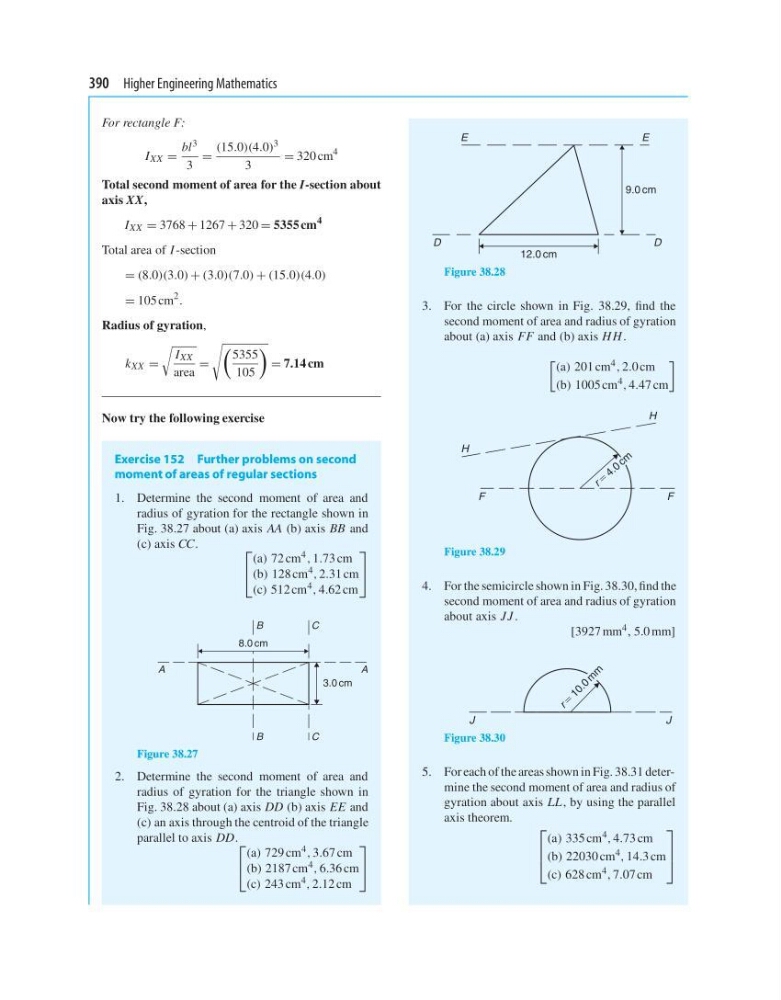
2. Determine the second moment of area and
radius of gyration for the triangle shown in
Fig. 38.28 about (a) axis DD (b) axis EE and
(c) an axis through the centroid of the triangle
parallel to axis DD. ⎡
⎣
(a) 729 cm 4 , 3.67 cm
(b) 2187 cm 4 , 6.36 cm
(c) 243 cm 4 , 2.12 cm
⎤
⎦
12.0 cm
9.0 cm
D
D
E
E
Figure 38.28
3. For the circle shown in Fig. 38.29, find the
second moment of area and radius of gyration
about (a) axis FF and (b) axis HH .
(a) 201 cm 4 , 2.0 cm
(b) 1005 cm 4 , 4.47 cm
r 5
4 . 0 c m
F
H
H
F
Figure 38.29
4. For the semicircle shown in Fig. 38.30, find the
second moment of area and radius of gyration
about axis JJ .
[3927 mm 4 , 5.0 mm]
J
J
r 5
1 0 . 0 m
m
Figure 38.30
5. For each of the areas shown in Fig. 38.31 determine the second moment of area and radius of
gyration about axis LL, by using the parallel
axis theorem.
⎡
⎢
⎣
(a) 335 cm 4 , 4.73 cm
(b) 22030 cm 4 , 14.3 cm
(c) 628 cm 4 , 7.07 cm
⎤
⎥
⎦
For rectangle F:
I XX =
bl 3
3
=
(15.0)(4.0) 3
3
= 320 cm
4
Total second moment of area for the I-section about
axis XX,
I XX = 3768 + 1267 + 320 = 5355 cm
4
Total area of I -section
= (8.0)(3.0) + (3.0)(7.0) + (15.0)(4.0)
= 105 cm
2
.
Radius of gyration,
k XX =
I XX
area
=
5355
105
= 7.14 cm
Now try the following exercise
Exercise 152 Further problems on second
moment of areas of regular sections
1. Determine the second moment of area and
radius of gyration for the rectangle shown in
Fig. 38.27 about (a) axis AA (b) axis BB and
(c) axis CC.
⎡
⎣
(a) 72 cm 4 , 1.73 cm
(b) 128 cm 4 , 2.31 cm
(c) 512 cm 4 , 4.62 cm
⎤
⎦
8.0 cm
B
B
C
A
A
C
3.0 cm
Figure 38.27
2. Determine the second moment of area and
radius of gyration for the triangle shown in
Fig. 38.28 about (a) axis DD (b) axis EE and
(c) an axis through the centroid of the triangle
parallel to axis DD. ⎡
⎣
(a) 729 cm 4 , 3.67 cm
(b) 2187 cm 4 , 6.36 cm
(c) 243 cm 4 , 2.12 cm
⎤
⎦
12.0 cm
9.0 cm
D
D
E
E
Figure 38.28
3. For the circle shown in Fig. 38.29, find the
second moment of area and radius of gyration
about (a) axis FF and (b) axis HH .
(a) 201 cm 4 , 2.0 cm
(b) 1005 cm 4 , 4.47 cm
r 5
4 . 0 c m
F
H
H
F
Figure 38.29
4. For the semicircle shown in Fig. 38.30, find the
second moment of area and radius of gyration
about axis JJ .
[3927 mm 4 , 5.0 mm]
J
J
r 5
1 0 . 0 m
m
Figure 38.30
5. For each of the areas shown in Fig. 38.31 determine the second moment of area and radius of
gyration about axis LL, by using the parallel
axis theorem.
⎡
⎢
⎣
(a) 335 cm 4 , 4.73 cm
(b) 22030 cm 4 , 14.3 cm
(c) 628 cm 4 , 7.07 cm
⎤
⎥
⎦