

388 Higher Engineering Mathematics
The centroid of a semicircle lies at
4r
3π
from its
diameter.
Using the parallel axis theorem:
I BB = I GG + Ad 2 ,
where
I BB =
πr 4
8
(from Table 38.1)
=
π(10.0) 4
8
= 3927 mm 4 ,
A =
πr
2
2
=
π(10.0)
2
2
= 157.1 mm 2
and
d =
4r
3π
=
4(10.0)
3π
= 4.244 mm
Hence
3927 = I GG + (157.1)(4.244) 2
i.e.
3927 = I GG + 2830,
from which, I GG = 3927 − 2830 = 1097 mm 4
Using the parallel axis theorem again:
I XX = I GG + A(15.0 + 4.244) 2
i.e. I XX = 1097 + (157.1)(19.244) 2
= 1097 + 58 179
= 59276 mm 4 or 59280 mm
4 ,
correct to 4 significant figures.
Radius of gyration, k XX =
I XX
area
=
59 276
157.1
= 19.42 mm
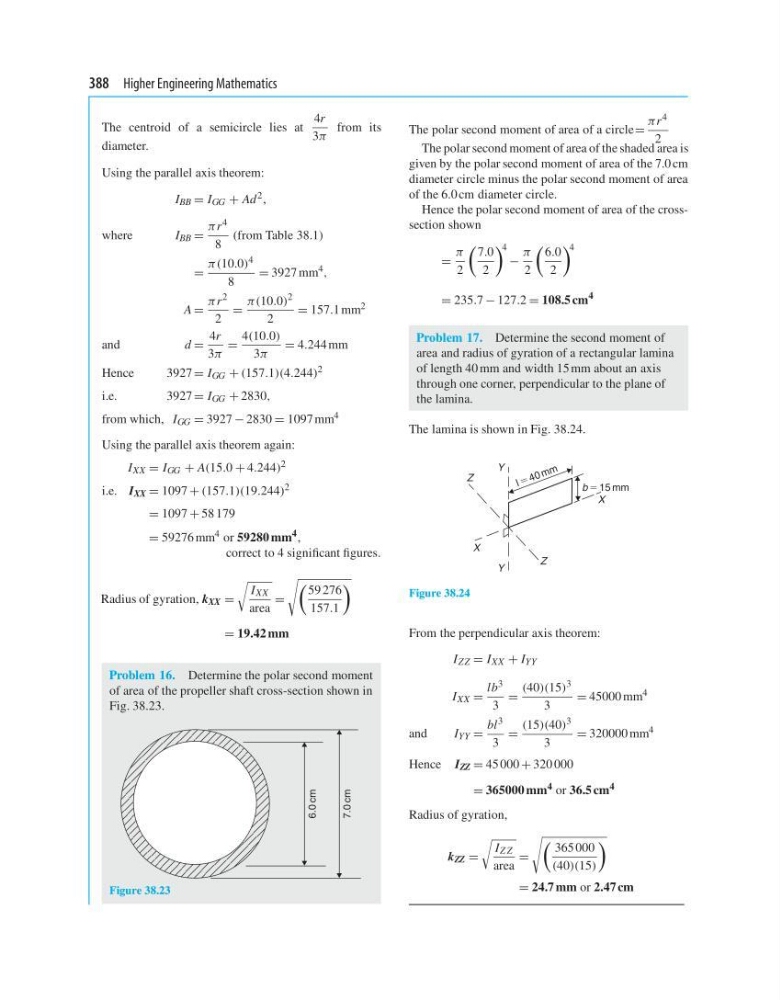
Problem 16. Determine the polar second moment
of area of the propeller shaft cross-section shown in
Fig. 38.23.
6.0 cm
7.0 cm
Figure 38.23
The polar second moment of area of a circle=
πr 4
2
The polar second moment of area of the shaded area is
given by the polar second moment of area of the 7.0 cm
diameter circle minus the polar second moment of area
of the 6.0 cm diameter circle.
Hence the polar second moment of area of the crosssection shown
=
π
2
7.0
2
4
−
π
2
6.0
2
4
= 235.7 − 127.2 = 108.5 cm
4
Problem 17. Determine the second moment of
area and radius of gyration of a rectangular lamina
of length 40 mm and width 15 mm about an axis
through one corner, perpendicular to the plane of
the lamina.
The lamina is shown in Fig. 38.24.
l 5 4 0 m m
b 5 15 mm
X
X
Z
Y
Y
Z
Figure 38.24
From the perpendicular axis theorem:
I ZZ = I XX + I YY
I XX =
lb 3
3
=
(40)(15) 3
3
= 45000 mm 4
and
I YY =
bl 3
3
=
(15)(40) 3
3
= 320000 mm 4
Hence I ZZ = 45 000 + 320 000
= 365000 mm 4 or 36.5 cm 4
Radius of gyration,
k ZZ =
I Z Z
area
=
365 000
(40)(15)
= 24.7 mm or 2.47 cm
The centroid of a semicircle lies at
4r
3π
from its
diameter.
Using the parallel axis theorem:
I BB = I GG + Ad 2 ,
where
I BB =
πr 4
8
(from Table 38.1)
=
π(10.0) 4
8
= 3927 mm 4 ,
A =
πr
2
2
=
π(10.0)
2
2
= 157.1 mm 2
and
d =
4r
3π
=
4(10.0)
3π
= 4.244 mm
Hence
3927 = I GG + (157.1)(4.244) 2
i.e.
3927 = I GG + 2830,
from which, I GG = 3927 − 2830 = 1097 mm 4
Using the parallel axis theorem again:
I XX = I GG + A(15.0 + 4.244) 2
i.e. I XX = 1097 + (157.1)(19.244) 2
= 1097 + 58 179
= 59276 mm 4 or 59280 mm
4 ,
correct to 4 significant figures.
Radius of gyration, k XX =
I XX
area
=
59 276
157.1
= 19.42 mm
Problem 16. Determine the polar second moment
of area of the propeller shaft cross-section shown in
Fig. 38.23.
6.0 cm
7.0 cm
Figure 38.23
The polar second moment of area of a circle=
πr 4
2
The polar second moment of area of the shaded area is
given by the polar second moment of area of the 7.0 cm
diameter circle minus the polar second moment of area
of the 6.0 cm diameter circle.
Hence the polar second moment of area of the crosssection shown
=
π
2
7.0
2
4
−
π
2
6.0
2
4
= 235.7 − 127.2 = 108.5 cm
4
Problem 17. Determine the second moment of
area and radius of gyration of a rectangular lamina
of length 40 mm and width 15 mm about an axis
through one corner, perpendicular to the plane of
the lamina.
The lamina is shown in Fig. 38.24.
l 5 4 0 m m
b 5 15 mm
X
X
Z
Y
Y
Z
Figure 38.24
From the perpendicular axis theorem:
I ZZ = I XX + I YY
I XX =
lb 3
3
=
(40)(15) 3
3
= 45000 mm 4
and
I YY =
bl 3
3
=
(15)(40) 3
3
= 320000 mm 4
Hence I ZZ = 45 000 + 320 000
= 365000 mm 4 or 36.5 cm 4
Radius of gyration,
k ZZ =
I Z Z
area
=
365 000
(40)(15)
= 24.7 mm or 2.47 cm