

Some applications of integration 387
I PP = Ak
2
PP , from which,
k PP =
I PP
area
=
645000
600
= 32.79 mm
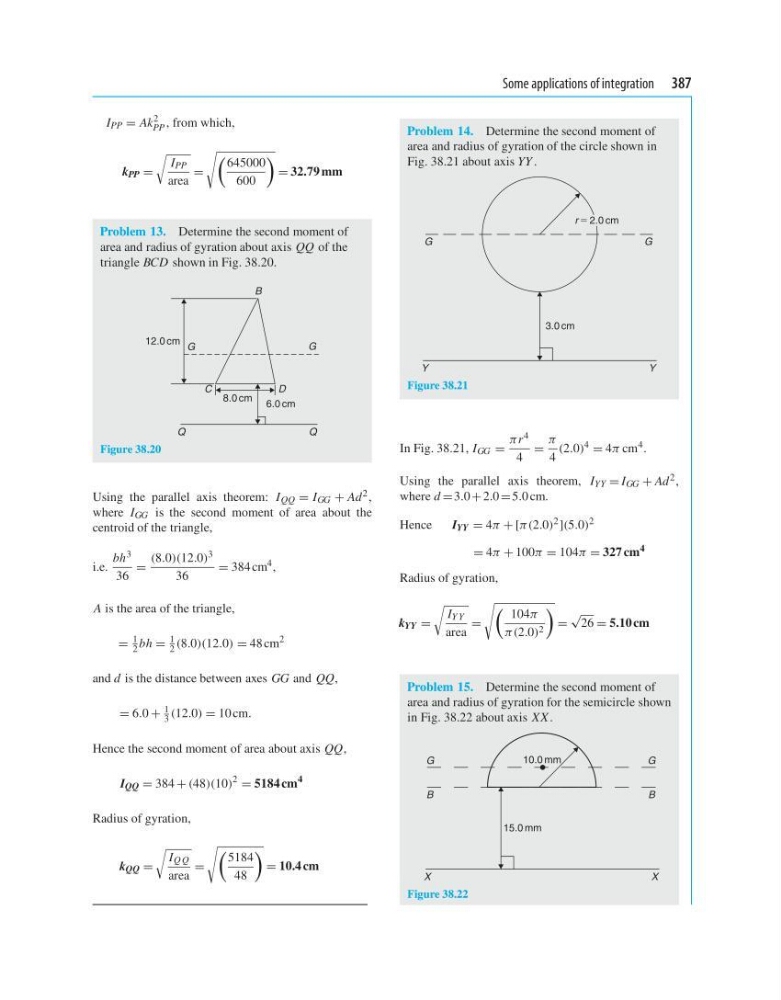
Problem 13. Determine the second moment of
area and radius of gyration about axis QQ of the
triangle BCD shown in Fig. 38.20.
Q
Q
D
C
6.0 cm
12.0 cm
8.0 cm
G
B
G
Figure 38.20
Using the parallel axis theorem: I QQ = I GG + Ad 2 ,
where I GG is the second moment of area about the
centroid of the triangle,
i.e.
bh 3
36
=
(8.0)(12.0) 3
36
= 384 cm 4 ,
A is the area of the triangle,
=
1
2 bh =
1
2 (8.0)(12.0) = 48 cm
2
and d is the distance between axes GG and QQ,
= 6.0 +
1
3 (12.0) = 10 cm.
Hence the second moment of area about axis QQ,
I QQ = 384 + (48)(10)
2
= 5184 cm
4
Radius of gyration,
k QQ =
I Q Q
area
=
5184
48
= 10.4 cm
Problem 14. Determine the second moment of
area and radius of gyration of the circle shown in
Fig. 38.21 about axis YY .
Y
3.0 cm
Y
G
G
r 5 2.0 cm
Figure 38.21
In Fig. 38.21, I GG =
πr 4
4
=
π
4
(2.0) 4 = 4π cm 4 .
Using the parallel axis theorem, I YY = I GG + Ad 2 ,
where d = 3.0 + 2.0 = 5.0 cm.
Hence
I YY = 4π + [π(2.0) 2 ](5.0) 2
= 4π + 100π = 104π = 327 cm 4
Radius of gyration,
k YY =
I Y Y
area
=
104π
π(2.0) 2
=
√
26 = 5.10 cm
Problem 15. Determine the second moment of
area and radius of gyration for the semicircle shown
in Fig. 38.22 about axis XX .
X
X
G
G
B
B
10.0 mm
15.0 mm
Figure 38.22
I PP = Ak
2
PP , from which,
k PP =
I PP
area
=
645000
600
= 32.79 mm
Problem 13. Determine the second moment of
area and radius of gyration about axis QQ of the
triangle BCD shown in Fig. 38.20.
Q
Q
D
C
6.0 cm
12.0 cm
8.0 cm
G
B
G
Figure 38.20
Using the parallel axis theorem: I QQ = I GG + Ad 2 ,
where I GG is the second moment of area about the
centroid of the triangle,
i.e.
bh 3
36
=
(8.0)(12.0) 3
36
= 384 cm 4 ,
A is the area of the triangle,
=
1
2 bh =
1
2 (8.0)(12.0) = 48 cm
2
and d is the distance between axes GG and QQ,
= 6.0 +
1
3 (12.0) = 10 cm.
Hence the second moment of area about axis QQ,
I QQ = 384 + (48)(10)
2
= 5184 cm
4
Radius of gyration,
k QQ =
I Q Q
area
=
5184
48
= 10.4 cm
Problem 14. Determine the second moment of
area and radius of gyration of the circle shown in
Fig. 38.21 about axis YY .
Y
3.0 cm
Y
G
G
r 5 2.0 cm
Figure 38.21
In Fig. 38.21, I GG =
πr 4
4
=
π
4
(2.0) 4 = 4π cm 4 .
Using the parallel axis theorem, I YY = I GG + Ad 2 ,
where d = 3.0 + 2.0 = 5.0 cm.
Hence
I YY = 4π + [π(2.0) 2 ](5.0) 2
= 4π + 100π = 104π = 327 cm 4
Radius of gyration,
k YY =
I Y Y
area
=
104π
π(2.0) 2
=
√
26 = 5.10 cm
Problem 15. Determine the second moment of
area and radius of gyration for the semicircle shown
in Fig. 38.22 about axis XX .
X
X
G
G
B
B
10.0 mm
15.0 mm
Figure 38.22