

378 Higher Engineering Mathematics
In this case,
r.m.s. value =
1
√
2
× 100 = 70.71 V]
Now try the following exercise
Exercise 148 Further problems on mean
and r.m.s. values
1. The vertical height h km of a missile varies
with the horizontal distance d km, and is given
by h = 4d − d 2 . Determine the mean height of
the missile from d = 0 to d = 4 km.
[2
2
3 km].
2. The distances of points y from the mean value
of a frequency distribution are related to the
variate x by the equation y = x +
1
x
. Determine the standard deviation (i.e. the r.m.s.
value), correct to 4 significant figures for
values of x from 1 to 2.
[2.198]
3. A current i = 25 sin 100πt mA flows in an
electrical circuit. Determine, using integral
calculus, its mean and r.m.s. values each correct to 2 decimal places over the range t = 0
to t = 10 ms.
[15.92 mA, 17.68 mA]
4. A wave is defined by the equation:
v = E 1 sin ωt + E 3 sin 3ωt
where E 1 , E 3 and ω are constants.
Determine the r.m.s. value of v over the
interval 0 ≤ t ≤
π
ω
.
⎡
⎣
E
2
1 + E
2
3
2
⎤
⎦
38.4 Volumes of solids of revolution
With reference to Fig. 38.6, the volume of revolution,
V , obtained by rotating area A through one revolution
about the x-axis is given by:
V =
b
a
πy
2 dx
If a curve x = f ( y) is rotated 360 ◦ about the y-axis
between the limits y = c and y = d then the volume
0
x 5 a
x 5 b
y 5 f (x)
y
x
A
Figure 38.6
generated, V , is given by:
V =
d
c
πx
2 dy
Problem 5. The curve y = x 2 + 4 is rotated one
revolution about the x-axis between the limits x = 1
and x = 4. Determine the volume of solid of
revolution produced.
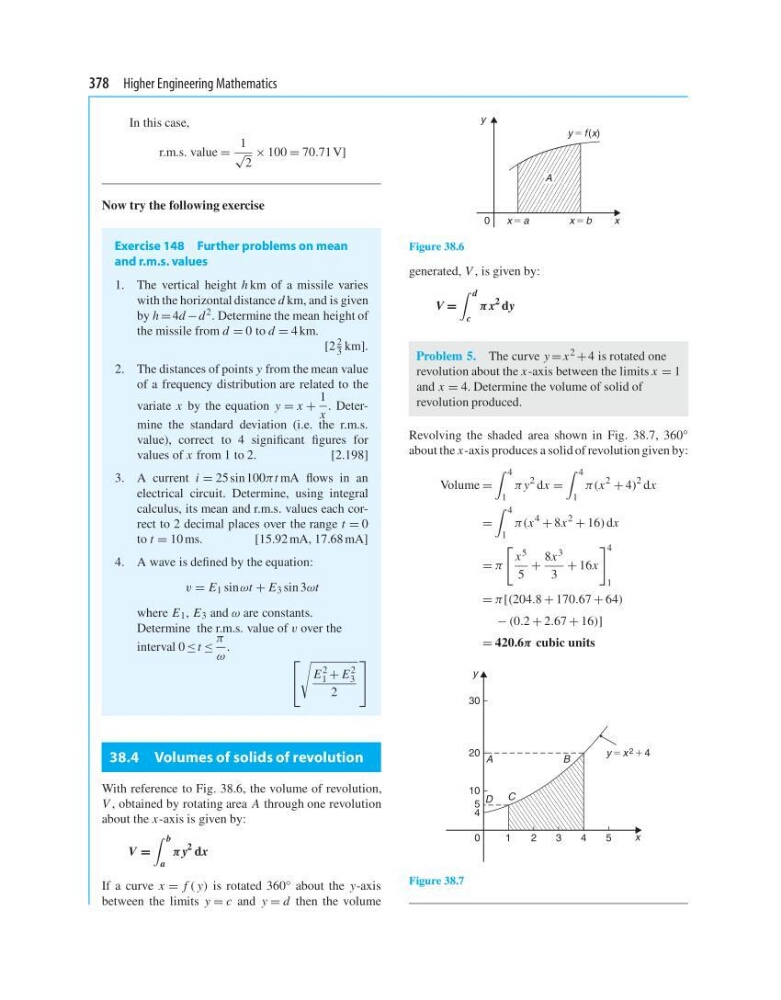
Revolving the shaded area shown in Fig. 38.7, 360 ◦
about the x-axis produces a solid of revolution given by:
Volume =
4
1
π y
2 dx =
4
1
π(x
2
+ 4)
2 dx
=
4
1
π(x
4
+ 8x
2
+ 16) dx
= π
x 5
5
+
8x 3
3
+ 16x
4
1
= π[(204.8 + 170.67 + 64)
− (0.2 + 2.67 + 16)]
= 420.6π cubic units
0
1
2
x
4
5
30
20
B
A
D C
10
y
4
3
5
y 5 x 2 1 4
Figure 38.7
In this case,
r.m.s. value =
1
√
2
× 100 = 70.71 V]
Now try the following exercise
Exercise 148 Further problems on mean
and r.m.s. values
1. The vertical height h km of a missile varies
with the horizontal distance d km, and is given
by h = 4d − d 2 . Determine the mean height of
the missile from d = 0 to d = 4 km.
[2
2
3 km].
2. The distances of points y from the mean value
of a frequency distribution are related to the
variate x by the equation y = x +
1
x
. Determine the standard deviation (i.e. the r.m.s.
value), correct to 4 significant figures for
values of x from 1 to 2.
[2.198]
3. A current i = 25 sin 100πt mA flows in an
electrical circuit. Determine, using integral
calculus, its mean and r.m.s. values each correct to 2 decimal places over the range t = 0
to t = 10 ms.
[15.92 mA, 17.68 mA]
4. A wave is defined by the equation:
v = E 1 sin ωt + E 3 sin 3ωt
where E 1 , E 3 and ω are constants.
Determine the r.m.s. value of v over the
interval 0 ≤ t ≤
π
ω
.
⎡
⎣
E
2
1 + E
2
3
2
⎤
⎦
38.4 Volumes of solids of revolution
With reference to Fig. 38.6, the volume of revolution,
V , obtained by rotating area A through one revolution
about the x-axis is given by:
V =
b
a
πy
2 dx
If a curve x = f ( y) is rotated 360 ◦ about the y-axis
between the limits y = c and y = d then the volume
0
x 5 a
x 5 b
y 5 f (x)
y
x
A
Figure 38.6
generated, V , is given by:
V =
d
c
πx
2 dy
Problem 5. The curve y = x 2 + 4 is rotated one
revolution about the x-axis between the limits x = 1
and x = 4. Determine the volume of solid of
revolution produced.
Revolving the shaded area shown in Fig. 38.7, 360 ◦
about the x-axis produces a solid of revolution given by:
Volume =
4
1
π y
2 dx =
4
1
π(x
2
+ 4)
2 dx
=
4
1
π(x
4
+ 8x
2
+ 16) dx
= π
x 5
5
+
8x 3
3
+ 16x
4
1
= π[(204.8 + 170.67 + 64)
− (0.2 + 2.67 + 16)]
= 420.6π cubic units
0
1
2
x
4
5
30
20
B
A
D C
10
y
4
3
5
y 5 x 2 1 4
Figure 38.7