

Some applications of integration 379
Problem 6. Determine the area enclosed by the
two curves y = x 2 and y 2 = 8x. If this area is
rotated 360 ◦ about the x-axis determine the volume
of the solid of revolution produced.
At the points of intersection the co-ordinates of the
curves are equal. Since y = x 2 then y 2 = x 4 . Hence
equating the y
2 values at the points of intersection:
x 4 = 8x
from which,
x 4 − 8x = 0
and
x(x 3 − 8) = 0
Hence, at the points of intersection, x = 0 and x = 2.
When x = 0, y = 0 and when x = 2, y = 4. The points
of intersection of the curves y = x 2 and y 2 = 8x are
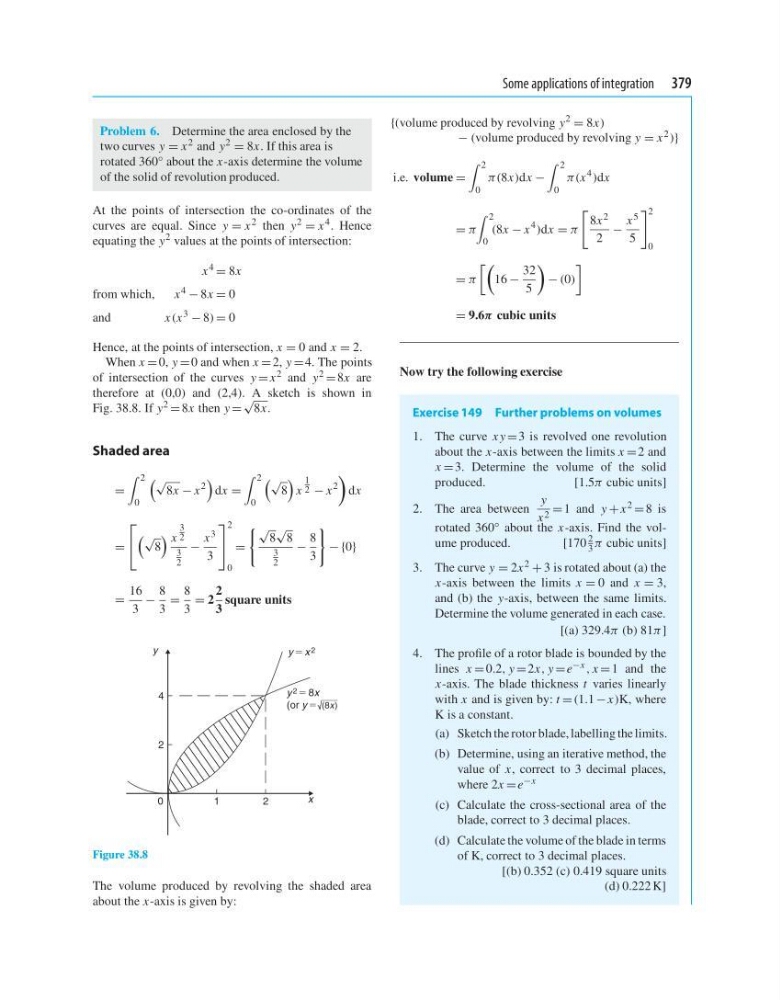
therefore at (0,0) and (2,4). A sketch is shown in
Fig. 38.8. If y 2 = 8x then y =
√
8x.
Shaded area
=
2
0
√
8x − x
2
dx =
2
0
√
8
x
1
2 − x
2
dx
=
⎡
⎣
√
8
x
3
2
3
2
−
x 3
3
⎤
⎦
2
0
=
√
8
√
8
3
2
−
8
3
− {0}
=
16
3
−
8
3
=
8
3
= 2
2
3
square units
y
x
0
1
2
4
2
y 5 x 2
y 2 5 8x
(or y 5 Œ Œ(8x)
Figure 38.8
The volume produced by revolving the shaded area
about the x-axis is given by:
{(volume produced by revolving y
2
= 8x)
− (volume produced by revolving y = x 2 )}
i.e. volume =
2
0
π(8x)dx −
2
0
π(x
4
)dx
= π
2
0
(8x − x
4
)dx = π
8x 2
2
−
x 5
5
2
0
= π
16 −
32
5
− (0)
= 9.6π cubic units
Now try the following exercise
Exercise 149 Further problems on volumes
1. The curve x y = 3 is revolved one revolution
about the x-axis between the limits x = 2 and
x = 3. Determine the volume of the solid
produced.
[1.5π cubic units]
2. The area between
y
x 2 = 1 and y + x 2 = 8 is
rotated 360 ◦ about the x-axis. Find the volume produced.
[170
2
3 π cubic units]
3. The curve y = 2x 2 + 3 is rotated about (a) the
x-axis between the limits x = 0 and x = 3,
and (b) the y-axis, between the same limits.
Determine the volume generated in each case.
[(a) 329.4π (b) 81π]
4. The profile of a rotor blade is bounded by the
lines x = 0.2, y = 2x, y = e −x , x = 1 and the
x-axis. The blade thickness t varies linearly
with x and is given by: t = (1.1 − x)K, where
K is a constant.
(a) Sketch the rotor blade, labelling the limits.
(b) Determine, using an iterative method, the
value of x, correct to 3 decimal places,
where 2x = e −x
(c) Calculate the cross-sectional area of the
blade, correct to 3 decimal places.
(d) Calculate the volume of the blade in terms
of K, correct to 3 decimal places.
[(b) 0.352 (c) 0.419 square units
(d) 0.222 K]
Problem 6. Determine the area enclosed by the
two curves y = x 2 and y 2 = 8x. If this area is
rotated 360 ◦ about the x-axis determine the volume
of the solid of revolution produced.
At the points of intersection the co-ordinates of the
curves are equal. Since y = x 2 then y 2 = x 4 . Hence
equating the y
2 values at the points of intersection:
x 4 = 8x
from which,
x 4 − 8x = 0
and
x(x 3 − 8) = 0
Hence, at the points of intersection, x = 0 and x = 2.
When x = 0, y = 0 and when x = 2, y = 4. The points
of intersection of the curves y = x 2 and y 2 = 8x are
therefore at (0,0) and (2,4). A sketch is shown in
Fig. 38.8. If y 2 = 8x then y =
√
8x.
Shaded area
=
2
0
√
8x − x
2
dx =
2
0
√
8
x
1
2 − x
2
dx
=
⎡
⎣
√
8
x
3
2
3
2
−
x 3
3
⎤
⎦
2
0
=
√
8
√
8
3
2
−
8
3
− {0}
=
16
3
−
8
3
=
8
3
= 2
2
3
square units
y
x
0
1
2
4
2
y 5 x 2
y 2 5 8x
(or y 5 Œ Œ(8x)
Figure 38.8
The volume produced by revolving the shaded area
about the x-axis is given by:
{(volume produced by revolving y
2
= 8x)
− (volume produced by revolving y = x 2 )}
i.e. volume =
2
0
π(8x)dx −
2
0
π(x
4
)dx
= π
2
0
(8x − x
4
)dx = π
8x 2
2
−
x 5
5
2
0
= π
16 −
32
5
− (0)
= 9.6π cubic units
Now try the following exercise
Exercise 149 Further problems on volumes
1. The curve x y = 3 is revolved one revolution
about the x-axis between the limits x = 2 and
x = 3. Determine the volume of the solid
produced.
[1.5π cubic units]
2. The area between
y
x 2 = 1 and y + x 2 = 8 is
rotated 360 ◦ about the x-axis. Find the volume produced.
[170
2
3 π cubic units]
3. The curve y = 2x 2 + 3 is rotated about (a) the
x-axis between the limits x = 0 and x = 3,
and (b) the y-axis, between the same limits.
Determine the volume generated in each case.
[(a) 329.4π (b) 81π]
4. The profile of a rotor blade is bounded by the
lines x = 0.2, y = 2x, y = e −x , x = 1 and the
x-axis. The blade thickness t varies linearly
with x and is given by: t = (1.1 − x)K, where
K is a constant.
(a) Sketch the rotor blade, labelling the limits.
(b) Determine, using an iterative method, the
value of x, correct to 3 decimal places,
where 2x = e −x
(c) Calculate the cross-sectional area of the
blade, correct to 3 decimal places.
(d) Calculate the volume of the blade in terms
of K, correct to 3 decimal places.
[(b) 0.352 (c) 0.419 square units
(d) 0.222 K]