

Some applications of integration 377
2. Sketch the curves y = x 2 + 3 and y = 7 − 3x
and determine the area enclosed by them.
[20
5
6 square units]
3. Determine the area enclosed by the three
straight lines y = 3x, 2y = x and y + 2x = 5.
[2
1
2 square units]
38.3 Mean and r.m.s. values
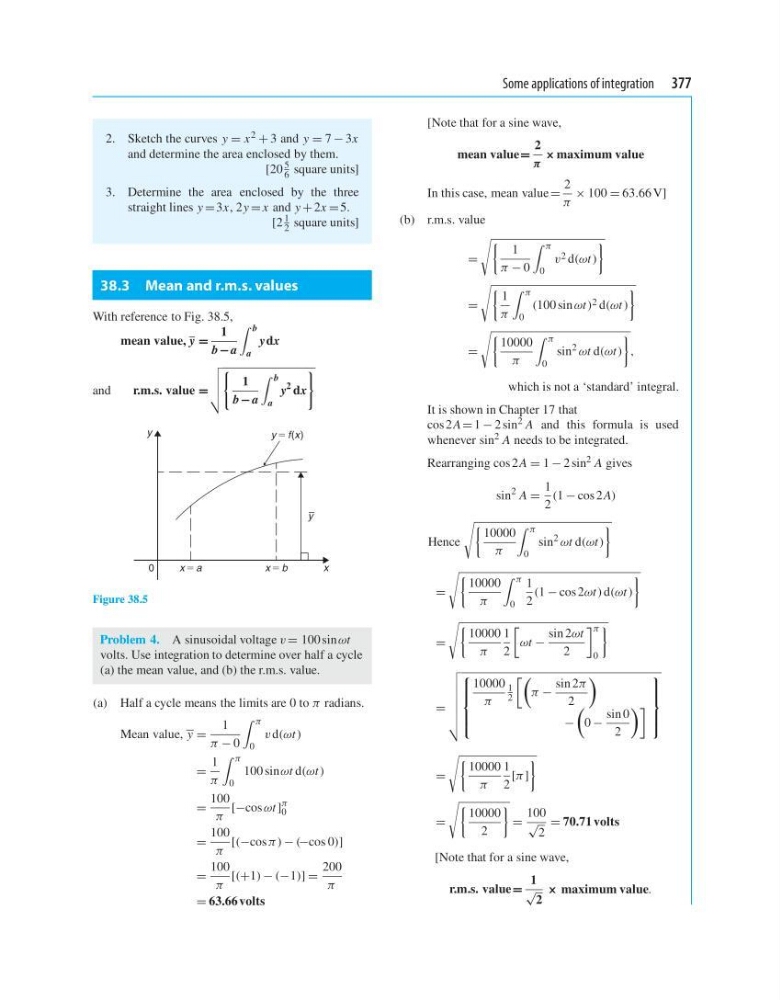
With reference to Fig. 38.5,
mean value, y =
1
b −a
b
a
y dx
and
r.m.s. value =
1
b − a
b
a
y
2 dx
0
x 5 a
x 5 b
y
x
y
y 5 f(x)
Figure 38.5
Problem 4. A sinusoidal voltage v = 100 sin ωt
volts. Use integration to determine over half a cycle
(a) the mean value, and (b) the r.m.s. value.
(a) Half a cycle means the limits are 0 to π radians.
Mean value, y =
1
π − 0
π
0
v d(ωt )
=
1
π
π
0
100 sinωt d(ωt )
=
100
π
[−cos ωt ]
π
0
=
100
π
[(−cos π) − (−cos 0)]
=
100
π
[(+1) − (−1)] =
200
π
= 63.66 volts
[Note that for a sine wave,
mean value=
2
π
× maximum value
In this case, mean value =
2
π
× 100 = 63.66 V]
(b) r.m.s. value
=
1
π − 0
π
0
v 2 d(ωt )
=
1
π
π
0
(100 sin ωt ) 2 d(ωt )
=
10000
π
π
0
sin 2 ωt d(ωt )
,
which is not a ‘standard’ integral.
It is shown in Chapter 17 that
cos 2 A = 1 − 2 sin 2 A and this formula is used
whenever sin 2 A needs to be integrated.
Rearranging cos 2 A = 1 − 2 sin 2 A gives
sin
2 A =
1
2
(1 − cos 2 A)
Hence
10000
π
π
0
sin 2 ωt d(ωt )
=
10000
π
π
0
1
2
(1 − cos 2ωt ) d(ωt )
=
10000
π
1
2
ωt −
sin 2ωt
2
π
0
=
⎧
⎪ ⎪ ⎨
⎪ ⎪ ⎩
10000
π
1
2
π −
sin 2π
2
−
0 −
sin 0
2
⎫
⎪ ⎪ ⎬
⎪ ⎪ ⎭
=
10000
π
1
2
[π]
=
10000
2
=
100
√
2
= 70.71 volts
[Note that for a sine wave,
r.m.s. value=
1
√
2
× maximum value.
2. Sketch the curves y = x 2 + 3 and y = 7 − 3x
and determine the area enclosed by them.
[20
5
6 square units]
3. Determine the area enclosed by the three
straight lines y = 3x, 2y = x and y + 2x = 5.
[2
1
2 square units]
38.3 Mean and r.m.s. values
With reference to Fig. 38.5,
mean value, y =
1
b −a
b
a
y dx
and
r.m.s. value =
1
b − a
b
a
y
2 dx
0
x 5 a
x 5 b
y
x
y
y 5 f(x)
Figure 38.5
Problem 4. A sinusoidal voltage v = 100 sin ωt
volts. Use integration to determine over half a cycle
(a) the mean value, and (b) the r.m.s. value.
(a) Half a cycle means the limits are 0 to π radians.
Mean value, y =
1
π − 0
π
0
v d(ωt )
=
1
π
π
0
100 sinωt d(ωt )
=
100
π
[−cos ωt ]
π
0
=
100
π
[(−cos π) − (−cos 0)]
=
100
π
[(+1) − (−1)] =
200
π
= 63.66 volts
[Note that for a sine wave,
mean value=
2
π
× maximum value
In this case, mean value =
2
π
× 100 = 63.66 V]
(b) r.m.s. value
=
1
π − 0
π
0
v 2 d(ωt )
=
1
π
π
0
(100 sin ωt ) 2 d(ωt )
=
10000
π
π
0
sin 2 ωt d(ωt )
,
which is not a ‘standard’ integral.
It is shown in Chapter 17 that
cos 2 A = 1 − 2 sin 2 A and this formula is used
whenever sin 2 A needs to be integrated.
Rearranging cos 2 A = 1 − 2 sin 2 A gives
sin
2 A =
1
2
(1 − cos 2 A)
Hence
10000
π
π
0
sin 2 ωt d(ωt )
=
10000
π
π
0
1
2
(1 − cos 2ωt ) d(ωt )
=
10000
π
1
2
ωt −
sin 2ωt
2
π
0
=
⎧
⎪ ⎪ ⎨
⎪ ⎪ ⎩
10000
π
1
2
π −
sin 2π
2
−
0 −
sin 0
2
⎫
⎪ ⎪ ⎬
⎪ ⎪ ⎭
=
10000
π
1
2
[π]
=
10000
2
=
100
√
2
= 70.71 volts
[Note that for a sine wave,
r.m.s. value=
1
√
2
× maximum value.