

376 Higher Engineering Mathematics
Problem 2. Determine the area enclosed between
the curves y = x 2 + 1 and y = 7 − x.
At the points of intersection the curves are equal. Thus,
equating the y values of each curve gives:
x 2 + 1 = 7 − x
from which,
x 2 + x − 6 = 0
Factorizing gives (x − 2)(x + 3) = 0
from which x = 2 and x = −3
By firstly determining the points of intersection the
range of x-values has been found. Tables of values are
produced as shown below.
x
−3 −2 −1 0 1 2
y = x 2 + 1 10
5
2 1 2 5
x
−3 0 2
y = 7 − x 10 7 5
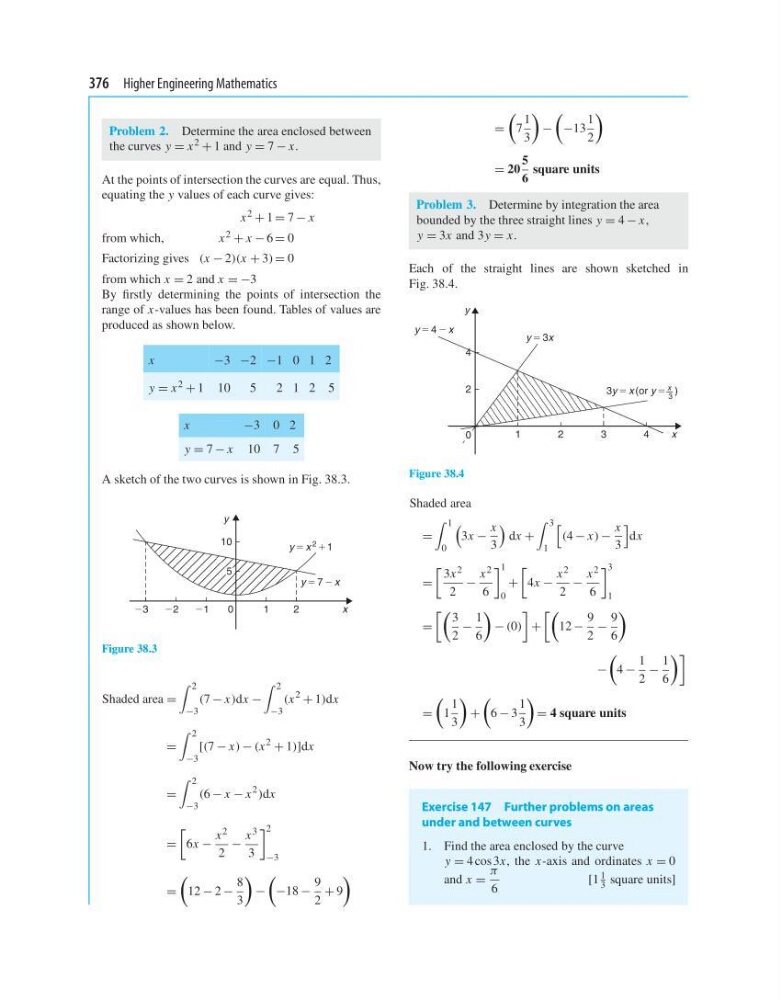
A sketch of the two curves is shown in Fig. 38.3.
y
10
21
0
1
2
x
22
23
5
y 5 7 2 x
y 5 x 2 11
Figure 38.3
Shaded area =
2
−3
(7 − x)dx −
2
−3
(x
2
+ 1)dx
=
2
−3
[(7 − x) − (x
2
+ 1)]dx
=
2
−3
(6 − x − x
2
)dx
=
6x −
x 2
2
−
x 3
3
2
−3
=
12 − 2 −
8
3
−
−18 −
9
2
+ 9
=
7
1
3
−
−13
1
2
= 20
5
6
square units
Problem 3. Determine by integration the area
bounded by the three straight lines y = 4 − x,
y = 3x and 3y = x.
Each of the straight lines are shown sketched in
Fig. 38.4.
1
2
3
x
4
y 5 3x
y 5 4 2 x
y
4
2
0
3y 5 x (or y 5
x )
3
Figure 38.4
Shaded area
=
1
0
3x −
x
3
dx +
3
1
(4 − x) −
x
3
dx
=
3x 2
2
−
x 2
6
1
0
+
4x −
x 2
2
−
x 2
6
3
1
=
3
2
−
1
6
− (0)
+
12 −
9
2
−
9
6
−
4 −
1
2
−
1
6
=
1
1
3
+
6 − 3
1
3
= 4 square units
Now try the following exercise
Exercise 147 Further problems on areas
under and between curves
1. Find the area enclosed by the curve
y = 4 cos 3x, the x-axis and ordinates x = 0
and x =
π
6
[1
1
3 square units]
Problem 2. Determine the area enclosed between
the curves y = x 2 + 1 and y = 7 − x.
At the points of intersection the curves are equal. Thus,
equating the y values of each curve gives:
x 2 + 1 = 7 − x
from which,
x 2 + x − 6 = 0
Factorizing gives (x − 2)(x + 3) = 0
from which x = 2 and x = −3
By firstly determining the points of intersection the
range of x-values has been found. Tables of values are
produced as shown below.
x
−3 −2 −1 0 1 2
y = x 2 + 1 10
5
2 1 2 5
x
−3 0 2
y = 7 − x 10 7 5
A sketch of the two curves is shown in Fig. 38.3.
y
10
21
0
1
2
x
22
23
5
y 5 7 2 x
y 5 x 2 11
Figure 38.3
Shaded area =
2
−3
(7 − x)dx −
2
−3
(x
2
+ 1)dx
=
2
−3
[(7 − x) − (x
2
+ 1)]dx
=
2
−3
(6 − x − x
2
)dx
=
6x −
x 2
2
−
x 3
3
2
−3
=
12 − 2 −
8
3
−
−18 −
9
2
+ 9
=
7
1
3
−
−13
1
2
= 20
5
6
square units
Problem 3. Determine by integration the area
bounded by the three straight lines y = 4 − x,
y = 3x and 3y = x.
Each of the straight lines are shown sketched in
Fig. 38.4.
1
2
3
x
4
y 5 3x
y 5 4 2 x
y
4
2
0
3y 5 x (or y 5
x )
3
Figure 38.4
Shaded area
=
1
0
3x −
x
3
dx +
3
1
(4 − x) −
x
3
dx
=
3x 2
2
−
x 2
6
1
0
+
4x −
x 2
2
−
x 2
6
3
1
=
3
2
−
1
6
− (0)
+
12 −
9
2
−
9
6
−
4 −
1
2
−
1
6
=
1
1
3
+
6 − 3
1
3
= 4 square units
Now try the following exercise
Exercise 147 Further problems on areas
under and between curves
1. Find the area enclosed by the curve
y = 4 cos 3x, the x-axis and ordinates x = 0
and x =
π
6
[1
1
3 square units]