

364 Higher Engineering Mathematics
Let z = f (x, y) = x
3
− 3x
2
− 4y
2
+ 2.
Following the procedure:
(i)
∂z
∂x
= 3x 2 − 6x and
∂z
∂ y
=−8y
(ii) for stationary points, 3x 2 −6x = 0
( 1 )
and
−8y = 0
( 2 )
(iii) From equation (1), 3x(x − 2) = 0 from which,
x = 0 and x = 2.
From equation (2), y = 0.
Hence the stationary points are (0, 0)
and (2, 0).
(iv)
∂ 2 z
∂x 2 = 6x − 6,
∂ 2 z
∂ y 2 =−8 and
∂ 2 z
∂x∂ y
= 0
(v) For the point (0, 0),
∂ 2 z
∂x 2 =−6,
∂ 2 z
∂ y 2 =−8 and
∂ 2 z
∂x∂ y
= 0
For the point (2, 0),
∂ 2 z
∂x 2 = 6,
∂ 2 z
∂ y 2 =−8 and
∂ 2 z
∂x∂ y
= 0
0
z 5 2 1
z 5 2 2
z 5 2 4
z 5
2
MAX
S
x
y
22
22
2
2
4
z
5
2
1
3
Figure 36.10
(vi)
∂ 2 z
∂x∂ y
2
= (0) 2 = 0
(vii) (0, 0) = 0 −(−6)(−8) =−48
(2, 0) = 0 −(6)(−8) = 48
(viii) Since (0, 0) < 0 and
∂ 2 z
∂x 2
(0, 0)
< 0, the
point (0, 0) is a maximum point and hence the
maximum value is 0.
Since (2, 0) > 0, the point (2, 0) is a saddle
point.
The value of z at the saddle point is
2 3 − 3(2) 2 − 4(0) 2 + 2 =−2.
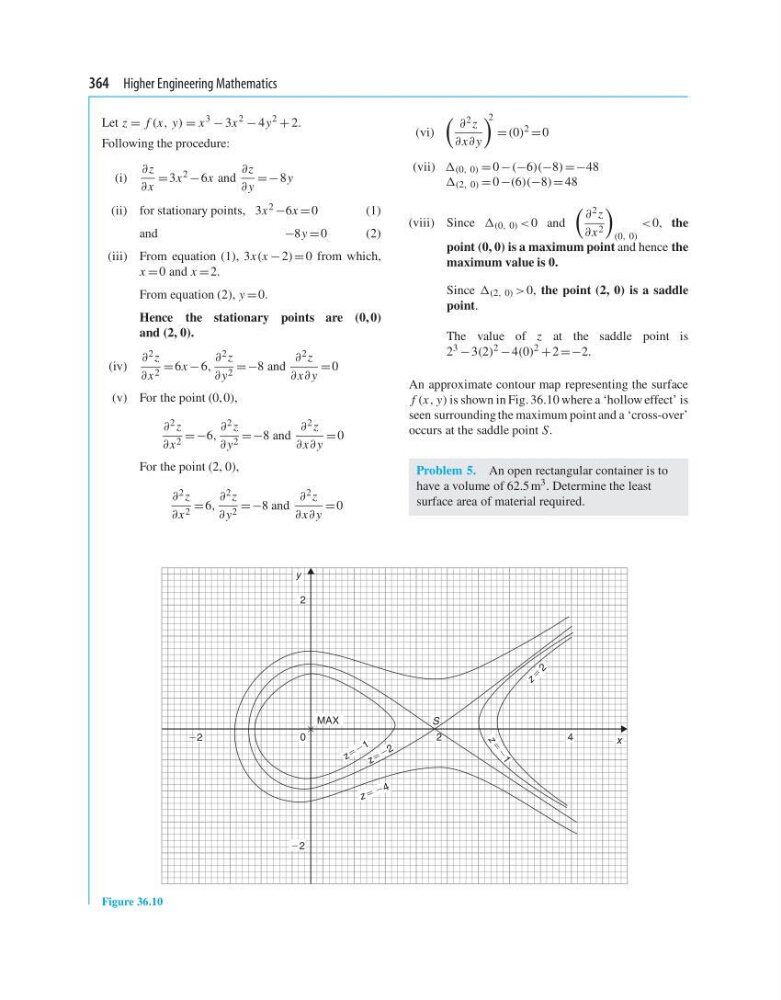
An approximate contour map representing the surface
f (x, y) is shown in Fig. 36.10 where a ‘hollow effect’ is
seen surrounding the maximum point and a ‘cross-over’
occurs at the saddle point S.
Problem 5. An open rectangular container is to
have a volume of 62.5 m 3 . Determine the least
surface area of material required.
Let z = f (x, y) = x
3
− 3x
2
− 4y
2
+ 2.
Following the procedure:
(i)
∂z
∂x
= 3x 2 − 6x and
∂z
∂ y
=−8y
(ii) for stationary points, 3x 2 −6x = 0
( 1 )
and
−8y = 0
( 2 )
(iii) From equation (1), 3x(x − 2) = 0 from which,
x = 0 and x = 2.
From equation (2), y = 0.
Hence the stationary points are (0, 0)
and (2, 0).
(iv)
∂ 2 z
∂x 2 = 6x − 6,
∂ 2 z
∂ y 2 =−8 and
∂ 2 z
∂x∂ y
= 0
(v) For the point (0, 0),
∂ 2 z
∂x 2 =−6,
∂ 2 z
∂ y 2 =−8 and
∂ 2 z
∂x∂ y
= 0
For the point (2, 0),
∂ 2 z
∂x 2 = 6,
∂ 2 z
∂ y 2 =−8 and
∂ 2 z
∂x∂ y
= 0
0
z 5 2 1
z 5 2 2
z 5 2 4
z 5
2
MAX
S
x
y
22
22
2
2
4
z
5
2
1
3
Figure 36.10
(vi)
∂ 2 z
∂x∂ y
2
= (0) 2 = 0
(vii) (0, 0) = 0 −(−6)(−8) =−48
(2, 0) = 0 −(6)(−8) = 48
(viii) Since (0, 0) < 0 and
∂ 2 z
∂x 2
(0, 0)
< 0, the
point (0, 0) is a maximum point and hence the
maximum value is 0.
Since (2, 0) > 0, the point (2, 0) is a saddle
point.
The value of z at the saddle point is
2 3 − 3(2) 2 − 4(0) 2 + 2 =−2.
An approximate contour map representing the surface
f (x, y) is shown in Fig. 36.10 where a ‘hollow effect’ is
seen surrounding the maximum point and a ‘cross-over’
occurs at the saddle point S.
Problem 5. An open rectangular container is to
have a volume of 62.5 m 3 . Determine the least
surface area of material required.