

Maxima, minima and saddle points for functions of two variables 365
z
x
y
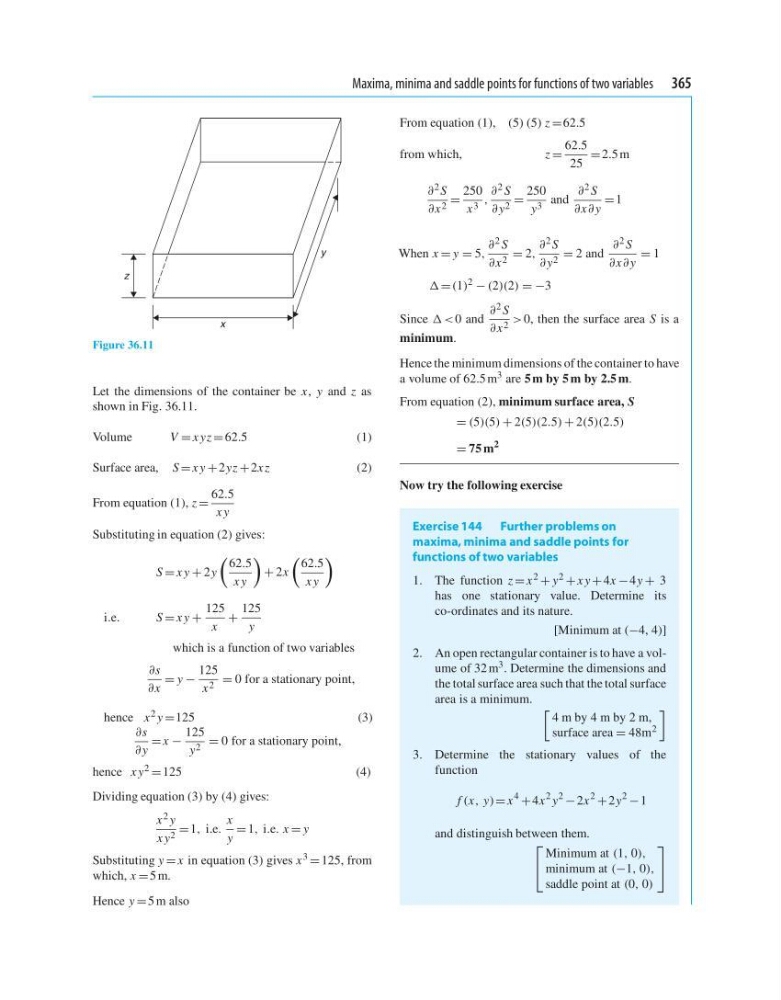
Figure 36.11
Let the dimensions of the container be x, y and z as
shown in Fig. 36.11.
Volume
V = x yz = 62.5
( 1 )
Surface area, S = x y + 2yz + 2xz
(2)
From equation (1), z =
62.5
x y
Substituting in equation (2) gives:
S = x y + 2y
62.5
x y
+ 2x
62.5
x y
i.e.
S = x y +
125
x
+
125
y
which is a function of two variables
∂s
∂x
= y −
125
x 2 = 0 for a stationary point,
hence x 2 y =125
(3)
∂s
∂ y
= x −
125
y 2 = 0 for a stationary point,
hence x y 2 = 125
(4)
Dividing equation (3) by (4) gives:
x 2 y
x y 2 = 1, i.e.
x
y
= 1, i.e. x = y
Substituting y = x in equation (3) gives x 3 = 125, from
which, x = 5 m.
Hence y = 5 m also
From equation (1), (5) (5) z =62.5
from which,
z =
62.5
25
= 2.5 m
∂ 2 S
∂x 2 =
250
x 3 ,
∂ 2 S
∂ y 2 =
250
y 3 and
∂ 2 S
∂x∂ y
= 1
When x = y = 5,
∂ 2 S
∂x 2 = 2,
∂ 2 S
∂ y 2 = 2 and
∂ 2 S
∂x∂ y
= 1
= (1) 2 − (2)(2) = −3
Since <0 and
∂ 2 S
∂x 2 > 0, then the surface area S is a
minimum.
Hence the minimum dimensions of the container to have
a volume of 62.5 m 3 are 5 m by 5 m by 2.5 m.
From equation (2), minimum surface area, S
= (5)(5) + 2(5)(2.5) + 2(5)(2.5)
= 75 m
2
Now try the following exercise
Exercise 144 Further problems on
maxima, minima and saddle points for
functions of two variables
1. The function z = x 2 + y 2 + x y + 4x − 4y + 3
has one stationary value. Determine its
co-ordinates and its nature.
[Minimum at (−4, 4)]
2. An open rectangular container is to have a volume of 32 m 3 . Determine the dimensions and
the total surface area such that the total surface
area is a minimum.
4 m by 4 m by 2 m,
surface area = 48m 2
3. Determine the stationary values of the
function
f (x, y) = x
4
+ 4x
2 y
2
− 2x
2
+ 2y
2
− 1
and distinguish between them.
⎡
⎣
Minimum at (1, 0),
minimum at (−1, 0),
saddle point at (0, 0)
⎤
⎦
z
x
y
Figure 36.11
Let the dimensions of the container be x, y and z as
shown in Fig. 36.11.
Volume
V = x yz = 62.5
( 1 )
Surface area, S = x y + 2yz + 2xz
(2)
From equation (1), z =
62.5
x y
Substituting in equation (2) gives:
S = x y + 2y
62.5
x y
+ 2x
62.5
x y
i.e.
S = x y +
125
x
+
125
y
which is a function of two variables
∂s
∂x
= y −
125
x 2 = 0 for a stationary point,
hence x 2 y =125
(3)
∂s
∂ y
= x −
125
y 2 = 0 for a stationary point,
hence x y 2 = 125
(4)
Dividing equation (3) by (4) gives:
x 2 y
x y 2 = 1, i.e.
x
y
= 1, i.e. x = y
Substituting y = x in equation (3) gives x 3 = 125, from
which, x = 5 m.
Hence y = 5 m also
From equation (1), (5) (5) z =62.5
from which,
z =
62.5
25
= 2.5 m
∂ 2 S
∂x 2 =
250
x 3 ,
∂ 2 S
∂ y 2 =
250
y 3 and
∂ 2 S
∂x∂ y
= 1
When x = y = 5,
∂ 2 S
∂x 2 = 2,
∂ 2 S
∂ y 2 = 2 and
∂ 2 S
∂x∂ y
= 1
= (1) 2 − (2)(2) = −3
Since <0 and
∂ 2 S
∂x 2 > 0, then the surface area S is a
minimum.
Hence the minimum dimensions of the container to have
a volume of 62.5 m 3 are 5 m by 5 m by 2.5 m.
From equation (2), minimum surface area, S
= (5)(5) + 2(5)(2.5) + 2(5)(2.5)
= 75 m
2
Now try the following exercise
Exercise 144 Further problems on
maxima, minima and saddle points for
functions of two variables
1. The function z = x 2 + y 2 + x y + 4x − 4y + 3
has one stationary value. Determine its
co-ordinates and its nature.
[Minimum at (−4, 4)]
2. An open rectangular container is to have a volume of 32 m 3 . Determine the dimensions and
the total surface area such that the total surface
area is a minimum.
4 m by 4 m by 2 m,
surface area = 48m 2
3. Determine the stationary values of the
function
f (x, y) = x
4
+ 4x
2 y
2
− 2x
2
+ 2y
2
− 1
and distinguish between them.
⎡
⎣
Minimum at (1, 0),
minimum at (−1, 0),
saddle point at (0, 0)
⎤
⎦