

Maxima, minima and saddle points for functions of two variables 363
y
x
z 5 0
z 5 1 2 8
z 5 9
h
g
c
d
22
2
22
2a
S
e
b
f
j
i
24
4
3
3
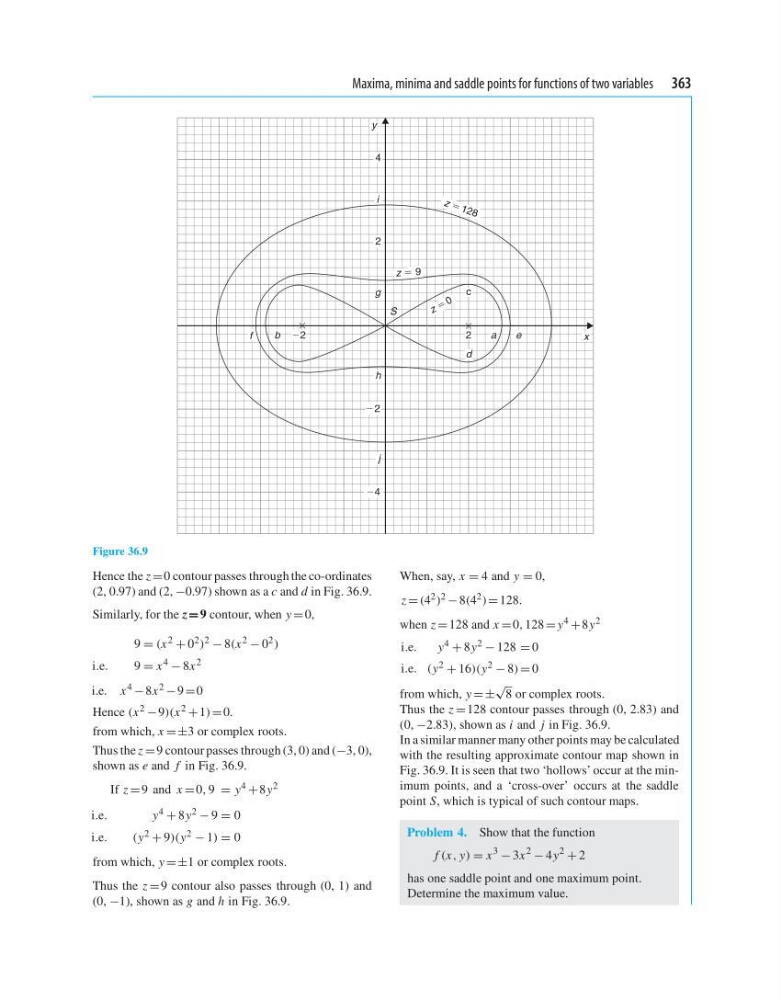
Figure 36.9
Hence the z =0 contour passes through the co-ordinates
(2, 0.97) and (2, −0.97) shown as a c and d in Fig. 36.9.
Similarly, for the z = 9 contour, when y = 0,
9 = (x 2 + 0 2 ) 2 − 8(x 2 − 0 2 )
i.e.
9 = x 4 − 8x 2
i.e. x 4 − 8x 2 − 9 =0
Hence (x 2 − 9)(x 2 + 1) = 0.
from which, x =±3 or complex roots.
Thus the z = 9 contour passes through (3, 0) and (−3, 0),
shown as e and f in Fig. 36.9.
If z = 9 and x = 0, 9 = y 4 + 8y 2
i.e.
y 4 + 8y 2 − 9 = 0
i.e.
(y 2 + 9)(y 2 − 1) = 0
from which, y =±1 or complex roots.
Thus the z = 9 contour also passes through (0, 1) and
(0, −1), shown as g and h in Fig. 36.9.
When, say, x = 4 and y = 0,
z = (4 2 ) 2 − 8(4 2 ) = 128.
when z = 128 and x = 0, 128 = y 4 + 8y 2
i.e.
y 4 + 8y 2 − 128 = 0
i.e. (y 2 + 16)(y 2 − 8) = 0
from which, y =±
√
8 or complex roots.
Thus the z = 128 contour passes through (0, 2.83) and
(0, −2.83), shown as i and j in Fig. 36.9.
In a similar manner many other points may be calculated
with the resulting approximate contour map shown in
Fig. 36.9. It is seen that two ‘hollows’ occur at the minimum points, and a ‘cross-over’ occurs at the saddle
point S, which is typical of such contour maps.
Problem 4. Show that the function
f (x, y) = x
3
− 3x
2
− 4y
2
+ 2
has one saddle point and one maximum point.
Determine the maximum value.
y
x
z 5 0
z 5 1 2 8
z 5 9
h
g
c
d
22
2
22
2a
S
e
b
f
j
i
24
4
3
3
Figure 36.9
Hence the z =0 contour passes through the co-ordinates
(2, 0.97) and (2, −0.97) shown as a c and d in Fig. 36.9.
Similarly, for the z = 9 contour, when y = 0,
9 = (x 2 + 0 2 ) 2 − 8(x 2 − 0 2 )
i.e.
9 = x 4 − 8x 2
i.e. x 4 − 8x 2 − 9 =0
Hence (x 2 − 9)(x 2 + 1) = 0.
from which, x =±3 or complex roots.
Thus the z = 9 contour passes through (3, 0) and (−3, 0),
shown as e and f in Fig. 36.9.
If z = 9 and x = 0, 9 = y 4 + 8y 2
i.e.
y 4 + 8y 2 − 9 = 0
i.e.
(y 2 + 9)(y 2 − 1) = 0
from which, y =±1 or complex roots.
Thus the z = 9 contour also passes through (0, 1) and
(0, −1), shown as g and h in Fig. 36.9.
When, say, x = 4 and y = 0,
z = (4 2 ) 2 − 8(4 2 ) = 128.
when z = 128 and x = 0, 128 = y 4 + 8y 2
i.e.
y 4 + 8y 2 − 128 = 0
i.e. (y 2 + 16)(y 2 − 8) = 0
from which, y =±
√
8 or complex roots.
Thus the z = 128 contour passes through (0, 2.83) and
(0, −2.83), shown as i and j in Fig. 36.9.
In a similar manner many other points may be calculated
with the resulting approximate contour map shown in
Fig. 36.9. It is seen that two ‘hollows’ occur at the minimum points, and a ‘cross-over’ occurs at the saddle
point S, which is typical of such contour maps.
Problem 4. Show that the function
f (x, y) = x
3
− 3x
2
− 4y
2
+ 2
has one saddle point and one maximum point.
Determine the maximum value.