

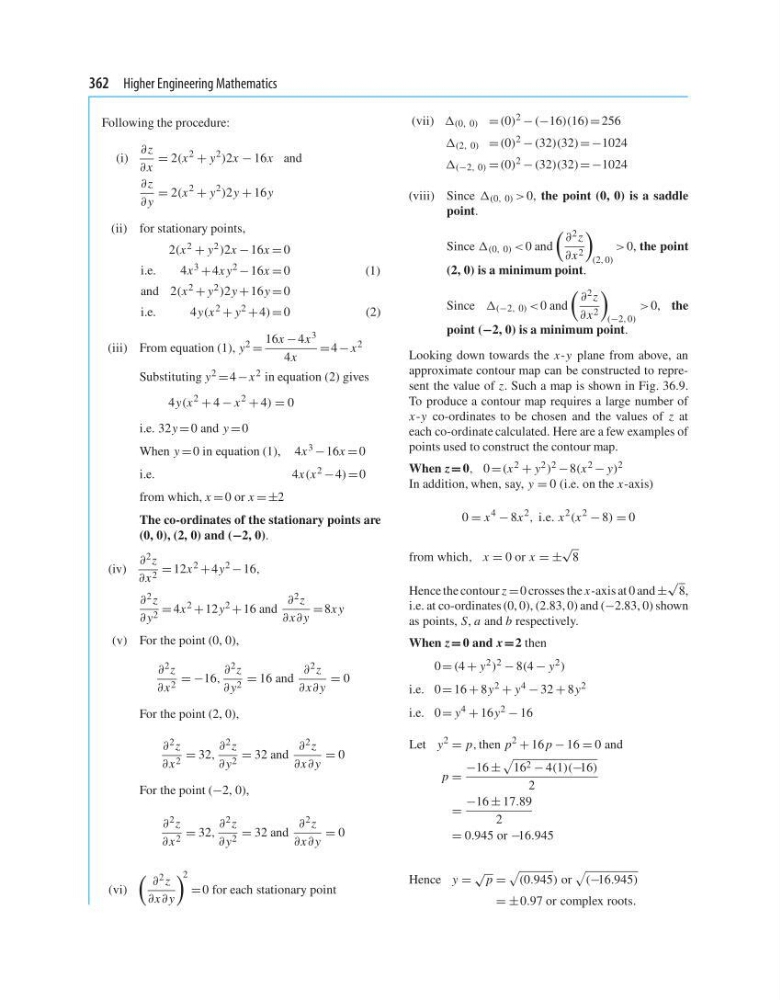
362 Higher Engineering Mathematics
Following the procedure:
(i)
∂z
∂x
= 2(x
2
+ y
2
)2x − 16x and
∂z
∂ y
= 2(x
2
+ y
2
)2y + 16y
(ii) for stationary points,
2(x 2 + y 2 )2x − 16x = 0
i.e.
4x 3 + 4x y 2 − 16x = 0
( 1 )
and 2(x 2 + y 2 )2y + 16y = 0
i.e.
4y(x 2 + y 2 + 4) = 0
( 2 )
(iii) From equation (1), y 2 =
16x − 4x 3
4x
= 4 − x 2
Substituting y 2 = 4 − x 2 in equation (2) gives
4y(x
2
+ 4 − x
2
+ 4) = 0
i.e. 32y = 0 and y = 0
When y = 0 in equation (1), 4x 3 − 16x = 0
i.e.
4x(x 2 − 4) = 0
from which, x = 0 or x =±2
The co-ordinates of the stationary points are
(0, 0), (2, 0) and (−2, 0).
(iv)
∂ 2 z
∂x 2 = 12x 2 + 4y 2 − 16,
∂ 2 z
∂ y 2 = 4x 2 + 12y 2 + 16 and
∂ 2 z
∂x∂ y
= 8x y
(v) For the point (0, 0),
∂ 2 z
∂x 2 = −16,
∂ 2 z
∂ y 2 = 16 and
∂ 2 z
∂x∂ y
= 0
For the point (2, 0),
∂ 2 z
∂x 2 = 32,
∂ 2 z
∂ y 2 = 32 and
∂ 2 z
∂x∂ y
= 0
For the point (−2, 0),
∂
2 z
∂x 2 = 32,
∂
2 z
∂ y 2 = 32 and
∂
2 z
∂x∂ y
= 0
(vi)
∂ 2 z
∂x∂ y
2
= 0 for each stationary point
(vii) (0, 0) = (0) 2 − (−16)(16) = 256
(2, 0) = (0) 2 − (32)(32) = −1024
(−2, 0) = (0) 2 − (32)(32) = −1024
(viii) Since (0, 0) > 0, the point (0, 0) is a saddle
point.
Since (0, 0) < 0 and
∂ 2 z
∂x 2
(2, 0)
> 0, the point
(2, 0) is a minimum point.
Since (−2, 0) < 0 and
∂ 2 z
∂x 2
(−2, 0)
> 0, the
point (−2, 0) is a minimum point.
Looking down towards the x-y plane from above, an
approximate contour map can be constructed to represent the value of z. Such a map is shown in Fig. 36.9.
To produce a contour map requires a large number of
x-y co-ordinates to be chosen and the values of z at
each co-ordinate calculated. Here are a few examples of
points used to construct the contour map.
When z = 0, 0 =(x 2 + y 2 ) 2 − 8(x 2 − y) 2
In addition, when, say, y = 0 (i.e. on the x-axis)
0 = x
4
− 8x
2
, i.e. x
2
(x
2
− 8) = 0
from which, x = 0 or x = ±
√
8
Hence the contour z = 0 crosses the x-axis at 0 and ±
√
8,
i.e. at co-ordinates (0, 0), (2.83, 0) and (−2.83, 0) shown
as points, S, a and b respectively.
When z = 0 and x =2 then
0 = (4 + y 2 ) 2 − 8(4 − y 2 )
i.e. 0 = 16 + 8y 2 + y 4 − 32 + 8y 2
i.e. 0 = y 4 + 16y 2 − 16
Let y
2
= p, then p
2
+ 16 p − 16 = 0 and
p =
−16 ±
16 2 − 4(1)(−16)
2
=
−16 ± 17.89
2
= 0.945 or −16.945
Hence y =
√ p =
(0.945) or
(−16.945)
= ±0.97 or complex roots.
Following the procedure:
(i)
∂z
∂x
= 2(x
2
+ y
2
)2x − 16x and
∂z
∂ y
= 2(x
2
+ y
2
)2y + 16y
(ii) for stationary points,
2(x 2 + y 2 )2x − 16x = 0
i.e.
4x 3 + 4x y 2 − 16x = 0
( 1 )
and 2(x 2 + y 2 )2y + 16y = 0
i.e.
4y(x 2 + y 2 + 4) = 0
( 2 )
(iii) From equation (1), y 2 =
16x − 4x 3
4x
= 4 − x 2
Substituting y 2 = 4 − x 2 in equation (2) gives
4y(x
2
+ 4 − x
2
+ 4) = 0
i.e. 32y = 0 and y = 0
When y = 0 in equation (1), 4x 3 − 16x = 0
i.e.
4x(x 2 − 4) = 0
from which, x = 0 or x =±2
The co-ordinates of the stationary points are
(0, 0), (2, 0) and (−2, 0).
(iv)
∂ 2 z
∂x 2 = 12x 2 + 4y 2 − 16,
∂ 2 z
∂ y 2 = 4x 2 + 12y 2 + 16 and
∂ 2 z
∂x∂ y
= 8x y
(v) For the point (0, 0),
∂ 2 z
∂x 2 = −16,
∂ 2 z
∂ y 2 = 16 and
∂ 2 z
∂x∂ y
= 0
For the point (2, 0),
∂ 2 z
∂x 2 = 32,
∂ 2 z
∂ y 2 = 32 and
∂ 2 z
∂x∂ y
= 0
For the point (−2, 0),
∂
2 z
∂x 2 = 32,
∂
2 z
∂ y 2 = 32 and
∂
2 z
∂x∂ y
= 0
(vi)
∂ 2 z
∂x∂ y
2
= 0 for each stationary point
(vii) (0, 0) = (0) 2 − (−16)(16) = 256
(2, 0) = (0) 2 − (32)(32) = −1024
(−2, 0) = (0) 2 − (32)(32) = −1024
(viii) Since (0, 0) > 0, the point (0, 0) is a saddle
point.
Since (0, 0) < 0 and
∂ 2 z
∂x 2
(2, 0)
> 0, the point
(2, 0) is a minimum point.
Since (−2, 0) < 0 and
∂ 2 z
∂x 2
(−2, 0)
> 0, the
point (−2, 0) is a minimum point.
Looking down towards the x-y plane from above, an
approximate contour map can be constructed to represent the value of z. Such a map is shown in Fig. 36.9.
To produce a contour map requires a large number of
x-y co-ordinates to be chosen and the values of z at
each co-ordinate calculated. Here are a few examples of
points used to construct the contour map.
When z = 0, 0 =(x 2 + y 2 ) 2 − 8(x 2 − y) 2
In addition, when, say, y = 0 (i.e. on the x-axis)
0 = x
4
− 8x
2
, i.e. x
2
(x
2
− 8) = 0
from which, x = 0 or x = ±
√
8
Hence the contour z = 0 crosses the x-axis at 0 and ±
√
8,
i.e. at co-ordinates (0, 0), (2.83, 0) and (−2.83, 0) shown
as points, S, a and b respectively.
When z = 0 and x =2 then
0 = (4 + y 2 ) 2 − 8(4 − y 2 )
i.e. 0 = 16 + 8y 2 + y 4 − 32 + 8y 2
i.e. 0 = y 4 + 16y 2 − 16
Let y
2
= p, then p
2
+ 16 p − 16 = 0 and
p =
−16 ±
16 2 − 4(1)(−16)
2
=
−16 ± 17.89
2
= 0.945 or −16.945
Hence y =
√ p =
(0.945) or
(−16.945)
= ±0.97 or complex roots.