

10 Higher Engineering Mathematics
x 2 − x − 6
————————–
x − 1
x 3 − 2x 2 − 5x + 6
x 3 − x 2
− x
2
− 5x + 6
− x 2 + x
————–
− 6x + 6
− 6x + 6
———–
· ·
———–
Hence x
3
− 2x
2
− 5x + 6
= (x − 1)(x
2
− x − 6)
= (x − 1)(x − 3)(x + 2)
Summarizing, the factor theorem provides us with a
method of factorizing simple expressions, and an alternative, in certain circumstances, to polynomial division.
Now try the following exercise
Exercise 6 Further problems on the factor
theorem
Use the factor theorem to factorize the expressions
given in problems 1 to 4.
1. x 2 + 2x − 3
[ (x − 1)(x + 3)]
2. x 3 + x 2 − 4x − 4
[(x + 1)(x + 2)(x − 2)]
3. 2x
3
+ 5x
2
− 4x − 7
[(x + 1)(2x 2 + 3x − 7)]
4. 2x 3 − x 2 − 16x + 15
[(x − 1)(x + 3)(2x − 5)]
5. Use the factor theorem to factorize
x 3 + 4x 2 + x − 6 and hence solve the cubic
equation x 3 + 4x 2 + x − 6 = 0.
⎡
⎢
⎣
x 3 + 4x 2 + x − 6
= (x − 1)(x + 3)(x + 2)
x = 1, x = −3 and x = −2
⎤
⎥
⎦
6. Solve the equation x
3
− 2x
2
− x + 2 = 0.
[x = 1, x = 2 and x = −1]
1.6 The remainder theorem
Dividing a general quadratic expression
(ax 2 + bx + c) by (x − p), where p is any whole
number, by long division (see section 1.3) gives:
ax + (b + ap)
————————————–
x − p
ax 2 + bx
+ c
ax
2
− apx
(b + ap)x + c
(b + ap)x − (b + ap) p
—————————–
c + (b + ap) p
—————————–
The remainder, c + (b + ap) p = c + bp + ap 2 or
ap 2 + bp + c. This is, in fact, what the remainder
theorem states, i.e.,
‘if (ax 2 + bx + c) is divided by (x − p),
the remainder will be ap 2 + bp + c’
If, in the dividend (ax 2 + bx + c), we substitute p for
x we get the remainder ap 2 + bp + c.
For example, when (3x 2 − 4x + 5) is divided by
(x − 2) the remainder is ap 2 + bp + c (where a = 3,
b = −4, c = 5 and p = 2),
i.e. the remainder is
3(2)
2
+ (−4)(2) + 5 = 12 − 8 + 5 = 9
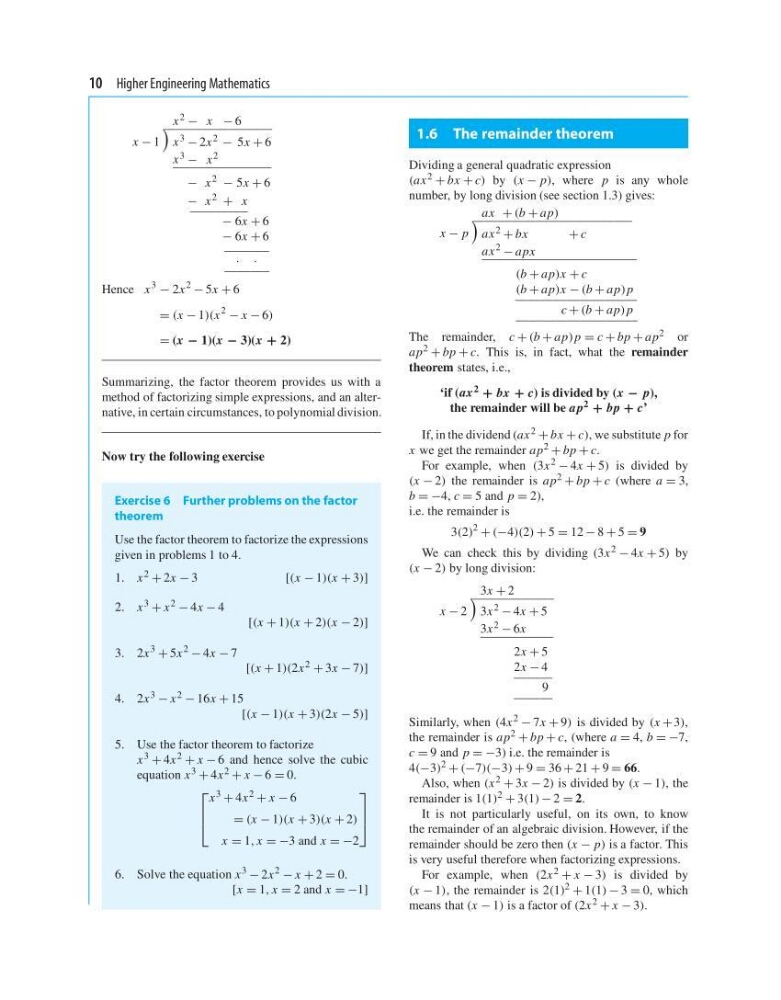
We can check this by dividing (3x 2 − 4x + 5) by
(x − 2) by long division:
3x + 2
——————–
x − 2
3x 2 − 4x + 5
3x 2 − 6x
2x + 5
2x − 4
———
9
———
Similarly, when (4x
2
− 7x + 9) is divided by (x + 3),
the remainder is ap 2 + bp + c, (where a = 4, b = −7,
c = 9 and p = −3) i.e. the remainder is
4(−3) 2 + (−7)(−3) + 9 = 36 + 21 + 9 = 66.
Also, when (x 2 + 3x − 2) is divided by (x − 1), the
remainder is 1(1) 2 + 3(1) − 2 = 2.
It is not particularly useful, on its own, to know
the remainder of an algebraic division. However, if the
remainder should be zero then (x − p) is a factor. This
is very useful therefore when factorizing expressions.
For example, when (2x 2 + x − 3) is divided by
(x − 1), the remainder is 2(1) 2 + 1(1) − 3 = 0, which
means that (x − 1) is a factor of (2x 2 + x − 3).
x 2 − x − 6
————————–
x − 1
x 3 − 2x 2 − 5x + 6
x 3 − x 2
− x
2
− 5x + 6
− x 2 + x
————–
− 6x + 6
− 6x + 6
———–
· ·
———–
Hence x
3
− 2x
2
− 5x + 6
= (x − 1)(x
2
− x − 6)
= (x − 1)(x − 3)(x + 2)
Summarizing, the factor theorem provides us with a
method of factorizing simple expressions, and an alternative, in certain circumstances, to polynomial division.
Now try the following exercise
Exercise 6 Further problems on the factor
theorem
Use the factor theorem to factorize the expressions
given in problems 1 to 4.
1. x 2 + 2x − 3
[ (x − 1)(x + 3)]
2. x 3 + x 2 − 4x − 4
[(x + 1)(x + 2)(x − 2)]
3. 2x
3
+ 5x
2
− 4x − 7
[(x + 1)(2x 2 + 3x − 7)]
4. 2x 3 − x 2 − 16x + 15
[(x − 1)(x + 3)(2x − 5)]
5. Use the factor theorem to factorize
x 3 + 4x 2 + x − 6 and hence solve the cubic
equation x 3 + 4x 2 + x − 6 = 0.
⎡
⎢
⎣
x 3 + 4x 2 + x − 6
= (x − 1)(x + 3)(x + 2)
x = 1, x = −3 and x = −2
⎤
⎥
⎦
6. Solve the equation x
3
− 2x
2
− x + 2 = 0.
[x = 1, x = 2 and x = −1]
1.6 The remainder theorem
Dividing a general quadratic expression
(ax 2 + bx + c) by (x − p), where p is any whole
number, by long division (see section 1.3) gives:
ax + (b + ap)
————————————–
x − p
ax 2 + bx
+ c
ax
2
− apx
(b + ap)x + c
(b + ap)x − (b + ap) p
—————————–
c + (b + ap) p
—————————–
The remainder, c + (b + ap) p = c + bp + ap 2 or
ap 2 + bp + c. This is, in fact, what the remainder
theorem states, i.e.,
‘if (ax 2 + bx + c) is divided by (x − p),
the remainder will be ap 2 + bp + c’
If, in the dividend (ax 2 + bx + c), we substitute p for
x we get the remainder ap 2 + bp + c.
For example, when (3x 2 − 4x + 5) is divided by
(x − 2) the remainder is ap 2 + bp + c (where a = 3,
b = −4, c = 5 and p = 2),
i.e. the remainder is
3(2)
2
+ (−4)(2) + 5 = 12 − 8 + 5 = 9
We can check this by dividing (3x 2 − 4x + 5) by
(x − 2) by long division:
3x + 2
——————–
x − 2
3x 2 − 4x + 5
3x 2 − 6x
2x + 5
2x − 4
———
9
———
Similarly, when (4x
2
− 7x + 9) is divided by (x + 3),
the remainder is ap 2 + bp + c, (where a = 4, b = −7,
c = 9 and p = −3) i.e. the remainder is
4(−3) 2 + (−7)(−3) + 9 = 36 + 21 + 9 = 66.
Also, when (x 2 + 3x − 2) is divided by (x − 1), the
remainder is 1(1) 2 + 3(1) − 2 = 2.
It is not particularly useful, on its own, to know
the remainder of an algebraic division. However, if the
remainder should be zero then (x − p) is a factor. This
is very useful therefore when factorizing expressions.
For example, when (2x 2 + x − 3) is divided by
(x − 1), the remainder is 2(1) 2 + 1(1) − 3 = 0, which
means that (x − 1) is a factor of (2x 2 + x − 3).