

Algebra 9
expression x
2
+ 2x − 8. We wouldn’t normally solve
quadratic equations this way — but suppose we have
to factorize a cubic expression (i.e. one in which the
highest power of the variable is 3). A cubic equation
might have three simple linear factors and the difficulty
of discovering all these factors by trial and error would
be considerable. It is to deal with this kind of case that
we use the factor theorem. This is just a generalized
version of what we established above for the quadratic
expression. The factor theorem provides a method of
factorizing any polynomial, f (x), which has simple
factors.
A statement of the factor theorem says:
‘if x = a is a root of the equation
f (x) = 0, then (x − a) is a factor of f (x)’
The following worked problems show the use of the
factor theorem.
Problem 28. Factorize x 3 − 7x − 6 and use it to
solve the cubic equation x
3
− 7x − 6 = 0.
Let f (x) = x 3 − 7x − 6
If x = 1, then f (1) = 1 3 − 7(1) − 6 = −12
If x = 2, then f (2) = 2 3 − 7(2) − 6 = −12
If x = 3, then f (3) = 3 3 − 7(3) − 6 = 0
If f (3) = 0, then (x − 3) is a factor — from the factor
theorem.
We have a choice now. We can divide x 3 − 7x − 6 by
(x − 3) or we could continue our ‘trial and error’ by substituting further values for x in the given expression —
and hope to arrive at f (x) = 0.
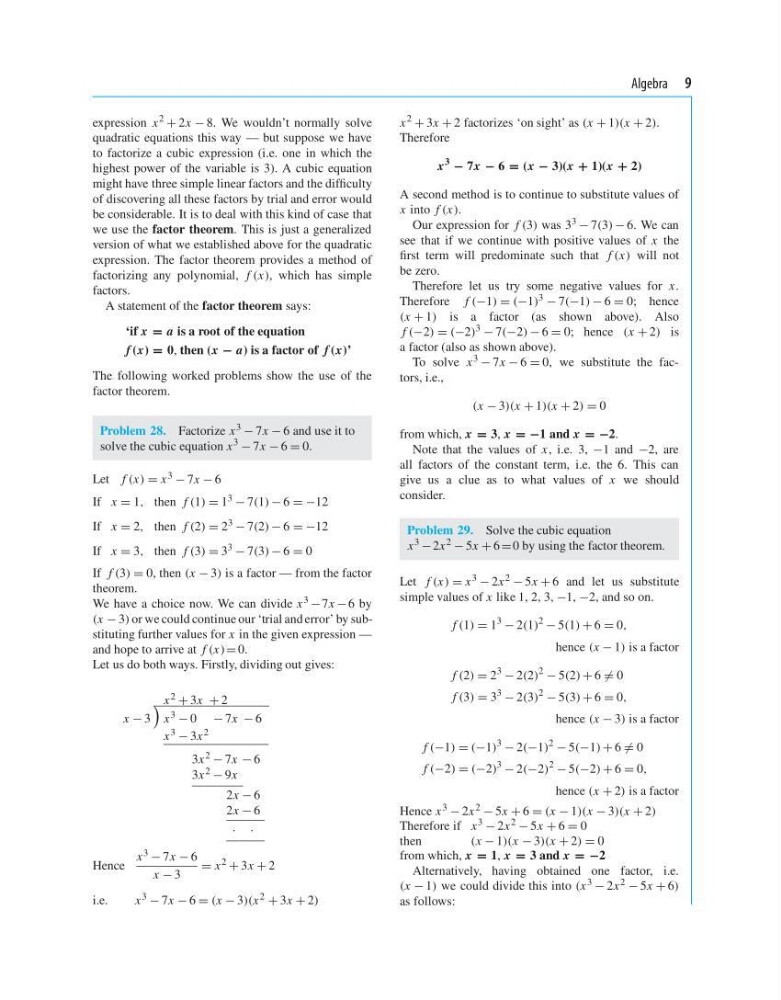
Let us do both ways. Firstly, dividing out gives:
x 2 + 3x + 2
—————————
x − 3
x 3 − 0 − 7x − 6
x 3 − 3x 2
3x 2 − 7x − 6
3x 2 − 9x
————
2x − 6
2x − 6
———
· ·
———
Hence
x 3 − 7x − 6
x − 3
= x 2 + 3x + 2
i.e.
x 3 − 7x − 6 = (x − 3)(x 2 + 3x + 2)
x
2
+ 3x + 2 factorizes ‘on sight’ as (x + 1)(x + 2).
Therefore
x
3
− 7x − 6 = (x − 3)(x + 1)(x + 2)
A second method is to continue to substitute values of
x into f (x).
Our expression for f (3) was 3 3 − 7(3) − 6. We can
see that if we continue with positive values of x the
first term will predominate such that f (x) will not
be zero.
Therefore let us try some negative values for x.
Therefore f (−1) = (−1) 3 − 7(−1) − 6 = 0; hence
(x + 1) is a factor (as shown above). Also
f (−2) = (−2) 3 − 7(−2) − 6 = 0; hence (x + 2) is
a factor (also as shown above).
To solve x 3 − 7x − 6 = 0, we substitute the factors, i.e.,
(x − 3)(x + 1)(x + 2) = 0
from which, x = 3, x = −1 and x = −2.
Note that the values of x, i.e. 3, −1 and −2, are
all factors of the constant term, i.e. the 6. This can
give us a clue as to what values of x we should
consider.
Problem 29. Solve the cubic equation
x 3 − 2x 2 − 5x + 6 = 0 by using the factor theorem.
Let f (x) = x 3 − 2x 2 − 5x + 6 and let us substitute
simple values of x like 1, 2, 3, −1, −2, and so on.
f (1) = 1
3
− 2(1)
2
− 5(1) + 6 = 0,
hence (x − 1) is a factor
f (2) = 2
3
− 2(2)
2
− 5(2) + 6 = 0
f (3) = 3
3
− 2(3)
2
− 5(3) + 6 = 0,
hence (x − 3) is a factor
f (−1) = (−1)
3
− 2(−1)
2
− 5(−1) + 6 = 0
f (−2) = (−2)
3
− 2(−2)
2
− 5(−2) + 6 = 0,
hence (x + 2) is a factor
Hence x 3 − 2x 2 − 5x + 6 = (x − 1)(x − 3)(x + 2)
Therefore if x 3 − 2x 2 − 5x + 6 = 0
then
(x − 1)(x − 3)(x + 2) = 0
from which, x = 1, x = 3 and x = −2
Alternatively, having obtained one factor, i.e.
(x − 1) we could divide this into (x 3 − 2x 2 − 5x + 6)
as follows:
expression x
2
+ 2x − 8. We wouldn’t normally solve
quadratic equations this way — but suppose we have
to factorize a cubic expression (i.e. one in which the
highest power of the variable is 3). A cubic equation
might have three simple linear factors and the difficulty
of discovering all these factors by trial and error would
be considerable. It is to deal with this kind of case that
we use the factor theorem. This is just a generalized
version of what we established above for the quadratic
expression. The factor theorem provides a method of
factorizing any polynomial, f (x), which has simple
factors.
A statement of the factor theorem says:
‘if x = a is a root of the equation
f (x) = 0, then (x − a) is a factor of f (x)’
The following worked problems show the use of the
factor theorem.
Problem 28. Factorize x 3 − 7x − 6 and use it to
solve the cubic equation x
3
− 7x − 6 = 0.
Let f (x) = x 3 − 7x − 6
If x = 1, then f (1) = 1 3 − 7(1) − 6 = −12
If x = 2, then f (2) = 2 3 − 7(2) − 6 = −12
If x = 3, then f (3) = 3 3 − 7(3) − 6 = 0
If f (3) = 0, then (x − 3) is a factor — from the factor
theorem.
We have a choice now. We can divide x 3 − 7x − 6 by
(x − 3) or we could continue our ‘trial and error’ by substituting further values for x in the given expression —
and hope to arrive at f (x) = 0.
Let us do both ways. Firstly, dividing out gives:
x 2 + 3x + 2
—————————
x − 3
x 3 − 0 − 7x − 6
x 3 − 3x 2
3x 2 − 7x − 6
3x 2 − 9x
————
2x − 6
2x − 6
———
· ·
———
Hence
x 3 − 7x − 6
x − 3
= x 2 + 3x + 2
i.e.
x 3 − 7x − 6 = (x − 3)(x 2 + 3x + 2)
x
2
+ 3x + 2 factorizes ‘on sight’ as (x + 1)(x + 2).
Therefore
x
3
− 7x − 6 = (x − 3)(x + 1)(x + 2)
A second method is to continue to substitute values of
x into f (x).
Our expression for f (3) was 3 3 − 7(3) − 6. We can
see that if we continue with positive values of x the
first term will predominate such that f (x) will not
be zero.
Therefore let us try some negative values for x.
Therefore f (−1) = (−1) 3 − 7(−1) − 6 = 0; hence
(x + 1) is a factor (as shown above). Also
f (−2) = (−2) 3 − 7(−2) − 6 = 0; hence (x + 2) is
a factor (also as shown above).
To solve x 3 − 7x − 6 = 0, we substitute the factors, i.e.,
(x − 3)(x + 1)(x + 2) = 0
from which, x = 3, x = −1 and x = −2.
Note that the values of x, i.e. 3, −1 and −2, are
all factors of the constant term, i.e. the 6. This can
give us a clue as to what values of x we should
consider.
Problem 29. Solve the cubic equation
x 3 − 2x 2 − 5x + 6 = 0 by using the factor theorem.
Let f (x) = x 3 − 2x 2 − 5x + 6 and let us substitute
simple values of x like 1, 2, 3, −1, −2, and so on.
f (1) = 1
3
− 2(1)
2
− 5(1) + 6 = 0,
hence (x − 1) is a factor
f (2) = 2
3
− 2(2)
2
− 5(2) + 6 = 0
f (3) = 3
3
− 2(3)
2
− 5(3) + 6 = 0,
hence (x − 3) is a factor
f (−1) = (−1)
3
− 2(−1)
2
− 5(−1) + 6 = 0
f (−2) = (−2)
3
− 2(−2)
2
− 5(−2) + 6 = 0,
hence (x + 2) is a factor
Hence x 3 − 2x 2 − 5x + 6 = (x − 1)(x − 3)(x + 2)
Therefore if x 3 − 2x 2 − 5x + 6 = 0
then
(x − 1)(x − 3)(x + 2) = 0
from which, x = 1, x = 3 and x = −2
Alternatively, having obtained one factor, i.e.
(x − 1) we could divide this into (x 3 − 2x 2 − 5x + 6)
as follows: