

8 Higher Engineering Mathematics
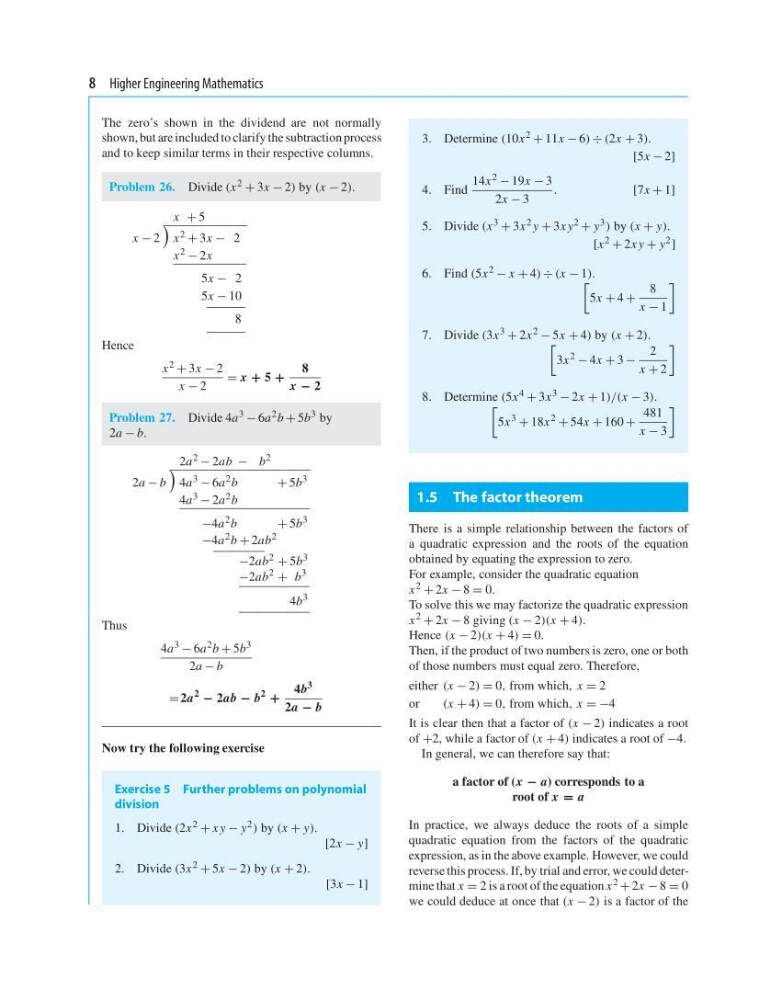
The zero’s shown in the dividend are not normally
shown, but are included to clarify the subtraction process
and to keep similar terms in their respective columns.
Problem 26. Divide (x 2 + 3x − 2) by (x − 2).
x + 5
——————–
x − 2
x 2 + 3x − 2
x
2
− 2x
5x − 2
5x − 10
———
8
———
Hence
x 2 + 3x − 2
x − 2
= x + 5 +
8
x − 2
Problem 27. Divide 4a 3 − 6a 2 b + 5b 3 by
2a − b.
2a 2 − 2ab − b 2
———————————
2a − b
4a 3 − 6a 2 b
+ 5b 3
4a 3 − 2a 2 b
−4a 2 b
+ 5b 3
−4a 2 b + 2ab 2
————
−2ab 2 + 5b 3
−2ab
2
+ b
3
—————–
4b
3
—————–
Thus
4a 3 − 6a 2 b + 5b 3
2a − b
= 2a
2
− 2ab − b
2
+
4b
3
2a − b
Now try the following exercise
Exercise 5 Further problems on polynomial
division
1. Divide (2x 2 + x y − y 2 ) by (x + y).
[2x − y]
2. Divide (3x 2 + 5x − 2) by (x + 2).
[3x − 1]
3. Determine (10x 2 + 11x − 6) ÷ (2x + 3).
[5x − 2]
4. Find
14x 2 − 19x − 3
2x − 3
.
[ 7 x + 1]
5. Divide (x 3 + 3x 2 y + 3x y 2 + y 3 ) by (x + y).
[x 2 + 2x y + y 2 ]
6. Find (5x 2 − x + 4) ÷ (x − 1).
5x + 4 +
8
x − 1
7. Divide (3x 3 + 2x 2 − 5x + 4) by (x + 2).
3x 2 − 4x + 3 −
2
x + 2
8. Determine (5x 4 + 3x 3 − 2x + 1)/(x − 3).
5x
3
+ 18x
2
+ 54x + 160 +
481
x − 3
1.5 The factor theorem
There is a simple relationship between the factors of
a quadratic expression and the roots of the equation
obtained by equating the expression to zero.
For example, consider the quadratic equation
x 2 + 2x − 8 = 0.
To solve this we may factorize the quadratic expression
x
2
+ 2x − 8 giving (x − 2)(x + 4).
Hence (x − 2)(x + 4) = 0.
Then, if the product of two numbers is zero, one or both
of those numbers must equal zero. Therefore,
either (x − 2) = 0, from which, x = 2
or
(x + 4) = 0, from which, x = −4
It is clear then that a factor of (x − 2) indicates a root
of +2, while a factor of (x + 4) indicates a root of −4.
In general, we can therefore say that:
a factor of (x − a) corresponds to a
root of x = a
In practice, we always deduce the roots of a simple
quadratic equation from the factors of the quadratic
expression, as in the above example. However, we could
reverse this process. If, by trial and error, we could determine that x = 2 is a root of the equation x 2 + 2x − 8 = 0
we could deduce at once that (x − 2) is a factor of the
The zero’s shown in the dividend are not normally
shown, but are included to clarify the subtraction process
and to keep similar terms in their respective columns.
Problem 26. Divide (x 2 + 3x − 2) by (x − 2).
x + 5
——————–
x − 2
x 2 + 3x − 2
x
2
− 2x
5x − 2
5x − 10
———
8
———
Hence
x 2 + 3x − 2
x − 2
= x + 5 +
8
x − 2
Problem 27. Divide 4a 3 − 6a 2 b + 5b 3 by
2a − b.
2a 2 − 2ab − b 2
———————————
2a − b
4a 3 − 6a 2 b
+ 5b 3
4a 3 − 2a 2 b
−4a 2 b
+ 5b 3
−4a 2 b + 2ab 2
————
−2ab 2 + 5b 3
−2ab
2
+ b
3
—————–
4b
3
—————–
Thus
4a 3 − 6a 2 b + 5b 3
2a − b
= 2a
2
− 2ab − b
2
+
4b
3
2a − b
Now try the following exercise
Exercise 5 Further problems on polynomial
division
1. Divide (2x 2 + x y − y 2 ) by (x + y).
[2x − y]
2. Divide (3x 2 + 5x − 2) by (x + 2).
[3x − 1]
3. Determine (10x 2 + 11x − 6) ÷ (2x + 3).
[5x − 2]
4. Find
14x 2 − 19x − 3
2x − 3
.
[ 7 x + 1]
5. Divide (x 3 + 3x 2 y + 3x y 2 + y 3 ) by (x + y).
[x 2 + 2x y + y 2 ]
6. Find (5x 2 − x + 4) ÷ (x − 1).
5x + 4 +
8
x − 1
7. Divide (3x 3 + 2x 2 − 5x + 4) by (x + 2).
3x 2 − 4x + 3 −
2
x + 2
8. Determine (5x 4 + 3x 3 − 2x + 1)/(x − 3).
5x
3
+ 18x
2
+ 54x + 160 +
481
x − 3
1.5 The factor theorem
There is a simple relationship between the factors of
a quadratic expression and the roots of the equation
obtained by equating the expression to zero.
For example, consider the quadratic equation
x 2 + 2x − 8 = 0.
To solve this we may factorize the quadratic expression
x
2
+ 2x − 8 giving (x − 2)(x + 4).
Hence (x − 2)(x + 4) = 0.
Then, if the product of two numbers is zero, one or both
of those numbers must equal zero. Therefore,
either (x − 2) = 0, from which, x = 2
or
(x + 4) = 0, from which, x = −4
It is clear then that a factor of (x − 2) indicates a root
of +2, while a factor of (x + 4) indicates a root of −4.
In general, we can therefore say that:
a factor of (x − a) corresponds to a
root of x = a
In practice, we always deduce the roots of a simple
quadratic equation from the factors of the quadratic
expression, as in the above example. However, we could
reverse this process. If, by trial and error, we could determine that x = 2 is a root of the equation x 2 + 2x − 8 = 0
we could deduce at once that (x − 2) is a factor of the