

Algebra 7
Problem 23. Divide 2x
2
+ x − 3 by x − 1.
2x
2
+ x − 3 is called the dividend and x − 1 the divisor. The usual layout is shown below with the dividend
and divisor both arranged in descending powers of the
symbols.
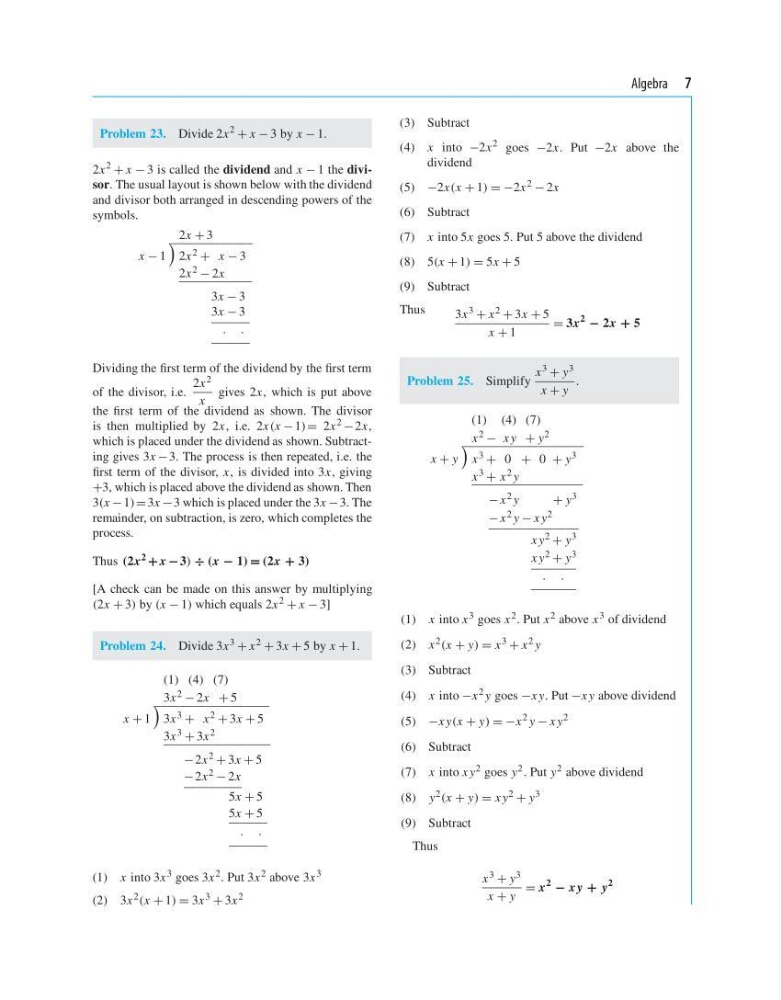
2x + 3
——————–
x − 1
2x 2 + x − 3
2x 2 − 2x
3x − 3
3x − 3
———
· ·
———
Dividing the first term of the dividend by the first term
of the divisor, i.e.
2x 2
x
gives 2x, which is put above
the first term of the dividend as shown. The divisor
is then multiplied by 2x, i.e. 2x(x − 1) = 2x 2 − 2x,
which is placed under the dividend as shown. Subtracting gives 3x − 3. The process is then repeated, i.e. the
first term of the divisor, x, is divided into 3x, giving
+3, which is placed above the dividend as shown. Then
3(x − 1) = 3x − 3 which is placed under the 3x − 3. The
remainder, on subtraction, is zero, which completes the
process.
Thus (2x 2 + x − 3) ÷ (x − 1) = (2x + 3)
[A check can be made on this answer by multiplying
(2x + 3) by (x − 1) which equals 2x 2 + x − 3]
Problem 24. Divide 3x 3 + x 2 + 3x + 5 by x + 1.
(1) (4) (7)
3x 2 − 2x + 5
—————————
x + 1
3x 3 + x 2 + 3x + 5
3x 3 + 3x 2
− 2x 2 + 3x + 5
− 2x 2 − 2x
————–
5x + 5
5x + 5
———
· ·
———
(1) x into 3x 3 goes 3x 2 . Put 3x 2 above 3x 3
(2) 3x 2 (x + 1) = 3x 3 + 3x 2
(3) Subtract
(4) x into −2x
2 goes −2x. Put −2x above the
dividend
(5) −2x(x + 1) = −2x 2 − 2x
(6) Subtract
(7) x into 5x goes 5. Put 5 above the dividend
(8) 5(x + 1) = 5x + 5
(9) Subtract
Thus
3x 3 + x 2 + 3x + 5
x + 1
= 3x
2
− 2x + 5
Problem 25. Simplify
x 3 + y 3
x + y
.
(1) (4) (7)
x 2 − x y + y 2
—————————–
x + y
x 3 + 0 + 0 + y 3
x 3 + x 2 y
− x 2 y
+ y 3
− x 2 y − x y 2
———————
x y 2 + y 3
x y 2 + y 3
———–
· ·
———–
(1) x into x 3 goes x 2 . Put x 2 above x 3 of dividend
(2) x 2 (x + y) = x 3 + x 2 y
(3) Subtract
(4) x into −x 2 y goes −x y. Put −x y above dividend
(5) −x y(x + y) = −x
2 y − x y
2
(6) Subtract
(7) x into x y 2 goes y 2 . Put y 2 above dividend
(8) y 2 (x + y) = x y 2 + y 3
(9) Subtract
Thus
x 3 + y 3
x + y
= x
2
− xy + y
2
Problem 23. Divide 2x
2
+ x − 3 by x − 1.
2x
2
+ x − 3 is called the dividend and x − 1 the divisor. The usual layout is shown below with the dividend
and divisor both arranged in descending powers of the
symbols.
2x + 3
——————–
x − 1
2x 2 + x − 3
2x 2 − 2x
3x − 3
3x − 3
———
· ·
———
Dividing the first term of the dividend by the first term
of the divisor, i.e.
2x 2
x
gives 2x, which is put above
the first term of the dividend as shown. The divisor
is then multiplied by 2x, i.e. 2x(x − 1) = 2x 2 − 2x,
which is placed under the dividend as shown. Subtracting gives 3x − 3. The process is then repeated, i.e. the
first term of the divisor, x, is divided into 3x, giving
+3, which is placed above the dividend as shown. Then
3(x − 1) = 3x − 3 which is placed under the 3x − 3. The
remainder, on subtraction, is zero, which completes the
process.
Thus (2x 2 + x − 3) ÷ (x − 1) = (2x + 3)
[A check can be made on this answer by multiplying
(2x + 3) by (x − 1) which equals 2x 2 + x − 3]
Problem 24. Divide 3x 3 + x 2 + 3x + 5 by x + 1.
(1) (4) (7)
3x 2 − 2x + 5
—————————
x + 1
3x 3 + x 2 + 3x + 5
3x 3 + 3x 2
− 2x 2 + 3x + 5
− 2x 2 − 2x
————–
5x + 5
5x + 5
———
· ·
———
(1) x into 3x 3 goes 3x 2 . Put 3x 2 above 3x 3
(2) 3x 2 (x + 1) = 3x 3 + 3x 2
(3) Subtract
(4) x into −2x
2 goes −2x. Put −2x above the
dividend
(5) −2x(x + 1) = −2x 2 − 2x
(6) Subtract
(7) x into 5x goes 5. Put 5 above the dividend
(8) 5(x + 1) = 5x + 5
(9) Subtract
Thus
3x 3 + x 2 + 3x + 5
x + 1
= 3x
2
− 2x + 5
Problem 25. Simplify
x 3 + y 3
x + y
.
(1) (4) (7)
x 2 − x y + y 2
—————————–
x + y
x 3 + 0 + 0 + y 3
x 3 + x 2 y
− x 2 y
+ y 3
− x 2 y − x y 2
———————
x y 2 + y 3
x y 2 + y 3
———–
· ·
———–
(1) x into x 3 goes x 2 . Put x 2 above x 3 of dividend
(2) x 2 (x + y) = x 3 + x 2 y
(3) Subtract
(4) x into −x 2 y goes −x y. Put −x y above dividend
(5) −x y(x + y) = −x
2 y − x y
2
(6) Subtract
(7) x into x y 2 goes y 2 . Put y 2 above dividend
(8) y 2 (x + y) = x y 2 + y 3
(9) Subtract
Thus
x 3 + y 3
x + y
= x
2
− xy + y
2