

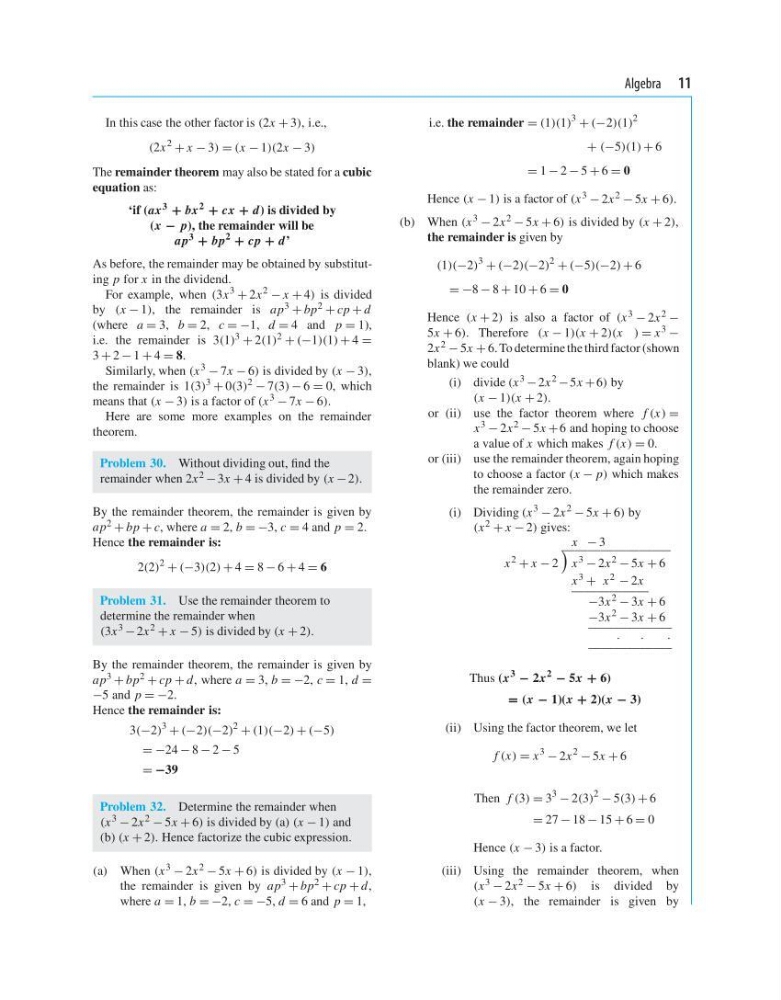
Algebra 11
In this case the other factor is (2x + 3), i.e.,
(2x
2
+ x − 3) = (x − 1)(2x − 3)
The remainder theorem may also be stated for a cubic
equation as:
‘if (ax 3 + bx
2
+ cx + d) is divided by
(x − p), the remainder will be
ap 3 + bp
2
+ cp + d’
As before, the remainder may be obtained by substituting p for x in the dividend.
For example, when (3x
3
+ 2x
2
− x + 4) is divided
by (x − 1), the remainder is ap 3 + bp 2 + cp + d
(where a = 3, b = 2, c = −1, d = 4 and p = 1),
i.e. the remainder is 3(1) 3 + 2(1) 2 + (−1)(1) + 4 =
3 + 2 − 1 + 4 = 8.
Similarly, when (x 3 − 7x − 6) is divided by (x − 3),
the remainder is 1(3)
3
+ 0(3)
2
− 7(3) − 6 = 0, which
means that (x − 3) is a factor of (x 3 − 7x − 6).
Here are some more examples on the remainder
theorem.
Problem 30. Without dividing out, find the
remainder when 2x 2 − 3x + 4 is divided by (x − 2).
By the remainder theorem, the remainder is given by
ap 2 + bp + c, where a = 2, b = −3, c = 4 and p = 2.
Hence the remainder is:
2(2)
2
+ (−3)(2) + 4 = 8 − 6 + 4 = 6
Problem 31. Use the remainder theorem to
determine the remainder when
(3x 3 − 2x 2 + x − 5) is divided by (x + 2).
By the remainder theorem, the remainder is given by
ap 3 + bp 2 + cp + d, where a = 3, b = −2, c = 1, d =
−5 and p = −2.
Hence the remainder is:
3(−2)
3
+ (−2)(−2)
2
+ (1)(−2) + (−5)
= −24 − 8 − 2 − 5
= −39
Problem 32. Determine the remainder when
(x 3 − 2x 2 − 5x + 6) is divided by (a) (x − 1) and
(b) (x + 2). Hence factorize the cubic expression.
(a) When (x 3 − 2x 2 − 5x + 6) is divided by (x − 1),
the remainder is given by ap 3 + bp 2 + cp + d,
where a = 1, b = −2, c = −5, d = 6 and p = 1,
i.e. the remainder = (1)(1)
3
+ (−2)(1)
2
+ (−5)(1) + 6
= 1 − 2 − 5 + 6 = 0
Hence (x − 1) is a factor of (x 3 − 2x 2 − 5x + 6).
(b) When (x 3 − 2x 2 − 5x + 6) is divided by (x + 2),
the remainder is given by
(1)(−2)
3
+ (−2)(−2)
2
+ (−5)(−2) + 6
= −8 − 8 + 10 + 6 = 0
Hence (x + 2) is also a factor of (x 3 − 2x 2 −
5x + 6). Therefore (x − 1)(x + 2)(x ) = x 3 −
2x 2 − 5x + 6. To determine the third factor (shown
blank) we could
(i) divide (x 3 − 2x 2 − 5x + 6) by
(x − 1)(x + 2).
or (ii) use the factor theorem where f (x) =
x 3 − 2x 2 − 5x + 6 and hoping to choose
a value of x which makes f (x) = 0.
or (iii) use the remainder theorem, again hoping
to choose a factor (x − p) which makes
the remainder zero.
(i) Dividing (x
3
− 2x
2
− 5x + 6) by
(x 2 + x − 2) gives:
x − 3
————————–
x 2 + x − 2
x 3 − 2x 2 − 5x + 6
x 3 + x 2 − 2x
——————
−3x 2 − 3x + 6
−3x
2
− 3x + 6
——————–
·
·
·
——————–
Thus (x
3
− 2x
2
− 5x + 6)
= (x − 1)(x + 2)(x − 3)
(ii) Using the factor theorem, we let
f (x) = x
3
− 2x
2
− 5x + 6
Then f (3) = 3
3
− 2(3)
2
− 5(3) + 6
= 27 − 18 − 15 + 6 = 0
Hence (x − 3) is a factor.
(iii) Using the remainder theorem, when
(x 3 − 2x 2 − 5x + 6) is divided by
(x − 3), the remainder is given by
In this case the other factor is (2x + 3), i.e.,
(2x
2
+ x − 3) = (x − 1)(2x − 3)
The remainder theorem may also be stated for a cubic
equation as:
‘if (ax 3 + bx
2
+ cx + d) is divided by
(x − p), the remainder will be
ap 3 + bp
2
+ cp + d’
As before, the remainder may be obtained by substituting p for x in the dividend.
For example, when (3x
3
+ 2x
2
− x + 4) is divided
by (x − 1), the remainder is ap 3 + bp 2 + cp + d
(where a = 3, b = 2, c = −1, d = 4 and p = 1),
i.e. the remainder is 3(1) 3 + 2(1) 2 + (−1)(1) + 4 =
3 + 2 − 1 + 4 = 8.
Similarly, when (x 3 − 7x − 6) is divided by (x − 3),
the remainder is 1(3)
3
+ 0(3)
2
− 7(3) − 6 = 0, which
means that (x − 3) is a factor of (x 3 − 7x − 6).
Here are some more examples on the remainder
theorem.
Problem 30. Without dividing out, find the
remainder when 2x 2 − 3x + 4 is divided by (x − 2).
By the remainder theorem, the remainder is given by
ap 2 + bp + c, where a = 2, b = −3, c = 4 and p = 2.
Hence the remainder is:
2(2)
2
+ (−3)(2) + 4 = 8 − 6 + 4 = 6
Problem 31. Use the remainder theorem to
determine the remainder when
(3x 3 − 2x 2 + x − 5) is divided by (x + 2).
By the remainder theorem, the remainder is given by
ap 3 + bp 2 + cp + d, where a = 3, b = −2, c = 1, d =
−5 and p = −2.
Hence the remainder is:
3(−2)
3
+ (−2)(−2)
2
+ (1)(−2) + (−5)
= −24 − 8 − 2 − 5
= −39
Problem 32. Determine the remainder when
(x 3 − 2x 2 − 5x + 6) is divided by (a) (x − 1) and
(b) (x + 2). Hence factorize the cubic expression.
(a) When (x 3 − 2x 2 − 5x + 6) is divided by (x − 1),
the remainder is given by ap 3 + bp 2 + cp + d,
where a = 1, b = −2, c = −5, d = 6 and p = 1,
i.e. the remainder = (1)(1)
3
+ (−2)(1)
2
+ (−5)(1) + 6
= 1 − 2 − 5 + 6 = 0
Hence (x − 1) is a factor of (x 3 − 2x 2 − 5x + 6).
(b) When (x 3 − 2x 2 − 5x + 6) is divided by (x + 2),
the remainder is given by
(1)(−2)
3
+ (−2)(−2)
2
+ (−5)(−2) + 6
= −8 − 8 + 10 + 6 = 0
Hence (x + 2) is also a factor of (x 3 − 2x 2 −
5x + 6). Therefore (x − 1)(x + 2)(x ) = x 3 −
2x 2 − 5x + 6. To determine the third factor (shown
blank) we could
(i) divide (x 3 − 2x 2 − 5x + 6) by
(x − 1)(x + 2).
or (ii) use the factor theorem where f (x) =
x 3 − 2x 2 − 5x + 6 and hoping to choose
a value of x which makes f (x) = 0.
or (iii) use the remainder theorem, again hoping
to choose a factor (x − p) which makes
the remainder zero.
(i) Dividing (x
3
− 2x
2
− 5x + 6) by
(x 2 + x − 2) gives:
x − 3
————————–
x 2 + x − 2
x 3 − 2x 2 − 5x + 6
x 3 + x 2 − 2x
——————
−3x 2 − 3x + 6
−3x
2
− 3x + 6
——————–
·
·
·
——————–
Thus (x
3
− 2x
2
− 5x + 6)
= (x − 1)(x + 2)(x − 3)
(ii) Using the factor theorem, we let
f (x) = x
3
− 2x
2
− 5x + 6
Then f (3) = 3
3
− 2(3)
2
− 5(3) + 6
= 27 − 18 − 15 + 6 = 0
Hence (x − 3) is a factor.
(iii) Using the remainder theorem, when
(x 3 − 2x 2 − 5x + 6) is divided by
(x − 3), the remainder is given by