

262 Higher Engineering Mathematics
R
0
227.67
26.99
␣
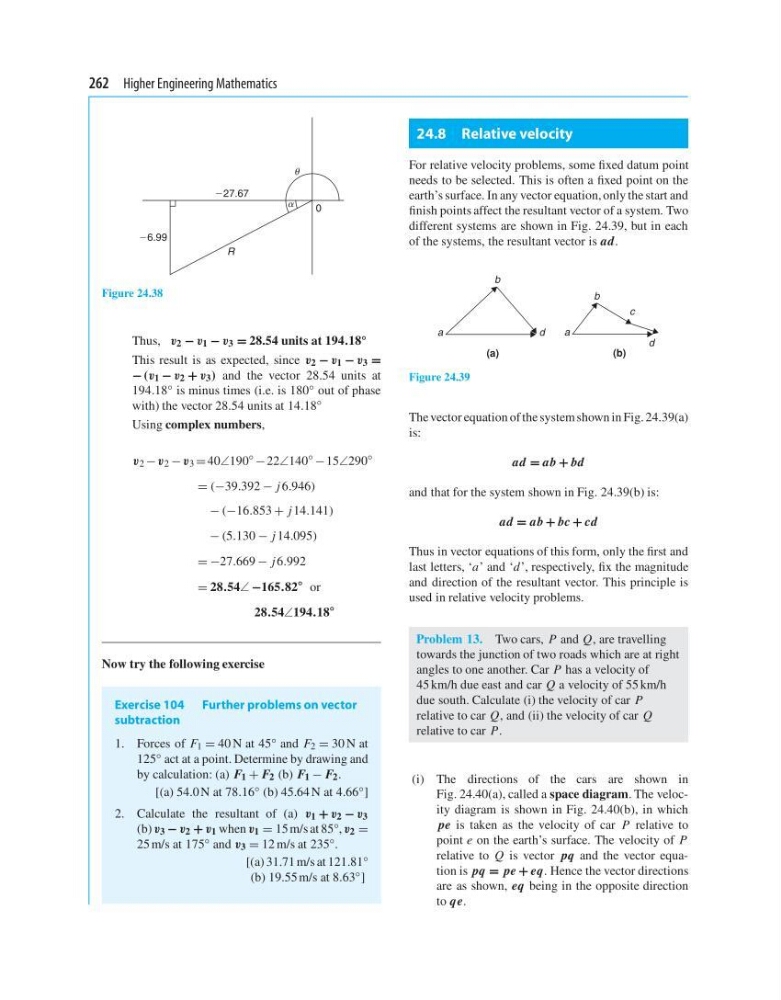
Figure 24.38
Thus, v 2 − v 1 − v 3 = 28.54 units at 194.18 ◦
This result is as expected, since v 2 − v 1 − v 3 =
− (v 1 − v 2 + v 3 ) and the vector 28.54 units at
194.18 ◦ is minus times (i.e. is 180 ◦ out of phase
with) the vector 28.54 units at 14.18 ◦
Using complex numbers,
v 2 − v 2 − v 3 = 40∠190
◦
− 22∠140
◦
− 15∠290
◦
= (−39.392 − j 6.946)
− (−16.853 + j 14.141)
− (5.130 − j 14.095)
= −27.669 − j 6.992
= 28.54∠ −165.82
◦ or
28.54∠194.18
◦
Now try the following exercise
Exercise 104 Further problems on vector
subtraction
1. Forces of F 1 = 40 N at 45 ◦ and F 2 = 30 N at
125 ◦ act at a point. Determine by drawing and
by calculation: (a) F 1 + F 2 (b) F 1 − F 2 .
[(a) 54.0 N at 78.16 ◦ (b) 45.64 N at 4.66 ◦ ]
2. Calculate the resultant of (a) v 1 + v 2 − v 3
(b) v 3 − v 2 + v 1 when v 1 = 15 m/s at 85 ◦ , v 2 =
25 m/s at 175 ◦ and v 3 = 12 m/s at 235 ◦ .
[(a) 31.71 m/s at 121.81 ◦
(b) 19.55 m/s at 8.63 ◦ ]
24.8 Relative velocity
For relative velocity problems, some fixed datum point
needs to be selected. This is often a fixed point on the
earth’s surface. In any vector equation, only the start and
finish points affect the resultant vector of a system. Two
different systems are shown in Fig. 24.39, but in each
of the systems, the resultant vector is ad.
a
d
b
(a)
a
d
b
c
(b)
Figure 24.39
The vector equation of the system shown in Fig. 24.39(a)
is:
ad = ab + bd
and that for the system shown in Fig. 24.39(b) is:
ad = ab + bc + cd
Thus in vector equations of this form, only the first and
last letters, ‘a’ and ‘d’, respectively, fix the magnitude
and direction of the resultant vector. This principle is
used in relative velocity problems.
Problem 13. Two cars, P and Q, are travelling
towards the junction of two roads which are at right
angles to one another. Car P has a velocity of
45 km/h due east and car Q a velocity of 55 km/h
due south. Calculate (i) the velocity of car P
relative to car Q, and (ii) the velocity of car Q
relative to car P.
(i) The directions of the cars are shown in
Fig. 24.40(a), called a space diagram. The velocity diagram is shown in Fig. 24.40(b), in which
pe is taken as the velocity of car P relative to
point e on the earth’s surface. The velocity of P
relative to Q is vector pq and the vector equation is pq = pe + eq. Hence the vector directions
are as shown, eq being in the opposite direction
to qe.
R
0
227.67
26.99
␣
Figure 24.38
Thus, v 2 − v 1 − v 3 = 28.54 units at 194.18 ◦
This result is as expected, since v 2 − v 1 − v 3 =
− (v 1 − v 2 + v 3 ) and the vector 28.54 units at
194.18 ◦ is minus times (i.e. is 180 ◦ out of phase
with) the vector 28.54 units at 14.18 ◦
Using complex numbers,
v 2 − v 2 − v 3 = 40∠190
◦
− 22∠140
◦
− 15∠290
◦
= (−39.392 − j 6.946)
− (−16.853 + j 14.141)
− (5.130 − j 14.095)
= −27.669 − j 6.992
= 28.54∠ −165.82
◦ or
28.54∠194.18
◦
Now try the following exercise
Exercise 104 Further problems on vector
subtraction
1. Forces of F 1 = 40 N at 45 ◦ and F 2 = 30 N at
125 ◦ act at a point. Determine by drawing and
by calculation: (a) F 1 + F 2 (b) F 1 − F 2 .
[(a) 54.0 N at 78.16 ◦ (b) 45.64 N at 4.66 ◦ ]
2. Calculate the resultant of (a) v 1 + v 2 − v 3
(b) v 3 − v 2 + v 1 when v 1 = 15 m/s at 85 ◦ , v 2 =
25 m/s at 175 ◦ and v 3 = 12 m/s at 235 ◦ .
[(a) 31.71 m/s at 121.81 ◦
(b) 19.55 m/s at 8.63 ◦ ]
24.8 Relative velocity
For relative velocity problems, some fixed datum point
needs to be selected. This is often a fixed point on the
earth’s surface. In any vector equation, only the start and
finish points affect the resultant vector of a system. Two
different systems are shown in Fig. 24.39, but in each
of the systems, the resultant vector is ad.
a
d
b
(a)
a
d
b
c
(b)
Figure 24.39
The vector equation of the system shown in Fig. 24.39(a)
is:
ad = ab + bd
and that for the system shown in Fig. 24.39(b) is:
ad = ab + bc + cd
Thus in vector equations of this form, only the first and
last letters, ‘a’ and ‘d’, respectively, fix the magnitude
and direction of the resultant vector. This principle is
used in relative velocity problems.
Problem 13. Two cars, P and Q, are travelling
towards the junction of two roads which are at right
angles to one another. Car P has a velocity of
45 km/h due east and car Q a velocity of 55 km/h
due south. Calculate (i) the velocity of car P
relative to car Q, and (ii) the velocity of car Q
relative to car P.
(i) The directions of the cars are shown in
Fig. 24.40(a), called a space diagram. The velocity diagram is shown in Fig. 24.40(b), in which
pe is taken as the velocity of car P relative to
point e on the earth’s surface. The velocity of P
relative to Q is vector pq and the vector equation is pq = pe + eq. Hence the vector directions
are as shown, eq being in the opposite direction
to qe.