

Vectors 263
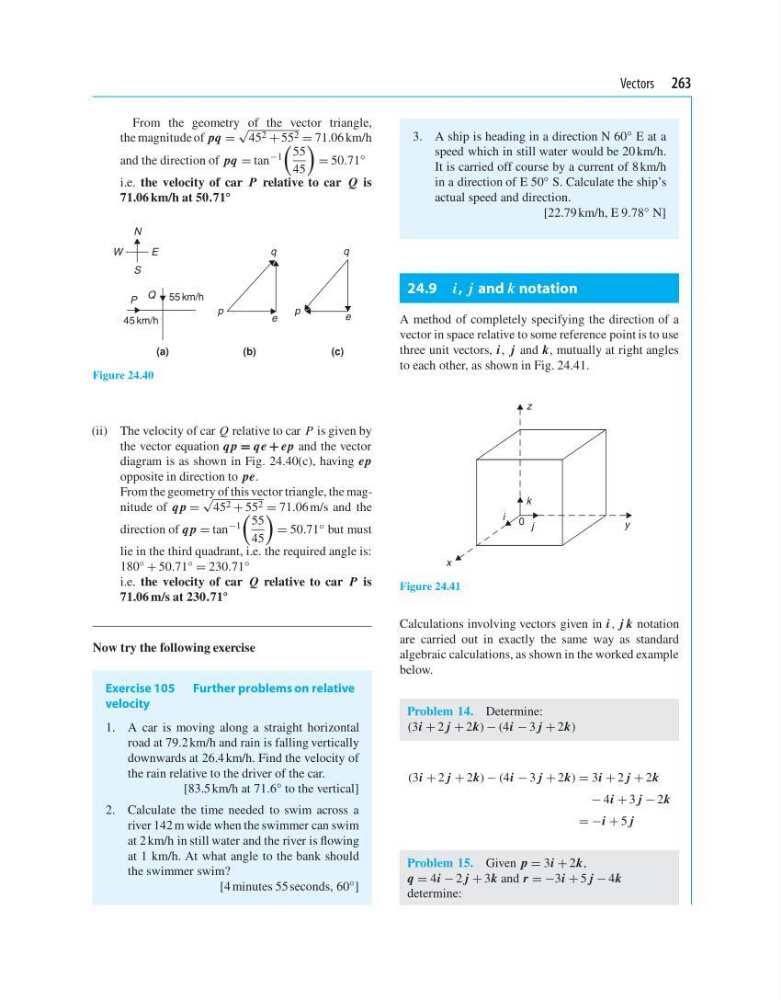
From the geometry of the vector triangle,
the magnitude of pq =
√
45 2 + 55 2 = 71.06 km/h
and the direction of pq = tan −1
55
45
= 50.71 ◦
i.e. the velocity of car P relative to car Q is
71.06 km/h at 50.71 ◦
(a)
(b)
(c)
Q
P
E
N
W
S
55 km/h
45 km/h
p
e
q
p
e
q
Figure 24.40
(ii) The velocity of car Q relative to car P is given by
the vector equation qp = qe + ep and the vector
diagram is as shown in Fig. 24.40(c), having ep
opposite in direction to pe.
From the geometry of this vector triangle, the magnitude of qp =
√
45 2 + 55 2 = 71.06 m/s and the
direction of qp = tan −1
55
45
= 50.71 ◦ but must
lie in the third quadrant, i.e. the required angle is:
180 ◦ + 50.71 ◦ = 230.71 ◦
i.e. the velocity of car Q relative to car P is
71.06 m/s at 230.71 ◦
Now try the following exercise
Exercise 105 Further problems on relative
velocity
1. A car is moving along a straight horizontal
road at 79.2 km/h and rain is falling vertically
downwards at 26.4 km/h. Find the velocity of
the rain relative to the driver of the car.
[83.5 km/h at 71.6
◦ to the vertical]
2. Calculate the time needed to swim across a
river 142 m wide when the swimmer can swim
at 2 km/h in still water and the river is flowing
at 1 km/h. At what angle to the bank should
the swimmer swim?
[4 minutes 55 seconds, 60 ◦ ]
3. A ship is heading in a direction N 60 ◦ E at a
speed which in still water would be 20 km/h.
It is carried off course by a current of 8 km/h
in a direction of E 50 ◦ S. Calculate the ship’s
actual speed and direction.
[22.79 km/h, E 9.78 ◦ N]
24.9 i, j and k notation
A method of completely specifying the direction of a
vector in space relative to some reference point is to use
three unit vectors, i, j and k, mutually at right angles
to each other, as shown in Fig. 24.41.
y
x
0
z
k
j
i
Figure 24.41
Calculations involving vectors given in i, j k notation
are carried out in exactly the same way as standard
algebraic calculations, as shown in the worked example
below.
Problem 14. Determine:
(3i + 2j + 2k) − (4i − 3j + 2k)
(3i + 2j + 2k) − (4i − 3j + 2k) = 3i + 2j + 2k
− 4i + 3j − 2k
= −i + 5j
Problem 15. Given p = 3i + 2k,
q = 4i − 2j + 3k and r = −3i + 5j − 4k
determine:
From the geometry of the vector triangle,
the magnitude of pq =
√
45 2 + 55 2 = 71.06 km/h
and the direction of pq = tan −1
55
45
= 50.71 ◦
i.e. the velocity of car P relative to car Q is
71.06 km/h at 50.71 ◦
(a)
(b)
(c)
Q
P
E
N
W
S
55 km/h
45 km/h
p
e
q
p
e
q
Figure 24.40
(ii) The velocity of car Q relative to car P is given by
the vector equation qp = qe + ep and the vector
diagram is as shown in Fig. 24.40(c), having ep
opposite in direction to pe.
From the geometry of this vector triangle, the magnitude of qp =
√
45 2 + 55 2 = 71.06 m/s and the
direction of qp = tan −1
55
45
= 50.71 ◦ but must
lie in the third quadrant, i.e. the required angle is:
180 ◦ + 50.71 ◦ = 230.71 ◦
i.e. the velocity of car Q relative to car P is
71.06 m/s at 230.71 ◦
Now try the following exercise
Exercise 105 Further problems on relative
velocity
1. A car is moving along a straight horizontal
road at 79.2 km/h and rain is falling vertically
downwards at 26.4 km/h. Find the velocity of
the rain relative to the driver of the car.
[83.5 km/h at 71.6
◦ to the vertical]
2. Calculate the time needed to swim across a
river 142 m wide when the swimmer can swim
at 2 km/h in still water and the river is flowing
at 1 km/h. At what angle to the bank should
the swimmer swim?
[4 minutes 55 seconds, 60 ◦ ]
3. A ship is heading in a direction N 60 ◦ E at a
speed which in still water would be 20 km/h.
It is carried off course by a current of 8 km/h
in a direction of E 50 ◦ S. Calculate the ship’s
actual speed and direction.
[22.79 km/h, E 9.78 ◦ N]
24.9 i, j and k notation
A method of completely specifying the direction of a
vector in space relative to some reference point is to use
three unit vectors, i, j and k, mutually at right angles
to each other, as shown in Fig. 24.41.
y
x
0
z
k
j
i
Figure 24.41
Calculations involving vectors given in i, j k notation
are carried out in exactly the same way as standard
algebraic calculations, as shown in the worked example
below.
Problem 14. Determine:
(3i + 2j + 2k) − (4i − 3j + 2k)
(3i + 2j + 2k) − (4i − 3j + 2k) = 3i + 2j + 2k
− 4i + 3j − 2k
= −i + 5j
Problem 15. Given p = 3i + 2k,
q = 4i − 2j + 3k and r = −3i + 5j − 4k
determine: