

Vectors 261
R
0
22.13
2.99
␣
Figure 24.36
Horizontal component of a 1 − a 2
= 1.5 cos90 ◦ − 2.6 cos 145 ◦ = 2.13
Vertical component of a 1 − a 2
= 1.5 sin90
◦
− 2.6 sin 145
◦
= 0
Magnitude of a 1 − a 2 =
√
2.13 2 + 0 2
= 2.13 m/s
2
Direction of a 1 − a 2 = tan
−1
0
2.13
= 0
◦
Thus,
a 1 − a 2 = 2.13 m/s 2 at 0 ◦
Problem 12. Calculate the resultant of (i)
v 1 − v 2 + v 3 and (ii) v 2 − v 1 − v 3 when v 1 = 22
units at 140 ◦ , v 2 = 40 units at 190 ◦ and v 3 = 15
units at 290 ◦ .
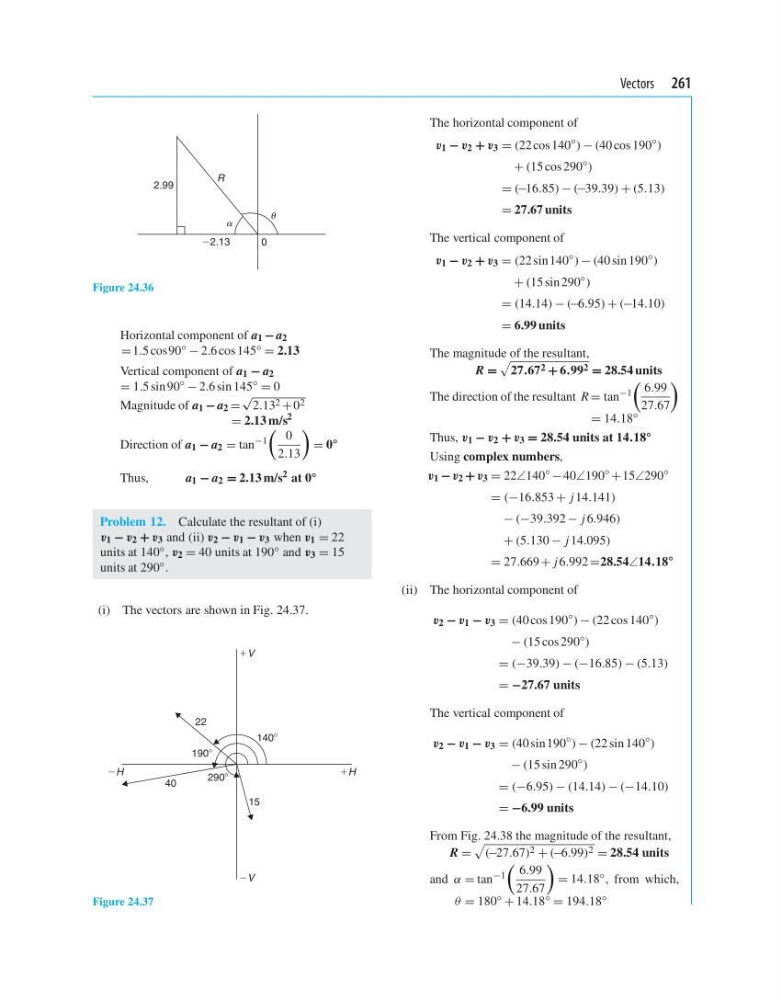
(i) The vectors are shown in Fig. 24.37.
15
40
22
1408
1908
2908
2H
1H
1V
2V
Figure 24.37
The horizontal component of
v 1 − v 2 + v 3 = (22 cos 140
◦
) − (40 cos 190
◦
)
+ (15 cos 290
◦
)
= (−16.85) − (−39.39) + (5.13)
= 27.67 units
The vertical component of
v 1 − v 2 + v 3 = (22 sin 140
◦
) − (40 sin 190
◦
)
+ (15 sin 290
◦
)
= (14.14) − (−6.95) + (−14.10)
= 6.99 units
The magnitude of the resultant,
R =
27.67 2 + 6.99 2 = 28.54 units
The direction of the resultant R = tan −1
6.99
27.67
= 14.18 ◦
Thus, v 1 − v 2 + v 3 = 28.54 units at 14.18 ◦
Using complex numbers,
v 1 − v 2 + v 3 = 22∠140
◦
− 40∠190
◦
+ 15∠290
◦
= (−16.853 + j 14.141)
− (−39.392 − j 6.946)
+ (5.130 − j 14.095)
= 27.669 + j 6.992 =28.54∠14.18
◦
(ii) The horizontal component of
v 2 − v 1 − v 3 = (40 cos 190
◦
) − (22 cos 140
◦
)
− (15 cos 290
◦
)
= (−39.39) − (−16.85) − (5.13)
= −27.67 units
The vertical component of
v 2 − v 1 − v 3 = (40 sin 190
◦
) − (22 sin 140
◦
)
− (15 sin 290
◦
)
= (−6.95) − (14.14) − (−14.10)
= −6.99 units
From Fig. 24.38 the magnitude of the resultant,
R =
(−27.67) 2 + (−6.99) 2 = 28.54 units
and α = tan −1
6.99
27.67
= 14.18 ◦ , from which,
θ = 180 ◦ + 14.18 ◦ = 194.18 ◦
R
0
22.13
2.99
␣
Figure 24.36
Horizontal component of a 1 − a 2
= 1.5 cos90 ◦ − 2.6 cos 145 ◦ = 2.13
Vertical component of a 1 − a 2
= 1.5 sin90
◦
− 2.6 sin 145
◦
= 0
Magnitude of a 1 − a 2 =
√
2.13 2 + 0 2
= 2.13 m/s
2
Direction of a 1 − a 2 = tan
−1
0
2.13
= 0
◦
Thus,
a 1 − a 2 = 2.13 m/s 2 at 0 ◦
Problem 12. Calculate the resultant of (i)
v 1 − v 2 + v 3 and (ii) v 2 − v 1 − v 3 when v 1 = 22
units at 140 ◦ , v 2 = 40 units at 190 ◦ and v 3 = 15
units at 290 ◦ .
(i) The vectors are shown in Fig. 24.37.
15
40
22
1408
1908
2908
2H
1H
1V
2V
Figure 24.37
The horizontal component of
v 1 − v 2 + v 3 = (22 cos 140
◦
) − (40 cos 190
◦
)
+ (15 cos 290
◦
)
= (−16.85) − (−39.39) + (5.13)
= 27.67 units
The vertical component of
v 1 − v 2 + v 3 = (22 sin 140
◦
) − (40 sin 190
◦
)
+ (15 sin 290
◦
)
= (14.14) − (−6.95) + (−14.10)
= 6.99 units
The magnitude of the resultant,
R =
27.67 2 + 6.99 2 = 28.54 units
The direction of the resultant R = tan −1
6.99
27.67
= 14.18 ◦
Thus, v 1 − v 2 + v 3 = 28.54 units at 14.18 ◦
Using complex numbers,
v 1 − v 2 + v 3 = 22∠140
◦
− 40∠190
◦
+ 15∠290
◦
= (−16.853 + j 14.141)
− (−39.392 − j 6.946)
+ (5.130 − j 14.095)
= 27.669 + j 6.992 =28.54∠14.18
◦
(ii) The horizontal component of
v 2 − v 1 − v 3 = (40 cos 190
◦
) − (22 cos 140
◦
)
− (15 cos 290
◦
)
= (−39.39) − (−16.85) − (5.13)
= −27.67 units
The vertical component of
v 2 − v 1 − v 3 = (40 sin 190
◦
) − (22 sin 140
◦
)
− (15 sin 290
◦
)
= (−6.95) − (14.14) − (−14.10)
= −6.99 units
From Fig. 24.38 the magnitude of the resultant,
R =
(−27.67) 2 + (−6.99) 2 = 28.54 units
and α = tan −1
6.99
27.67
= 14.18 ◦ , from which,
θ = 180 ◦ + 14.18 ◦ = 194.18 ◦