

258 Higher Engineering Mathematics
Thus, the resultant of the two accelerations is a single
vector of 31.76 m/s 2 at 118.18 ◦ to the horizontal.
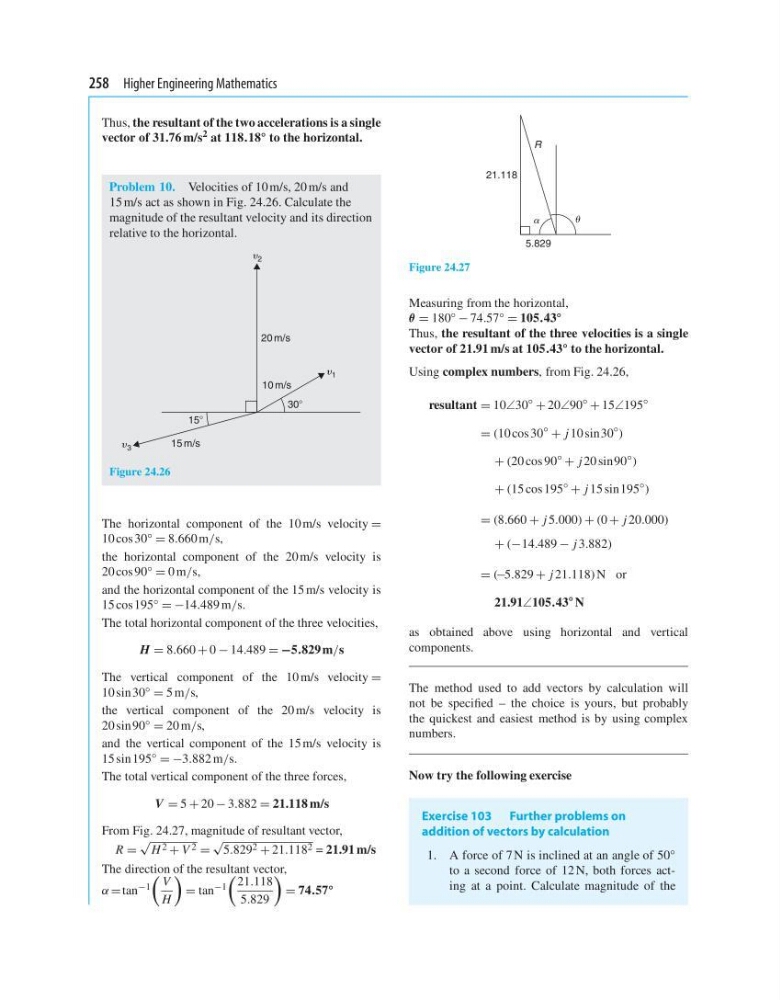
Problem 10. Velocities of 10 m/s, 20 m/s and
15 m/s act as shown in Fig. 24.26. Calculate the
magnitude of the resultant velocity and its direction
relative to the horizontal.
20 m/s
10 m/s
15 m/s
158
308
1
2
3
Figure 24.26
The horizontal component of the 10 m/s velocity =
10 cos 30 ◦ = 8.660 m/s,
the horizontal component of the 20 m/s velocity is
20 cos 90 ◦ = 0 m/s,
and the horizontal component of the 15 m/s velocity is
15 cos195 ◦ = −14.489 m/s.
The total horizontal component of the three velocities,
H = 8.660 + 0 − 14.489 = −5.829 m/s
The vertical component of the 10 m/s velocity =
10 sin 30 ◦ = 5 m/s,
the vertical component of the 20 m/s velocity is
20 sin 90 ◦ = 20 m/s,
and the vertical component of the 15 m/s velocity is
15 sin 195 ◦ = −3.882 m/s.
The total vertical component of the three forces,
V = 5 + 20 − 3.882 = 21.118 m/s
From Fig. 24.27, magnitude of resultant vector,
R =
√
H 2 + V 2 =
√
5.829 2 + 21.118 2 = 21.91 m/s
The direction of the resultant vector,
α = tan −1
V
H
= tan −1
21.118
5.829
= 74.57 ◦
5.829
21.118
R
␣
Figure 24.27
Measuring from the horizontal,
θ = 180 ◦ − 74.57 ◦ = 105.43 ◦
Thus, the resultant of the three velocities is a single
vector of 21.91 m/s at 105.43 ◦ to the horizontal.
Using complex numbers, from Fig. 24.26,
resultant = 10∠30
◦
+ 20∠90
◦
+ 15∠195
◦
= (10 cos 30
◦
+ j 10 sin30
◦
)
+ (20 cos 90
◦
+ j 20 sin90
◦
)
+ (15 cos 195
◦
+ j 15 sin195
◦
)
= (8.660 + j 5.000) + (0 + j 20.000)
+ (−14.489 − j 3.882)
= (−5.829 + j 21.118) N or
21.91∠105.43
◦ N
as obtained above using horizontal and vertical
components.
The method used to add vectors by calculation will
not be specified – the choice is yours, but probably
the quickest and easiest method is by using complex
numbers.
Now try the following exercise
Exercise 103 Further problems on
addition of vectors by calculation
1. A force of 7 N is inclined at an angle of 50 ◦
to a second force of 12 N, both forces acting at a point. Calculate magnitude of the
Thus, the resultant of the two accelerations is a single
vector of 31.76 m/s 2 at 118.18 ◦ to the horizontal.
Problem 10. Velocities of 10 m/s, 20 m/s and
15 m/s act as shown in Fig. 24.26. Calculate the
magnitude of the resultant velocity and its direction
relative to the horizontal.
20 m/s
10 m/s
15 m/s
158
308
1
2
3
Figure 24.26
The horizontal component of the 10 m/s velocity =
10 cos 30 ◦ = 8.660 m/s,
the horizontal component of the 20 m/s velocity is
20 cos 90 ◦ = 0 m/s,
and the horizontal component of the 15 m/s velocity is
15 cos195 ◦ = −14.489 m/s.
The total horizontal component of the three velocities,
H = 8.660 + 0 − 14.489 = −5.829 m/s
The vertical component of the 10 m/s velocity =
10 sin 30 ◦ = 5 m/s,
the vertical component of the 20 m/s velocity is
20 sin 90 ◦ = 20 m/s,
and the vertical component of the 15 m/s velocity is
15 sin 195 ◦ = −3.882 m/s.
The total vertical component of the three forces,
V = 5 + 20 − 3.882 = 21.118 m/s
From Fig. 24.27, magnitude of resultant vector,
R =
√
H 2 + V 2 =
√
5.829 2 + 21.118 2 = 21.91 m/s
The direction of the resultant vector,
α = tan −1
V
H
= tan −1
21.118
5.829
= 74.57 ◦
5.829
21.118
R
␣
Figure 24.27
Measuring from the horizontal,
θ = 180 ◦ − 74.57 ◦ = 105.43 ◦
Thus, the resultant of the three velocities is a single
vector of 21.91 m/s at 105.43 ◦ to the horizontal.
Using complex numbers, from Fig. 24.26,
resultant = 10∠30
◦
+ 20∠90
◦
+ 15∠195
◦
= (10 cos 30
◦
+ j 10 sin30
◦
)
+ (20 cos 90
◦
+ j 20 sin90
◦
)
+ (15 cos 195
◦
+ j 15 sin195
◦
)
= (8.660 + j 5.000) + (0 + j 20.000)
+ (−14.489 − j 3.882)
= (−5.829 + j 21.118) N or
21.91∠105.43
◦ N
as obtained above using horizontal and vertical
components.
The method used to add vectors by calculation will
not be specified – the choice is yours, but probably
the quickest and easiest method is by using complex
numbers.
Now try the following exercise
Exercise 103 Further problems on
addition of vectors by calculation
1. A force of 7 N is inclined at an angle of 50 ◦
to a second force of 12 N, both forces acting at a point. Calculate magnitude of the