

Vectors 257
10 N
15 N
Figure 24.22
The horizontal component of the 15 N force is 15 cos0 ◦
and the horizontal component of the 10 N force is
10 cos90 ◦
The total horizontal component of the two velocities,
H = 15 cos 0
◦
+ 10 cos 90
◦
= 15 + 0 = 15
The vertical component of the 15 N force is 15 sin 0 ◦
and the vertical component of the 10 N force is 10 sin 90 ◦
The total vertical component of the two velocities,
V = 15 sin 0
◦
+ 10 sin 90
◦
= 0 + 10 = 10
Magnitude of resultant vector
=
√
H 2 + V 2 =
√
15 2 + 10 2 = 18.03 N
The direction of the resultant vector,
θ = tan −1
V
H
= tan −1
10
15
= 33.69 ◦
Thus, the resultant of the two forces is a single vector
of 18.03 N at 33.69 ◦ to the 15 N vector.
There is an alternative method of calculating the resultant vector in this case.
If we used the triangle method, then the diagram would
be as shown in Fig. 24.23.
15 N
10 N
R
Figure 24.23
Since a right-angled triangle results then we could use
Pythagoras’s theorem without needing to go through
the procedure for horizontal and vertical components.
In fact, the horizontal and vertical components are 15 N
and 10 N respectively.
This is, of course, a special case. Pythagoras can only be
used when there is an angle of 90 ◦ between vectors.
This is demonstrated in the next worked problem.
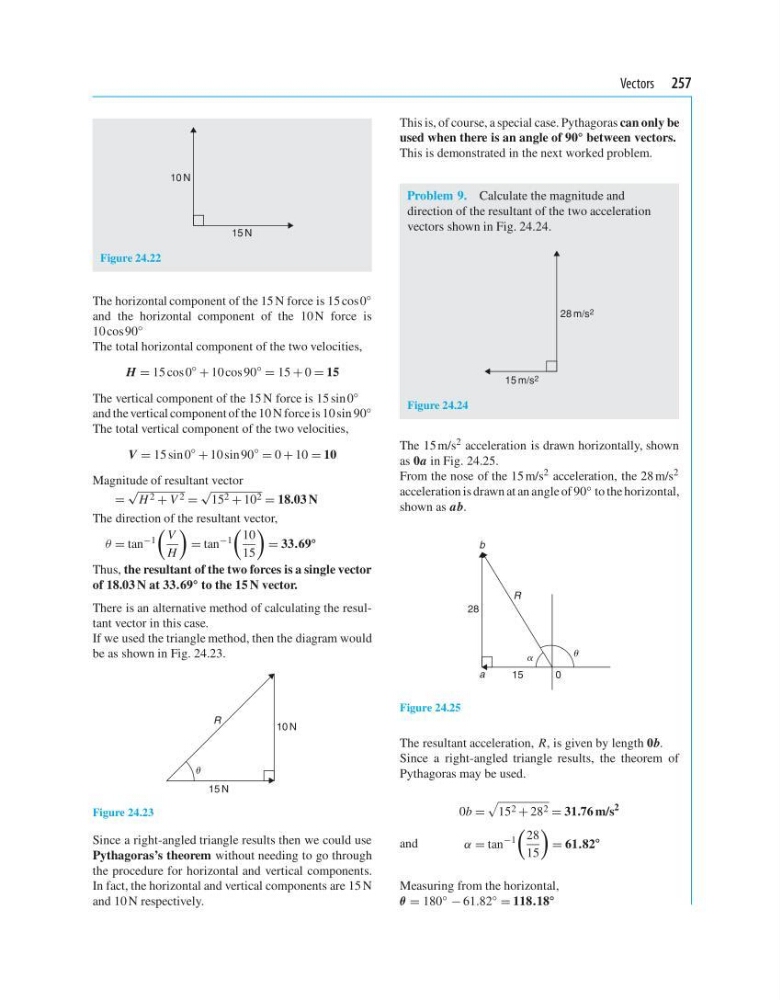
Problem 9. Calculate the magnitude and
direction of the resultant of the two acceleration
vectors shown in Fig. 24.24.
15 m/s 2
28 m/s 2
Figure 24.24
The 15 m/s 2 acceleration is drawn horizontally, shown
as 0a in Fig. 24.25.
From the nose of the 15 m/s 2 acceleration, the 28 m/s 2
acceleration is drawn at an angle of 90 ◦ to the horizontal,
shown as ab.
0
15
a
28
b
R
␣
Figure 24.25
The resultant acceleration, R, is given by length 0b.
Since a right-angled triangle results, the theorem of
Pythagoras may be used.
0b =
15 2 + 28 2 = 31.76 m/s
2
and
α = tan
−1
28
15
= 61.82
◦
Measuring from the horizontal,
θ = 180 ◦ − 61.82 ◦ = 118.18 ◦
10 N
15 N
Figure 24.22
The horizontal component of the 15 N force is 15 cos0 ◦
and the horizontal component of the 10 N force is
10 cos90 ◦
The total horizontal component of the two velocities,
H = 15 cos 0
◦
+ 10 cos 90
◦
= 15 + 0 = 15
The vertical component of the 15 N force is 15 sin 0 ◦
and the vertical component of the 10 N force is 10 sin 90 ◦
The total vertical component of the two velocities,
V = 15 sin 0
◦
+ 10 sin 90
◦
= 0 + 10 = 10
Magnitude of resultant vector
=
√
H 2 + V 2 =
√
15 2 + 10 2 = 18.03 N
The direction of the resultant vector,
θ = tan −1
V
H
= tan −1
10
15
= 33.69 ◦
Thus, the resultant of the two forces is a single vector
of 18.03 N at 33.69 ◦ to the 15 N vector.
There is an alternative method of calculating the resultant vector in this case.
If we used the triangle method, then the diagram would
be as shown in Fig. 24.23.
15 N
10 N
R
Figure 24.23
Since a right-angled triangle results then we could use
Pythagoras’s theorem without needing to go through
the procedure for horizontal and vertical components.
In fact, the horizontal and vertical components are 15 N
and 10 N respectively.
This is, of course, a special case. Pythagoras can only be
used when there is an angle of 90 ◦ between vectors.
This is demonstrated in the next worked problem.
Problem 9. Calculate the magnitude and
direction of the resultant of the two acceleration
vectors shown in Fig. 24.24.
15 m/s 2
28 m/s 2
Figure 24.24
The 15 m/s 2 acceleration is drawn horizontally, shown
as 0a in Fig. 24.25.
From the nose of the 15 m/s 2 acceleration, the 28 m/s 2
acceleration is drawn at an angle of 90 ◦ to the horizontal,
shown as ab.
0
15
a
28
b
R
␣
Figure 24.25
The resultant acceleration, R, is given by length 0b.
Since a right-angled triangle results, the theorem of
Pythagoras may be used.
0b =
15 2 + 28 2 = 31.76 m/s
2
and
α = tan
−1
28
15
= 61.82
◦
Measuring from the horizontal,
θ = 180 ◦ − 61.82 ◦ = 118.18 ◦