

256 Higher Engineering Mathematics
A method of adding two vectors together is to use
horizontal and vertical components.
The horizontal component of force F 1 is F 1 cos θ 1 and
the horizontal component of force F 2 is F 2 cos θ 2
The total horizontal component of the two forces,
H = F 1 cos θ 1 + F 2 cos θ 2
The vertical component of force F 1 is F 1 sin θ 1 and the
vertical component of force F 2 is F 2 sin θ 2
The total vertical component of the two forces,
V = F 1 sin θ 1 + F 2 sin θ 2
Since we have H and V , the resultant of F 1 and F 2
is obtained by using the theorem of Pythagoras. From
Fig. 24.19,
0b 2 = H 2 + V 2
i.e.
resultant =
H 2 + V 2
at an angle
given by θ = tan −1
V
H
V
b
R e s u l t a n t
a
H
0
Figure 24.19
Problem 7. A force of 5 N is inclined at an angle
of 45 ◦ to a second force of 8 N, both forces acting at
a point. Calculate the magnitude of the resultant of
these two forces and the direction of the resultant
with respect to the 8 N force.
The two forces are shown in Fig. 24.20.
458
8 N
5 N
Figure 24.20
The horizontal component of the 8 N force is 8 cos 0 ◦
and the horizontal component of the 5 N force is
5 cos 45 ◦
The total horizontal component of the two forces,
H = 8 cos 0
◦
+ 5 cos 45
◦
= 8 + 3.5355
= 11.5355
The vertical component of the 8 N force is 8 sin 0
◦
and the vertical component of the 5 N force is 5 sin 45 ◦
The total vertical component of the two forces,
V = 8 sin0
◦
+ 5 sin45
◦
= 0 + 3.5355
= 3.5355
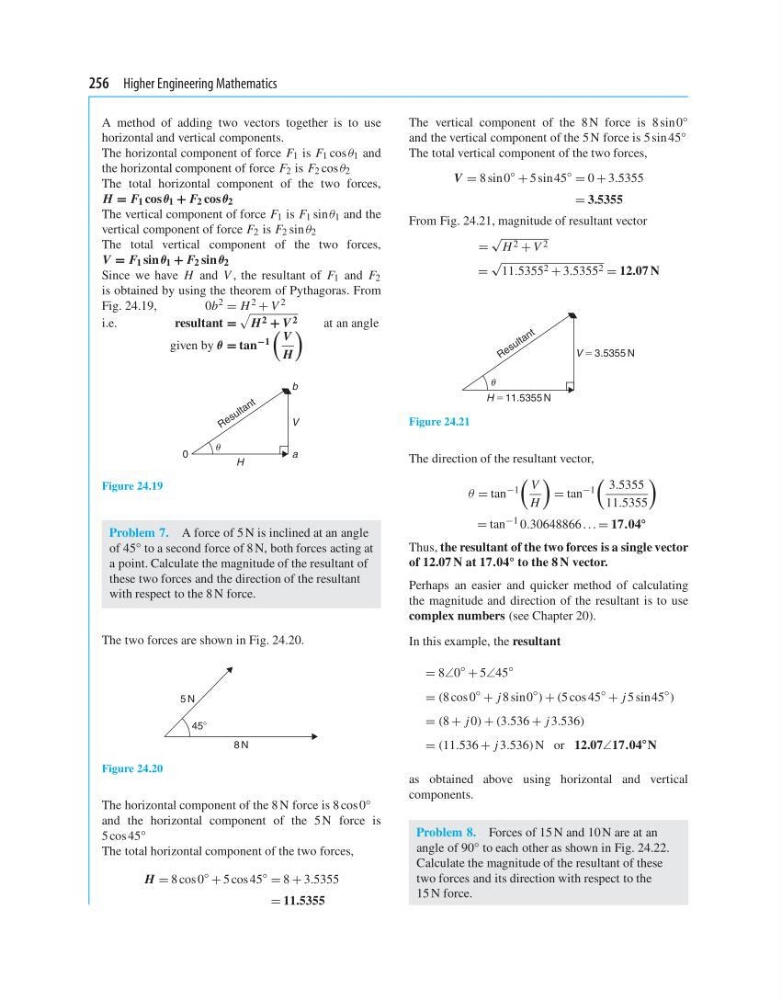
From Fig. 24.21, magnitude of resultant vector
=
√
H 2 + V 2
=
√
11.5355 2 + 3.5355 2 = 12.07 N
R e s u l t a n t
H ϭ11.5355 N
V ϭ 3.5355 N
Figure 24.21
The direction of the resultant vector,
θ = tan −1
V
H
= tan −1
3.5355
11.5355
= tan −1 0.30648866 ... = 17.04 ◦
Thus, the resultant of the two forces is a single vector
of 12.07 N at 17.04 ◦ to the 8 N vector.
Perhaps an easier and quicker method of calculating
the magnitude and direction of the resultant is to use
complex numbers (see Chapter 20).
In this example, the resultant
= 8∠0
◦
+ 5∠45
◦
= (8 cos 0
◦
+ j 8 sin0
◦
) + (5 cos 45
◦
+ j 5 sin45
◦
)
= (8 + j 0) + (3.536 + j 3.536)
= (11.536 + j 3.536) N or 12.07∠17.04
◦ N
as obtained above using horizontal and vertical
components.
Problem 8. Forces of 15 N and 10 N are at an
angle of 90 ◦ to each other as shown in Fig. 24.22.
Calculate the magnitude of the resultant of these
two forces and its direction with respect to the
15 N force.
A method of adding two vectors together is to use
horizontal and vertical components.
The horizontal component of force F 1 is F 1 cos θ 1 and
the horizontal component of force F 2 is F 2 cos θ 2
The total horizontal component of the two forces,
H = F 1 cos θ 1 + F 2 cos θ 2
The vertical component of force F 1 is F 1 sin θ 1 and the
vertical component of force F 2 is F 2 sin θ 2
The total vertical component of the two forces,
V = F 1 sin θ 1 + F 2 sin θ 2
Since we have H and V , the resultant of F 1 and F 2
is obtained by using the theorem of Pythagoras. From
Fig. 24.19,
0b 2 = H 2 + V 2
i.e.
resultant =
H 2 + V 2
at an angle
given by θ = tan −1
V
H
V
b
R e s u l t a n t
a
H
0
Figure 24.19
Problem 7. A force of 5 N is inclined at an angle
of 45 ◦ to a second force of 8 N, both forces acting at
a point. Calculate the magnitude of the resultant of
these two forces and the direction of the resultant
with respect to the 8 N force.
The two forces are shown in Fig. 24.20.
458
8 N
5 N
Figure 24.20
The horizontal component of the 8 N force is 8 cos 0 ◦
and the horizontal component of the 5 N force is
5 cos 45 ◦
The total horizontal component of the two forces,
H = 8 cos 0
◦
+ 5 cos 45
◦
= 8 + 3.5355
= 11.5355
The vertical component of the 8 N force is 8 sin 0
◦
and the vertical component of the 5 N force is 5 sin 45 ◦
The total vertical component of the two forces,
V = 8 sin0
◦
+ 5 sin45
◦
= 0 + 3.5355
= 3.5355
From Fig. 24.21, magnitude of resultant vector
=
√
H 2 + V 2
=
√
11.5355 2 + 3.5355 2 = 12.07 N
R e s u l t a n t
H ϭ11.5355 N
V ϭ 3.5355 N
Figure 24.21
The direction of the resultant vector,
θ = tan −1
V
H
= tan −1
3.5355
11.5355
= tan −1 0.30648866 ... = 17.04 ◦
Thus, the resultant of the two forces is a single vector
of 12.07 N at 17.04 ◦ to the 8 N vector.
Perhaps an easier and quicker method of calculating
the magnitude and direction of the resultant is to use
complex numbers (see Chapter 20).
In this example, the resultant
= 8∠0
◦
+ 5∠45
◦
= (8 cos 0
◦
+ j 8 sin0
◦
) + (5 cos 45
◦
+ j 5 sin45
◦
)
= (8 + j 0) + (3.536 + j 3.536)
= (11.536 + j 3.536) N or 12.07∠17.04
◦ N
as obtained above using horizontal and vertical
components.
Problem 8. Forces of 15 N and 10 N are at an
angle of 90 ◦ to each other as shown in Fig. 24.22.
Calculate the magnitude of the resultant of these
two forces and its direction with respect to the
15 N force.