

Vectors 255
From trigonometry (see Chapter 11),
cos θ =
0a
0b
from which, 0a = 0b cos θ
= F cos θ
i.e.
the horizontal component of F = F cos θ
and
sin θ =
ab
0b
from which,
ab = 0b sin θ
= F sin θ
i.e.
the vertical component of F = F sinθ
Problem 4. Resolve the force vector of 50 N at an
angle of 35
◦ to the horizontal into its horizontal and
vertical components.
The horizontal component of the 50 N force,
0a = 50 cos 35 ◦ = 40.96 N
The vertical component of the 50 N force,
ab = 50 sin 35 ◦ = 28.68 N
The horizontal and vertical components are shown in
Fig. 24.15.
358
0
40.96 N
28.68 N
50 N
a
b
Figure 24.15
(Checking: by Pythagoras, 0b =
√
40.96 2 + 28.68 2
= 50 N
and
θ = tan −1
28.68
40.96
= 35 ◦
Thus, the vector addition of components 40.96 N and
28.68 N is 50 N at 35 ◦ )
Problem 5. Resolve the velocity vector of 20 m/s
at an angle of −30 ◦ to the horizontal into horizontal
and vertical components.
The horizontal component of the 20 m/s velocity,
0a = 20 cos(−30 ◦ ) = 17.32 m/s
The vertical component of the 20 m/s velocity,
ab = 20 sin(−30 ◦ ) = −10 m/s
The horizontal and vertical components are shown in
Fig. 24.16.
308
2 0 m / s
210 m/s
17.32 m/s
b
a
0
Figure 24.16
Problem 6. Resolve the displacement vector of
40 m at an angle of 120 ◦ into horizontal and vertical
components.
The horizontal component of the 40 m displacement,
0a = 40 cos 120 ◦ = −20.0 m
The vertical component of the 40 m displacement,
ab = 40 sin 120
◦
= 34.64 m
The horizontal and vertical components are shown in
Fig. 24.17.
220.0 N
40 N
1208
0
34.64 N
a
b
Figure 24.17
24.6 Addition of vectors by
calculation
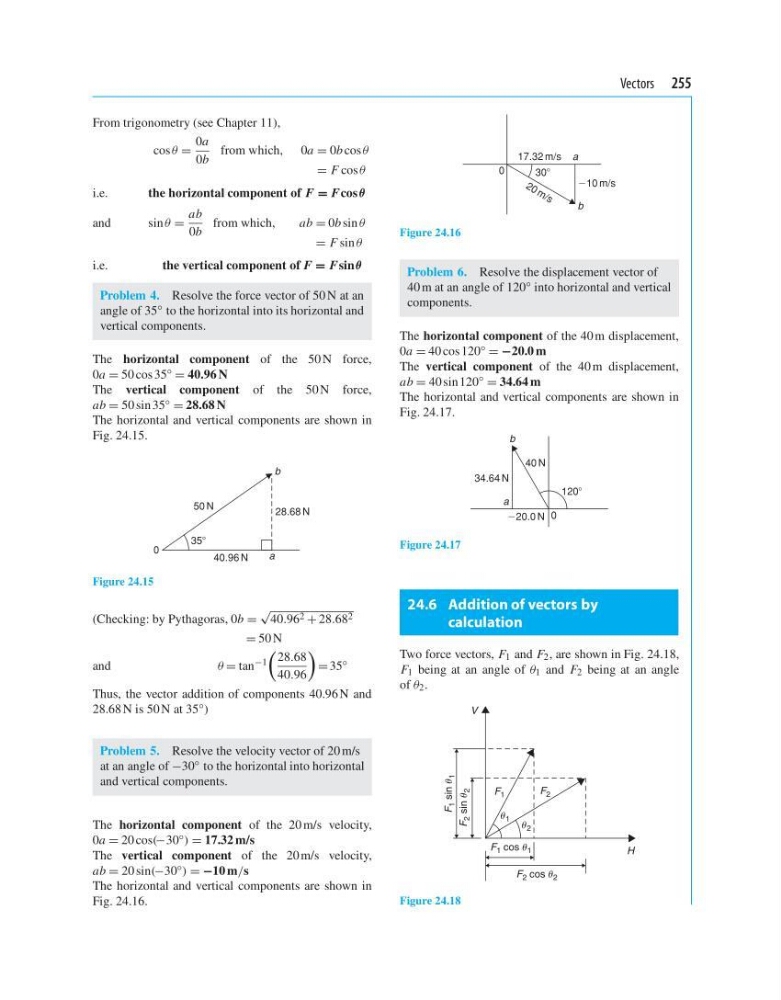
Two force vectors, F 1 and F 2 , are shown in Fig. 24.18,
F 1 being at an angle of θ 1 and F 2 being at an angle
of θ 2 .
F 1
F 2
F
1 sin
1
F
2 sin
2
H
V
1 2
F 2 cos 2
F 1 cos 1
Figure 24.18
From trigonometry (see Chapter 11),
cos θ =
0a
0b
from which, 0a = 0b cos θ
= F cos θ
i.e.
the horizontal component of F = F cos θ
and
sin θ =
ab
0b
from which,
ab = 0b sin θ
= F sin θ
i.e.
the vertical component of F = F sinθ
Problem 4. Resolve the force vector of 50 N at an
angle of 35
◦ to the horizontal into its horizontal and
vertical components.
The horizontal component of the 50 N force,
0a = 50 cos 35 ◦ = 40.96 N
The vertical component of the 50 N force,
ab = 50 sin 35 ◦ = 28.68 N
The horizontal and vertical components are shown in
Fig. 24.15.
358
0
40.96 N
28.68 N
50 N
a
b
Figure 24.15
(Checking: by Pythagoras, 0b =
√
40.96 2 + 28.68 2
= 50 N
and
θ = tan −1
28.68
40.96
= 35 ◦
Thus, the vector addition of components 40.96 N and
28.68 N is 50 N at 35 ◦ )
Problem 5. Resolve the velocity vector of 20 m/s
at an angle of −30 ◦ to the horizontal into horizontal
and vertical components.
The horizontal component of the 20 m/s velocity,
0a = 20 cos(−30 ◦ ) = 17.32 m/s
The vertical component of the 20 m/s velocity,
ab = 20 sin(−30 ◦ ) = −10 m/s
The horizontal and vertical components are shown in
Fig. 24.16.
308
2 0 m / s
210 m/s
17.32 m/s
b
a
0
Figure 24.16
Problem 6. Resolve the displacement vector of
40 m at an angle of 120 ◦ into horizontal and vertical
components.
The horizontal component of the 40 m displacement,
0a = 40 cos 120 ◦ = −20.0 m
The vertical component of the 40 m displacement,
ab = 40 sin 120
◦
= 34.64 m
The horizontal and vertical components are shown in
Fig. 24.17.
220.0 N
40 N
1208
0
34.64 N
a
b
Figure 24.17
24.6 Addition of vectors by
calculation
Two force vectors, F 1 and F 2 , are shown in Fig. 24.18,
F 1 being at an angle of θ 1 and F 2 being at an angle
of θ 2 .
F 1
F 2
F
1 sin
1
F
2 sin
2
H
V
1 2
F 2 cos 2
F 1 cos 1
Figure 24.18