

Vectors 259
resultant of the two forces, and the direction of the resultant with respect to the 12 N
force.
[17.35 N at 18.00 ◦ to the 12 N force]
2. Velocities of 5 m/s and 12 m/s act at a point
at 90 ◦ to each other. Calculate the resultant
velocity and its direction relative to the 12 m/s
velocity.
[13 m/s at 22.62 ◦ to the 12 m/s velocity]
3. Calculate the magnitude and direction of the
resultant of the two force vectors shown in
Fig. 24.28.
[16.40 N at 37.57 ◦ to the 13 N force]
10 N
13 N
Figure 24.28
4. Calculate the magnitude and direction of the
resultant of the two force vectors shown in
Fig. 24.29.
[28.43 N at 129.30 ◦ to the 18 N force]
22 N
18 N
Figure 24.29
5. A displacement vector s 1 is 30 m at 0 ◦ . A second displacement vector s 2 is 12 m at 90 ◦ .
Calculate magnitude and direction of the
resultant vector s 1 + s 2 .
[32.31 m at 21.80 ◦ to the 30 m
displacement]
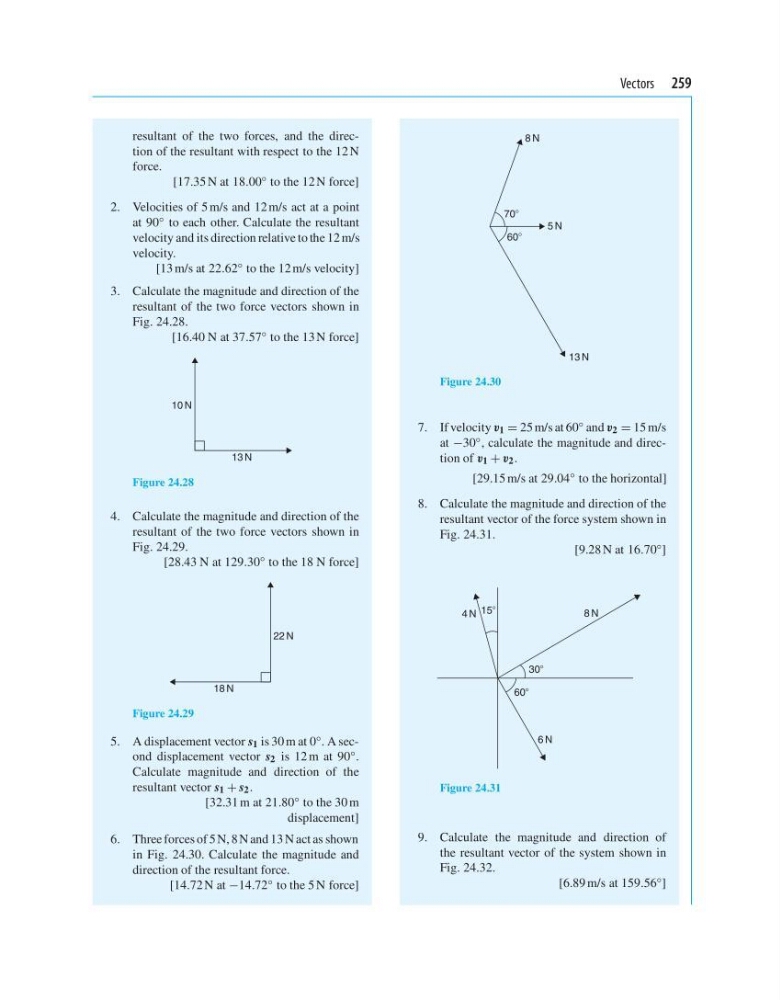
6. Three forces of 5 N, 8 N and 13 N act as shown
in Fig. 24.30. Calculate the magnitude and
direction of the resultant force.
[14.72 N at −14.72 ◦ to the 5 N force]
5 N
13 N
8 N
708
608
Figure 24.30
7. If velocity v 1 = 25 m/s at 60 ◦ and v 2 = 15 m/s
at −30 ◦ , calculate the magnitude and direction of v 1 + v 2 .
[29.15 m/s at 29.04 ◦ to the horizontal]
8. Calculate the magnitude and direction of the
resultant vector of the force system shown in
Fig. 24.31.
[9.28 N at 16.70 ◦ ]
308
158
608
6 N
8 N
4 N
Figure 24.31
9. Calculate the magnitude and direction of
the resultant vector of the system shown in
Fig. 24.32.
[6.89 m/s at 159.56 ◦ ]
resultant of the two forces, and the direction of the resultant with respect to the 12 N
force.
[17.35 N at 18.00 ◦ to the 12 N force]
2. Velocities of 5 m/s and 12 m/s act at a point
at 90 ◦ to each other. Calculate the resultant
velocity and its direction relative to the 12 m/s
velocity.
[13 m/s at 22.62 ◦ to the 12 m/s velocity]
3. Calculate the magnitude and direction of the
resultant of the two force vectors shown in
Fig. 24.28.
[16.40 N at 37.57 ◦ to the 13 N force]
10 N
13 N
Figure 24.28
4. Calculate the magnitude and direction of the
resultant of the two force vectors shown in
Fig. 24.29.
[28.43 N at 129.30 ◦ to the 18 N force]
22 N
18 N
Figure 24.29
5. A displacement vector s 1 is 30 m at 0 ◦ . A second displacement vector s 2 is 12 m at 90 ◦ .
Calculate magnitude and direction of the
resultant vector s 1 + s 2 .
[32.31 m at 21.80 ◦ to the 30 m
displacement]
6. Three forces of 5 N, 8 N and 13 N act as shown
in Fig. 24.30. Calculate the magnitude and
direction of the resultant force.
[14.72 N at −14.72 ◦ to the 5 N force]
5 N
13 N
8 N
708
608
Figure 24.30
7. If velocity v 1 = 25 m/s at 60 ◦ and v 2 = 15 m/s
at −30 ◦ , calculate the magnitude and direction of v 1 + v 2 .
[29.15 m/s at 29.04 ◦ to the horizontal]
8. Calculate the magnitude and direction of the
resultant vector of the force system shown in
Fig. 24.31.
[9.28 N at 16.70 ◦ ]
308
158
608
6 N
8 N
4 N
Figure 24.31
9. Calculate the magnitude and direction of
the resultant vector of the system shown in
Fig. 24.32.
[6.89 m/s at 159.56 ◦ ]