

Complex numbers 215
Thus, for example,
(2 + j 3) +(3 − j 4)= 2 + j 3 +3 − j 4
= 5 − j1
and (2 + j 3) −(3 − j 4)= 2 + j 3 −3 + j 4
= −1 + j7
The addition and subtraction of complex numbers may
be achieved graphically as shown in the Argand diagram
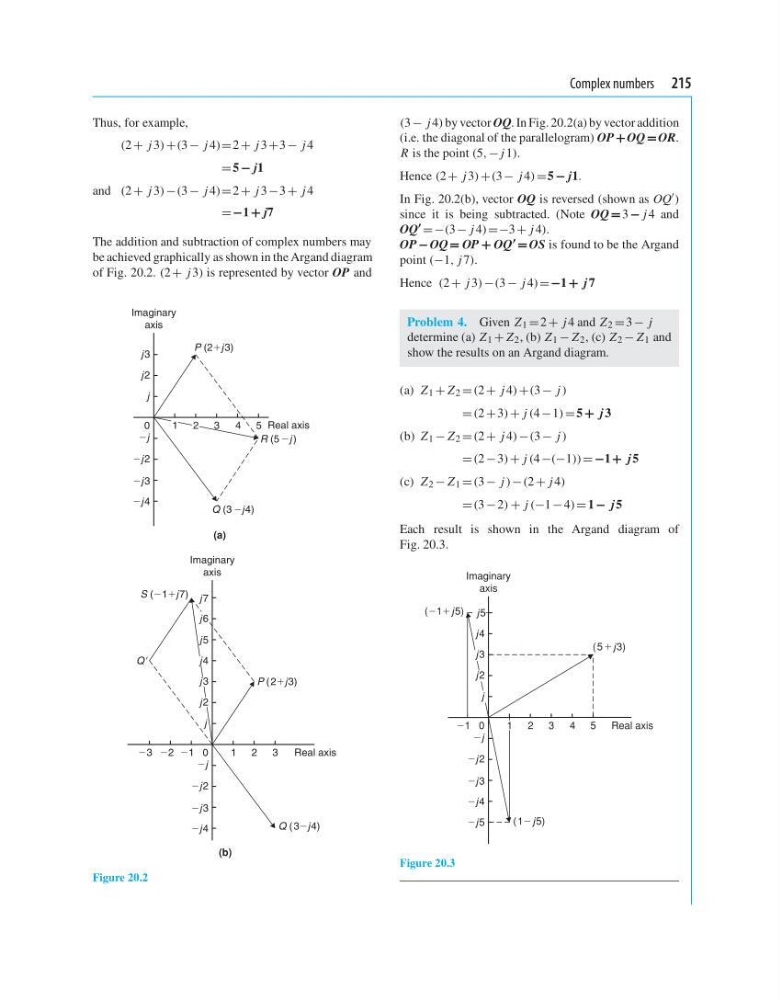
of Fig. 20.2. (2 + j 3) is represented by vector OP and
2
2j
j
2j2
j2
2j3
j3
2j4
3
4 5 Real axis
R (5 2j )
Q (3 2j 4)
P (21j3)
Imaginary
axis
0
1
(a)
(b)
2
21
22
2j
j
2j2
j2
2j3
j3
2j4
3
Real axis
Q (32j4)
P (21j3)
S (211j7)
Imaginary
axis
Q9
0
1
23
j4
j5
j7
j6
Figure 20.2
(3 − j 4) by vector OQ. In Fig. 20.2(a) by vector addition
(i.e. the diagonal of the parallelogram) OP + OQ = OR.
R is the point (5, − j 1).
Hence (2 + j 3) +(3 − j 4) =5 − j1.
In Fig. 20.2(b), vector OQ is reversed (shown as OQ )
since it is being subtracted. (Note OQ = 3 − j 4 and
OQ =−(3 − j 4) =−3 + j 4).
OP − OQ = OP + OQ = OS is found to be the Argand
point (−1, j 7).
Hence (2 + j 3) −(3 − j 4) =−1 + j 7
Problem 4. Given Z 1 = 2 + j 4 and Z 2 = 3 − j
determine (a) Z 1 + Z 2 , (b) Z 1 − Z 2 , (c) Z 2 − Z 1 and
show the results on an Argand diagram.
(a) Z 1 + Z 2 = (2 + j 4) +(3 − j )
= (2 + 3) + j (4 −1) = 5 + j 3
(b) Z 1 − Z 2 = (2 + j 4) −(3 − j )
= (2 − 3) + j (4 −(−1)) = −1 + j 5
(c) Z 2 − Z 1 = (3 − j ) −(2 + j 4)
= (3 − 2) + j (−1 − 4) = 1 − j 5
Each result is shown in the Argand diagram of
Fig. 20.3.
2
21
2j
j
2j 2
j 2
2j 3
j 3
2j 4
2j 5
3
Real axis
(12 j 5)
(51j 3)
(211 j 5)
Imaginary
axis
0
1
4 5
j 4
j 5
Figure 20.3
Thus, for example,
(2 + j 3) +(3 − j 4)= 2 + j 3 +3 − j 4
= 5 − j1
and (2 + j 3) −(3 − j 4)= 2 + j 3 −3 + j 4
= −1 + j7
The addition and subtraction of complex numbers may
be achieved graphically as shown in the Argand diagram
of Fig. 20.2. (2 + j 3) is represented by vector OP and
2
2j
j
2j2
j2
2j3
j3
2j4
3
4 5 Real axis
R (5 2j )
Q (3 2j 4)
P (21j3)
Imaginary
axis
0
1
(a)
(b)
2
21
22
2j
j
2j2
j2
2j3
j3
2j4
3
Real axis
Q (32j4)
P (21j3)
S (211j7)
Imaginary
axis
Q9
0
1
23
j4
j5
j7
j6
Figure 20.2
(3 − j 4) by vector OQ. In Fig. 20.2(a) by vector addition
(i.e. the diagonal of the parallelogram) OP + OQ = OR.
R is the point (5, − j 1).
Hence (2 + j 3) +(3 − j 4) =5 − j1.
In Fig. 20.2(b), vector OQ is reversed (shown as OQ )
since it is being subtracted. (Note OQ = 3 − j 4 and
OQ =−(3 − j 4) =−3 + j 4).
OP − OQ = OP + OQ = OS is found to be the Argand
point (−1, j 7).
Hence (2 + j 3) −(3 − j 4) =−1 + j 7
Problem 4. Given Z 1 = 2 + j 4 and Z 2 = 3 − j
determine (a) Z 1 + Z 2 , (b) Z 1 − Z 2 , (c) Z 2 − Z 1 and
show the results on an Argand diagram.
(a) Z 1 + Z 2 = (2 + j 4) +(3 − j )
= (2 + 3) + j (4 −1) = 5 + j 3
(b) Z 1 − Z 2 = (2 + j 4) −(3 − j )
= (2 − 3) + j (4 −(−1)) = −1 + j 5
(c) Z 2 − Z 1 = (3 − j ) −(2 + j 4)
= (3 − 2) + j (−1 − 4) = 1 − j 5
Each result is shown in the Argand diagram of
Fig. 20.3.
2
21
2j
j
2j 2
j 2
2j 3
j 3
2j 4
2j 5
3
Real axis
(12 j 5)
(51j 3)
(211 j 5)
Imaginary
axis
0
1
4 5
j 4
j 5
Figure 20.3